Admin Fee vs Platform Fee in iGaming

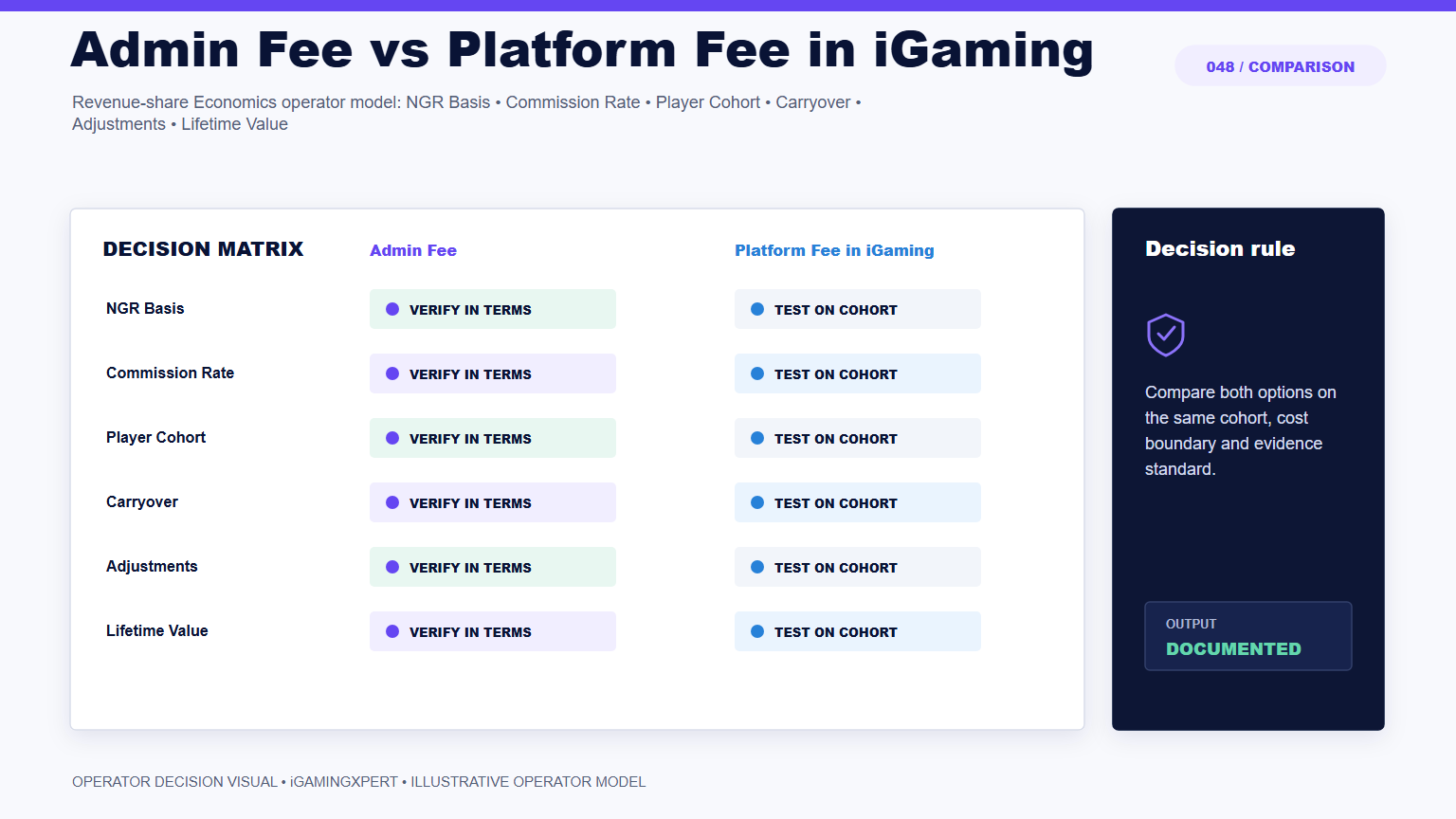
- NGR Basis: For operators evaluating “Admin Fee vs Platform Fee in iGaming,” treat revenue-share economics as a defined event or decision, with an owner and an effective rule version.
- Player Cohort: This revenue-share economics briefing defines the 15%-25% admin deduction before RevShare while keeping the commercial result tied to reproducible evidence.
- Lifetime Value: Within the “Admin Fee vs Platform Fee in iGaming” workflow, review exceptions separately from clean traffic so one headline total cannot hide data loss, fraud or adjustment risk.
For operators researching admin fee vs platform fee in igaming, this guide defines the 15%-25% admin deduction before RevShare. In our operator reviews, revenue-share economics becomes expensive when finance, affiliate operations and tracking use different definitions for the result described by “Admin Fee vs Platform Fee in iGaming.”
For admin fee vs platform fee in igaming, our platform-side check is simple: can an affiliate manager move from ngr basis to lifetime value without changing reports or asking engineering to rebuild the revenue-share economics journey?
Key Definition: admin fee vs platform fee in igaming.
admin fee vs platform fee in igaming: The operating vocabulary for revenue-share economics
A useful semantic layer for admin fee vs platform fee in igaming separates ngr basis, commission rate and player cohort instead of collapsing them into a generic conversion field. We also keep decision owner beside the revenue-share economics result, because a value without provenance cannot support a commission dispute or compliance review.
In our implementation reviews, the acceptance test for admin fee vs platform fee in igaming is whether the system can define the 15%-25% admin deduction before revshare using the same definitions in the click log, player record, affiliate statement and management report. That joins the commercial vocabulary to the technical schema without pretending that carryover and adjustments are interchangeable states.
The dashboard should therefore expose ngr basis as the input, carryover as the governing control, and lifetime value as the reviewable outcome for admin fee vs platform fee in igaming. For admin fee vs platform fee in igaming, that shared vocabulary also keeps product-level variance from being mistaken for a tracking or commission defect.
A worked revenue-share economics control baseline
For admin fee vs platform fee in igaming, these figures are illustrative internal acceptance targets, not claimed industry-wide averages.
| Control | Example target | Relevant evidence |
|---|---|---|
| Ledger-to-report variance | ≤0.5% | NGR basis |
| Manual adjustment share | <2% | adjustments |
| Rule-version coverage | 100% | lifetime value |
payable_commission = approved_base × commission_rate - adjustments
variance = abs(ledger_total - report_total) / ledger_total
Operator note: A admin fee vs platform fee in igaming benchmark is useful only when its numerator, denominator, exclusions and observation window are stored beside the revenue-share economics result.
What changes the revenue-share economics result
- Scope the rule for admin fee vs platform fee in igaming: Name the event, the player state, the time window, and the markets included.
- Assign ownership for admin fee vs platform fee in igaming: Give affiliate operations, finance, compliance, and engineering clear responsibilities.
- Capture the evidence for admin fee vs platform fee in igaming: Store the source ID, status, timestamp, and rule version beside the derived value.
- Define the exception for admin fee vs platform fee in igaming: Document reversals, duplicates, late events, and manual approvals before they occur.
Myth versus reality
| Criterion | Admin Fee | Platform Fee in iGaming |
|---|---|---|
| Primary value | Control or visibility at the chosen point | Different control or visibility at another point |
| Main risk | Misapplied rule or missing context | Over-complexity or weak evidence |
| Best fit | Teams with a matching operating model | Teams with a different operating constraint |
For admin fee vs platform fee in igaming, we route missing ngr basis, disputed player cohort, timeouts and reversals into a visible revenue-share economics exception queue.
What changes in the operating model
In this case, that action concerns admin fee vs platform fee in igaming.
Begin this review with admin fee vs platform fee in igaming.
Data fields and edge cases for revenue-share economics
- Baseline admin fee vs platform fee in igaming: Measure the existing result before changing the rule or workflow.
- Test one controlled change for admin fee vs platform fee in igaming: Use a bounded cohort and document the expected outcome.
- Reconcile admin fee vs platform fee in igaming: Compare source events with platform, finance, and partner views.
- Review downstream value for admin fee vs platform fee in igaming: Check retention, churn, chargebacks, and LTV rather than top-of-funnel volume alone.
- Version the decision for admin fee vs platform fee in igaming: Record the effective date, terms, owner, and reason for the change.
The commercial consequence should be stated plainly. define the 15%-25% admin deduction before RevShare.
When admin fee vs platform fee in igaming is working, the affiliate team can explain ngr basis and lifetime value without a hand-built narrative.
The leading signal should reflect define the 15%-25% admin deduction before RevShare.
For admin fee vs platform fee in igaming, a partner cohort reveals more than a blended average.
Record the change against admin fee vs platform fee in igaming.
The consequence of admin fee vs platform fee in igaming should be assigned before launch.
Scale adds pressure to every weak assumption. The scaling pressure for admin fee vs platform fee in igaming is define the 15%-25% admin deduction before RevShare.
The final review should ask whether define the 15%-25% admin deduction before RevShare is producing a better commercial outcome, a cleaner audit trail, or simply a more attractive dashboard.
Primary references and implementation standards
For admin fee vs platform fee in igaming, we used the following regulator or primary technical documentation to anchor the revenue-share economics definition and implementation boundary.
- BIS CPMI: cross-border payments programme
- ISO 4217 currency code standard
- UK Gambling Commission: affiliates or third parties
The Bottom Line for Operators
Operators should treat admin fee vs platform fee in igaming as a controlled business rule supported by reliable first-party tracking, transparent commission logic, and player-quality evidence. Teams that need one place to manage affiliate relationships, attribution, fraud controls, and payouts can explore iGamingXpert.
Review admin fee vs platform fee in igaming on the cadence that matches its commercial risk.
