Predictive Churn Analysis for iGaming Operators

The most useful churn model in iGaming doesn’t start with a score. It starts with a reason.
That distinction matters because the iGaming platform and sportsbook software market was valued at $14.8 billion in 2025 and is projected to reach $42.6 billion by 2034, with a projected 12.5% compound annual growth rate, driven by legalization and AI-enabled personalization embedded into platforms, according to Dataintelo’s iGaming market outlook. In a market expanding that quickly, operators can’t afford retention systems that merely label a player as “high risk” and leave the rest to guesswork.
In practice, that’s where many predictive churn programs stall. The model flags the player. The CRM creates the segment. The retention team gets a queue. But nobody knows whether the player is frustrated by KYC friction, confused by bonus terms, hitting repeated payment errors, or reacting to poor traffic quality upstream. A risk score without a driver is just a prioritization tool. It isn’t an intervention plan.
As a data science problem, predictive churn analysis in iGaming is unusually difficult because the environment is volatile. Player behavior shifts quickly. Traffic quality isn’t constant. Product friction can emerge in minutes, not weeks. Fraud controls, affiliate sources, bonus mechanics, sportsbook events, and jurisdictional rules all change the shape of the data. A model that performs well in a stable subscription business can underperform badly if you port it into a regulated gambling environment without redesigning the inputs and feedback loops.
A production churn system should answer three questions at once: who is at risk, why they are at risk, and what the operator should do next.
That’s the standard worth building toward.
The High-Stakes Game of Player Retention
Retention failure shows up faster in iGaming than in almost any other digital business. A player can move from active to dormant in a single session after a payment decline, a delayed withdrawal, an odds dispute, a bonus restriction, or low-quality acquisition traffic. That volatility changes what a churn program has to deliver. A score alone is not enough. The system has to identify the driver behind the score, or the retention team is left guessing.
Growth increases the cost of getting retention wrong
As noted earlier, the sector’s growth has raised the performance standard for operators. More competition means higher acquisition costs, tighter retention windows, and less tolerance for generic CRM treatment. Broad reactivation offers often miss the underlying problem because churn in iGaming is rarely a single pattern. Two players with the same risk score may need completely different interventions. One may be failing KYC. Another may be reacting to poor bonus fit. A third may have come from an affiliate source that produced low-intent traffic in the first place.
That is the driver-level explanation gap. Many models rank players accurately enough for prioritization, but they do not explain whether the risk comes from payment friction, product fatigue, support failure, sportsbook volatility, fraud controls, or source quality. In practice, that gap limits value. CRM can build a segment, but it cannot choose the right message, incentive, or product fix without a reason code grounded in observable behavior.
For high-value players, the standard is even stricter. Their churn risk should be estimated from their own sequence of deposits, withdrawals, wagering cadence, session timing, game mix, support contacts, and promotion response, not from broad market averages. The Playa makes a related point in its discussion of iGaming software and predictive models. Models are useful only if they can be validated against production outcomes and tied to actions that improve retention economics.
Churn in iGaming is operational, not theoretical
Telecom offers a useful reference point because it adopted churn modeling early, once attrition became too expensive to manage with reporting alone. A public telecom churn analysis example on Kaggle shows the familiar pattern. Usage changes, transaction behavior, and service interactions often deteriorate before the customer leaves. The lesson carries over, but iGaming adds more instability. Player intent can swing sharply around deposit success, event calendars, bonus mechanics, and trust signals.
That is why deployment is where the model’s true performance is revealed.
A model that looks strong offline can fail quickly if the input data ignores acquisition context. Affiliate source and tracking design matter because bad attribution can make healthy players look unprofitable and low-intent cohorts look normal. Teams that rely on event-level traffic data need to understand the differences in postback vs callback tracking for affiliate attribution before they treat source quality as a churn feature. If attribution is noisy, the explanation layer becomes noisy too.
The operating requirement is straightforward:
- Detect behavior change early: monitor deposit friction, session drop-off, stake compression, withdrawal pattern shifts, failed logins, support escalation, and bonus disengagement before revenue loss is obvious.
- Score at player level: estimate risk for the individual player, with timestamps that match the intervention window.
- Explain the driver: attach the dominant reason or contributing factors behind the score so CRM, VIP, payments, and support teams can act on something specific.
- Measure intervention effect: validate whether the selected action reduced churn for that driver, not just whether outreach was sent.
Practical rule: If your model can only tell the CRM whom to target, but not what message or fix belongs to that player, you haven’t built a retention system. You’ve built a queue.
The strongest programs treat predictive churn analysis as a decision layer connected to product telemetry, support logs, payment events, fraud controls, and acquisition data. In iGaming, retention improves when the model explains the cause of disengagement well enough for the business to remove it.
The Technical Pipeline for Churn Prediction
A churn model that survives production needs discipline long before algorithm selection. The most reliable framework is a six-step pipeline covering collection, preparation, engineering, modeling, evaluation, and deployment. DigitalRoute lays out that workflow clearly in its overview of the six-step churn prediction pipeline, including the case for ensemble methods such as Random Forests, XGBoost, and Gradient Boosting.
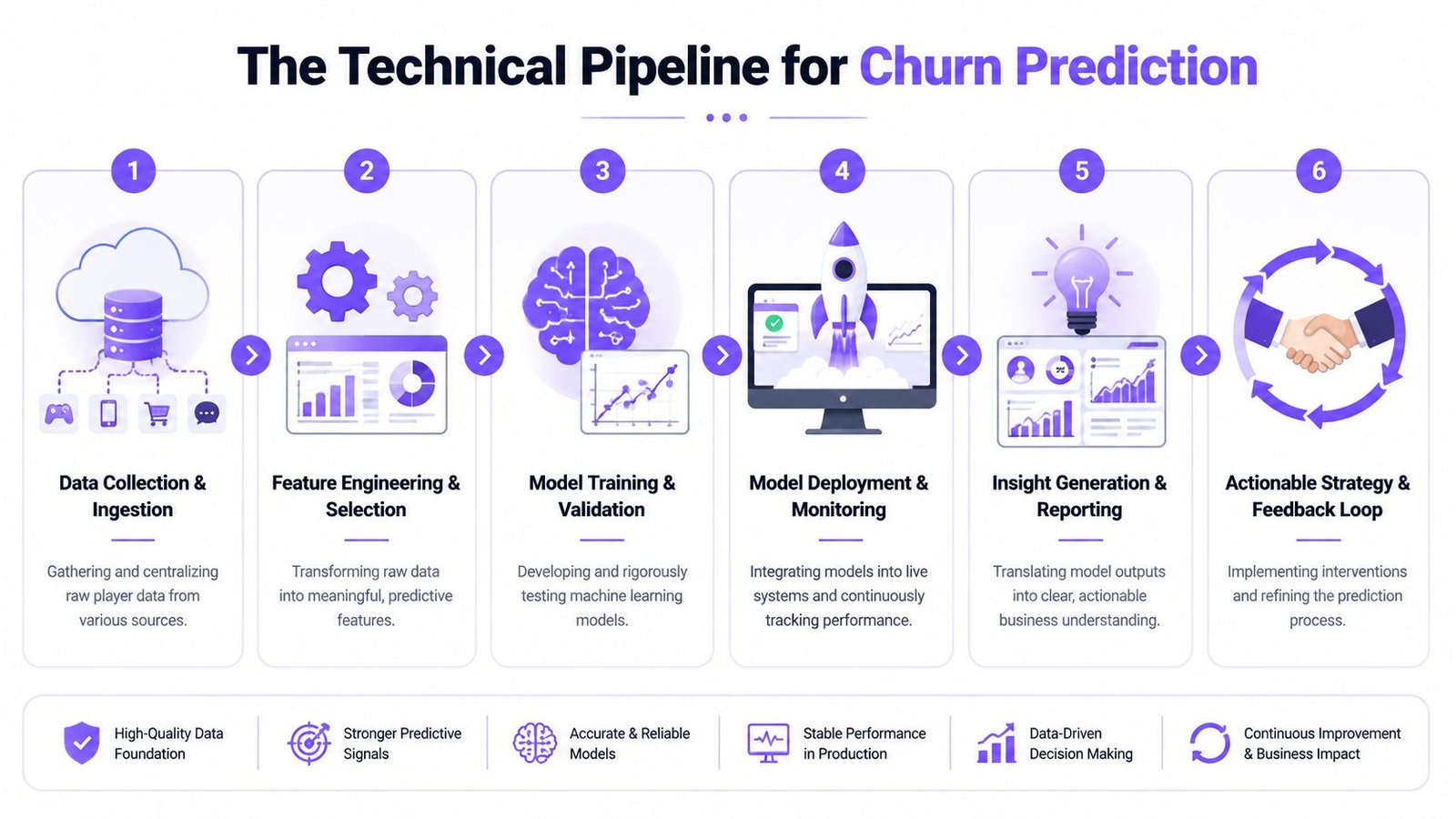
Step one through step three
The first requirement is a dataset that can support time-based prediction. At minimum, you need a unique customer identifier and a timestamp of the last interaction. Demographics and specific user actions improve the model materially, but without identity and time, you don’t have a churn dataset at all. Dataiku explains this baseline in its guide to predictive analytics for churn.
From there, the pipeline usually looks like this:
- Data collection pulls in player, product, transaction, support, and affiliate-event data.
- Data preparation handles missing values, broken event sequences, inconsistent labels, and outliers.
- Feature engineering converts raw logs into variables such as tenure, engagement, value, behavioral change, and payment friction.
In iGaming, event quality matters as much as event volume. If your attribution layer is noisy, the churn model inherits that noise. That’s one reason server-to-server event integrity matters when comparing postback vs callback tracking in affiliate measurement. Churn analysis can’t be cleaner than the conversion and session signals feeding it.
Step four through step six
Modeling is where many teams over-focus on novelty. In practice, simpler baselines are still useful, but single-model approaches often miss the interaction effects that matter in player behavior. Ensemble models usually perform better because they capture non-linear pathways such as “failed deposit plus support contact plus reduced session depth” more effectively than a plain logistic setup.
A production stack should include:
- A baseline model: Logistic regression for interpretability and sanity checks.
- An ensemble layer: Random Forest, XGBoost, or Gradient Boosting for higher predictive power on mixed tabular data.
- A scoring service: Batch or real-time inference depending on how quickly player risk evolves in your product.
Evaluation comes next. Accuracy alone won’t protect the business. Teams should watch precision, recall, and F1-score, because the cost of missing a valuable at-risk player isn’t the same as the cost of over-flagging a low-value one. Dataiku also emphasizes continuous monitoring and recalibration after deployment because customer behavior changes over time, and a static model decays.
A compact operating view looks like this:
| Stage | What the team does | iGaming-specific concern |
|---|---|---|
| Collection | Ingest gameplay, wallet, KYC, support, and traffic events | Cross-system timestamp consistency |
| Preparation | Clean nulls, remove duplicates, define churn window | Jurisdiction and brand differences |
| Engineering | Build behavioral and value features | Volatility around bonus and deposit actions |
| Modeling | Train baseline and ensemble models | High interaction effects across event types |
| Evaluation | Track precision, recall, F1-score | False negatives on high-value players |
| Deployment | Push scores into live workflows | Drift after product, promo, or GEO changes |
The model isn’t finished when training ends. In iGaming, deployment is where the real test begins.
Identifying High-Value Churn Signals in iGaming
Generic churn features don’t tell you enough in a gambling product. Login counts and session duration can help, but they’re weak proxies if you ignore where the player got stuck. The strongest signals often look like fragments of frustration rather than obvious disengagement.
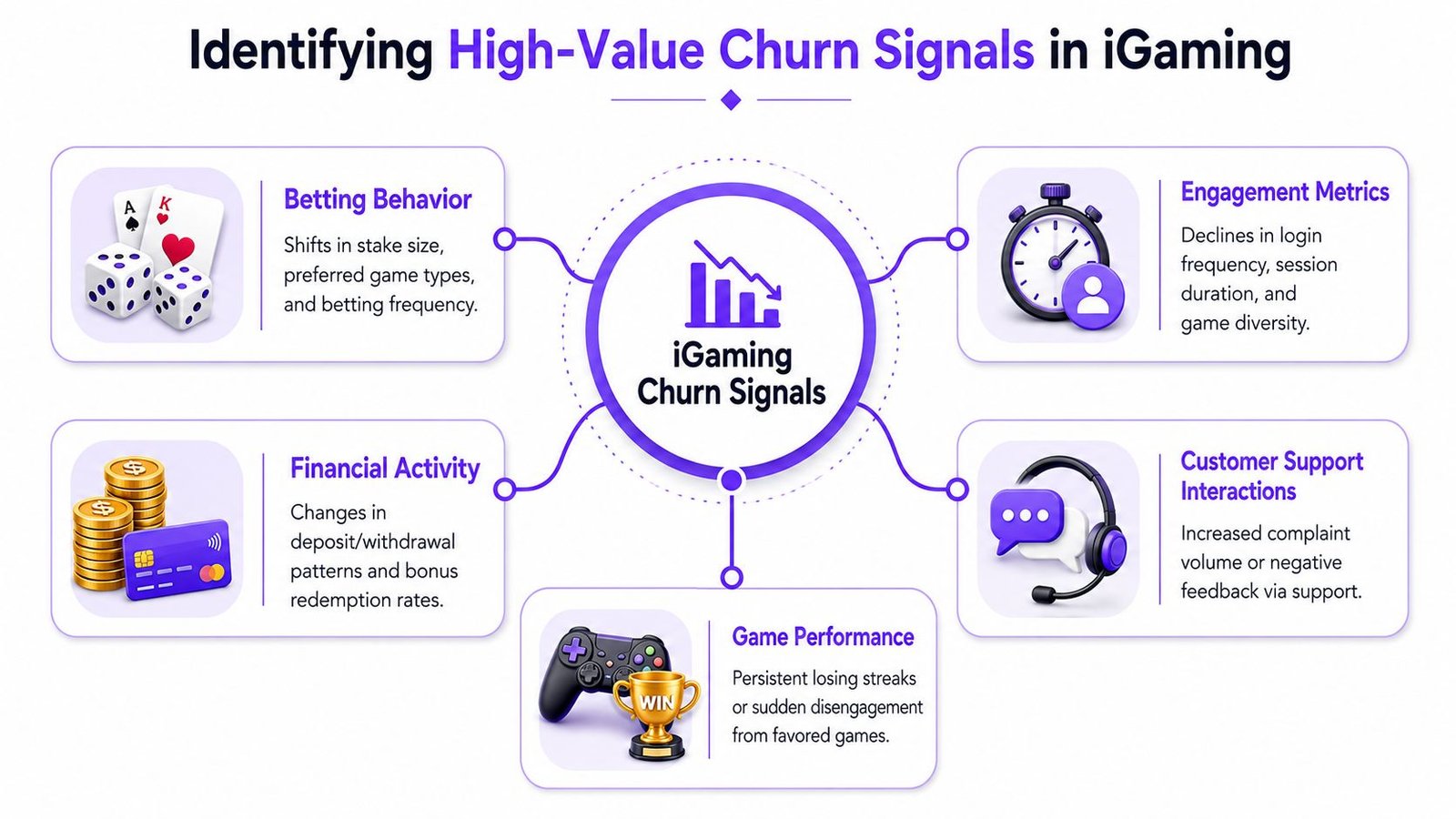
Signals that usually appear before a player disappears
Fullstory identifies several behaviors that are especially important in iGaming: rage clicks on deposit, bonus, or withdrawal forms; repeat verification failures; bouncing between pages without completing key actions; and abandoning a bonus after starting it. These are highlighted in Fullstory’s discussion of high-value player retention in iGaming.
Each one implies something different:
- Rage clicks on wallet flows: The player knows what they want to do and can’t complete it. That’s usually a payments or UX issue, not a motivation issue.
- Repeat verification failures: The player is still trying to comply, but the identity process is breaking trust.
- Page bouncing without completion: The player is searching for a path, not following one. Navigation or rules clarity is failing.
- Bonus abandonment: The offer generated intent but the redemption path created doubt or friction.
Those details matter because interventions should differ. A player blocked by KYC friction needs resolution. A player confused by bonus mechanics needs clarity. A player failing deposits may need payment routing help or an immediate support touch.
Turn behavior into features, not anecdotes
These signals only become useful when the data team models them as structured features. Good examples include event counts, time since last failed attempt, sequence patterns across pages, support-contact lag after friction, and changes in completion rate for previously successful actions.
The strongest feature families usually include:
- Interaction decay: Drops in session frequency, game variety, or completion of core actions.
- Financial friction: Deposit failures, withdrawal interruptions, bonus redemption drop-off.
- Support-linked distress: Escalating complaint patterns, unresolved ticket recency, negative free-text context.
- Traffic quality context: Whether the player originated from a low-quality source that inflated acquisition but never produced stable engagement.
For affiliate-heavy programs, that last point matters more than many retention teams admit. If low-intent or invalid traffic enters the funnel, the model may learn patterns that look like churn but really reflect poor acquisition quality. That’s why teams that care about predictive quality also invest in ad tracker software for affiliate visibility and event quality.
A useful churn feature should describe behavior in context. “Three failed deposits after six successful months” is actionable. “User inactive” isn’t.
The practical test is simple. If a retention manager sees a feature and still can’t infer what probably went wrong, the feature may help the model score risk, but it won’t help the business save the player.
Common Failures in Churn Prediction Models
Most churn models don’t fail because machine learning is weak. They fail because teams deploy statistically plausible systems into operationally messy environments.
Research published in Frontiers in Artificial Intelligence reports that advanced churn models can reach 85% to 90% recall in identifying high-risk customers, but common pitfalls can degrade performance by 20% to 30%. The same research identifies inconsistent churn definitions as the most critical failure point, and notes that models excluding unstructured signals miss 30% to 40% of the reasons customers cite for leaving, as detailed in the Frontiers study on predictive churn pitfalls.
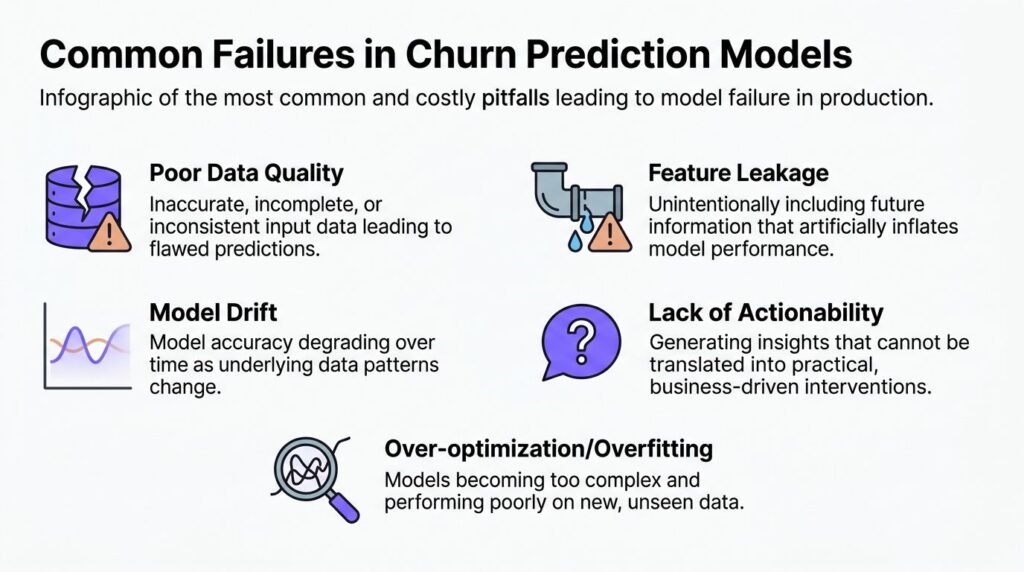
Failure one and failure two
The first failure is definitional. “Churn” sounds simple until teams operationalize it. Is it non-renewal, account dormancy, wallet inactivity, a session gap, or reduced spend? If product, BI, CRM, and finance use different labels, the model trains on contradictions. You can’t calibrate a target variable that means different things in different systems.
The second failure is the Driver-Level Explanation Gap. Many models assign a risk score without attaching a named reason. That leaves retention teams doing manual diagnosis after the model has already made its prediction. In iGaming, that often means the save attempt becomes generic: a broad promotion, a templated email, or a support escalation with no clue what triggered the risk.
Dimension Labs frames this gap sharply. It argues that 70% of churn decisions are driven by unstructured signals, while 90% of models ignore them because they rely on structured data only. That analysis appears in its piece on the missing “why” layer in predictive churn. Whether you agree with every framing choice or not, the operating point is right. If your model can’t parse chat logs, ticket text, or call notes, it will miss the language players use when they explain why they’re leaving.
Failure three through failure five
Other failures tend to cluster around execution:
- Feature leakage: The model accidentally learns from future information and looks excellent offline.
- Model drift: Product changes, new markets, bonus structures, or payment flows shift player behavior after launch.
- Cohort blindness: The system flags individuals but misses that a group of players is failing for the same reason.
The Frontiers research also notes that missing cohort-level patterns reduces the actionable value of churn prediction. That’s an important point in iGaming because a burst of churn risk can reflect a broken payment provider, a confusing bonus flow, or one affiliate source sending the wrong audience. If you only review player-level risk, you miss the product or go-to-market issue underneath.
A strong production review should ask:
| Failure mode | What it looks like in practice | What fixes it |
|---|---|---|
| Inconsistent churn definition | Different teams disagree on what “lost” means | One governed label and time window |
| Structured-data tunnel vision | Scores appear, reasons don’t | Add text and conversation signals |
| Leakage | Validation looks better than production | Strict time-based training splits |
| Drift | Recall decays after launch | Scheduled recalibration and monitoring |
| Cohort blindness | Repeated individual alerts, no pattern view | Root-cause clustering by source, GEO, or flow |
If the output is “Player X is likely to churn” and nothing else, the retention burden shifts back to humans. That’s not augmented decision-making. That’s a spreadsheet with confidence intervals.
Activating Insights with an Integrated iGaming Platform
Prediction only matters if the operating system around it is fast enough to act. In iGaming, that usually means the difference between event-driven workflows and delayed reporting pipelines.
Real-time AI and machine learning systems in iGaming help operators resolve issues faster by protecting users from bot accounts and low-quality traffic, while reshaping player profiling, predictive analytics, and fraud detection. SoftServe also notes that ownership of these tools needs to move closer to product management so decisions align with customer needs, as explained in its analysis of AI and ML in casinos, iGaming, and sports betting.
Why integrated systems outperform stitched-together stacks
When churn detection sits in one tool, affiliate data in another, fraud controls in a third, and reporting in spreadsheets, the latency isn’t just technical. It becomes organizational. By the time the retention team understands whether a player’s risk was triggered by traffic quality, payment friction, or product confusion, the intervention window may be gone.
An integrated operating layer fixes that in several ways:
- Real-time event capture: Deposit friction, bonus abandonment, session decay, and support events arrive fast enough to score before the player disappears.
- Traffic and fraud controls: Bots, duplicates, and low-quality sources get filtered early, which improves the quality of the training data.
- Unified reporting: Teams can see player behavior, source context, and commercial data in one place instead of reconciling systems manually.
- Workflow connectivity: Scores and driver flags can move directly into segmentation, alerting, and intervention queues.
This matters for model quality as much as operations. If invalid traffic pollutes the funnel, the model learns unstable patterns. If conversion events arrive late, labels drift. If support interactions aren’t connected to player records, the explanation layer breaks. Prediction quality is partly a data science problem and partly a systems design problem.
What an integrated platform should make possible
For affiliate-led operators, a useful platform shouldn’t stop at attribution. It should support the full loop from acquisition quality to player value preservation. That means tracking needs to connect with fraud prevention, reporting, and data export paths that support live scoring and intervention workflows.
A practical requirements list looks like this:
- Clean ingestion: Real-time clicks, conversions, revenue, and payout signals.
- Source integrity: Controls that identify bots, duplicates, and low-quality traffic.
- Operational visibility: Dashboards that let product, BI, affiliate, and retention teams work from the same event history.
- Connectivity: APIs and webhooks that let the model score players and push outputs into downstream systems.
That last requirement is often where teams get stuck. A model may be accurate, but if it can’t access current events or route output into production systems, it won’t influence player outcomes. That’s why integration depth matters. Teams evaluating their stack should care about how data moves across affiliate platform integrations and connected workflows, not just whether a dashboard exists.
The fastest way to improve a churn program isn’t always a new algorithm. Often it’s removing the lag between signal detection, root-cause visibility, and operator action.
The strongest iGaming environments treat churn, fraud, acquisition quality, and player experience as one connected system. That’s the right mental model. A player doesn’t experience those as separate departments.
From Prediction to Proactive Retention
Predictive churn analysis is mature enough that “who might leave” is no longer the hardest question. The harder question is why the player is moving toward exit, and whether your team can act before that motion becomes irreversible.
The answer isn’t a bigger feature set or a more complicated model by itself. It’s a system that combines stable labels, high-quality behavioral telemetry, unstructured player signals, real-time event flow, and a driver layer that names the likely cause behind the score. That’s what closes the gap between data science and actual retention.
What mature operators do differently
The strongest operators build churn programs that behave like decision engines, not reporting layers. They define churn consistently. They monitor precision, recall, and drift. They model iGaming-specific friction rather than generic inactivity. They review cohort-level causes so repeated player problems become product or traffic fixes, not just CRM campaigns.
They also accept a harder truth. A churn score without a reason creates work. A churn score with a reason creates options.
The real competitive edge
In a volatile iGaming environment, retention advantage comes from speed and relevance. The operator that understands the difference between “bonus confusion,” “payment friction,” “verification failure,” and “bad acquisition source” can respond with the right treatment instead of burning budget on generic recovery attempts.
That’s why the future of predictive churn analysis in iGaming isn’t black-box scoring. It’s explainable, operational modeling tied directly to product, payments, support, and affiliate data. Once the system can tell the team what’s wrong, not just who is at risk, retention stops being reactive and starts becoming precise.
If you’re running an affiliate-led iGaming operation and want the tracking, reporting, fraud controls, and integration layer required to support actionable predictive churn analysis, iGamingXpert is built for that environment. It gives operators and networks a unified platform for real-time event visibility, partner management, and data flows that make retention models more useful in production.
