Bonus Wagering Requirements Explained: How They Work and How to Calculate Them
Wagering requirements are the number of times you have to bet a bonus (and sometimes your deposit) before you’re allowed to withdraw any winnings from it. They’re written as a multiplier — like 35x or 40x — and they’re the single most important number in any casino bonus. A “100% up to $200” offer with 50x wagering is a worse deal than a smaller bonus with 20x, and most players never do the math to find out.
This guide explains exactly what that multiplier means, how to calculate the real amount you’ll need to bet, why slots and blackjack don’t count equally, and how to spot the terms that quietly make a bonus impossible to clear.
What are bonus wagering requirements?
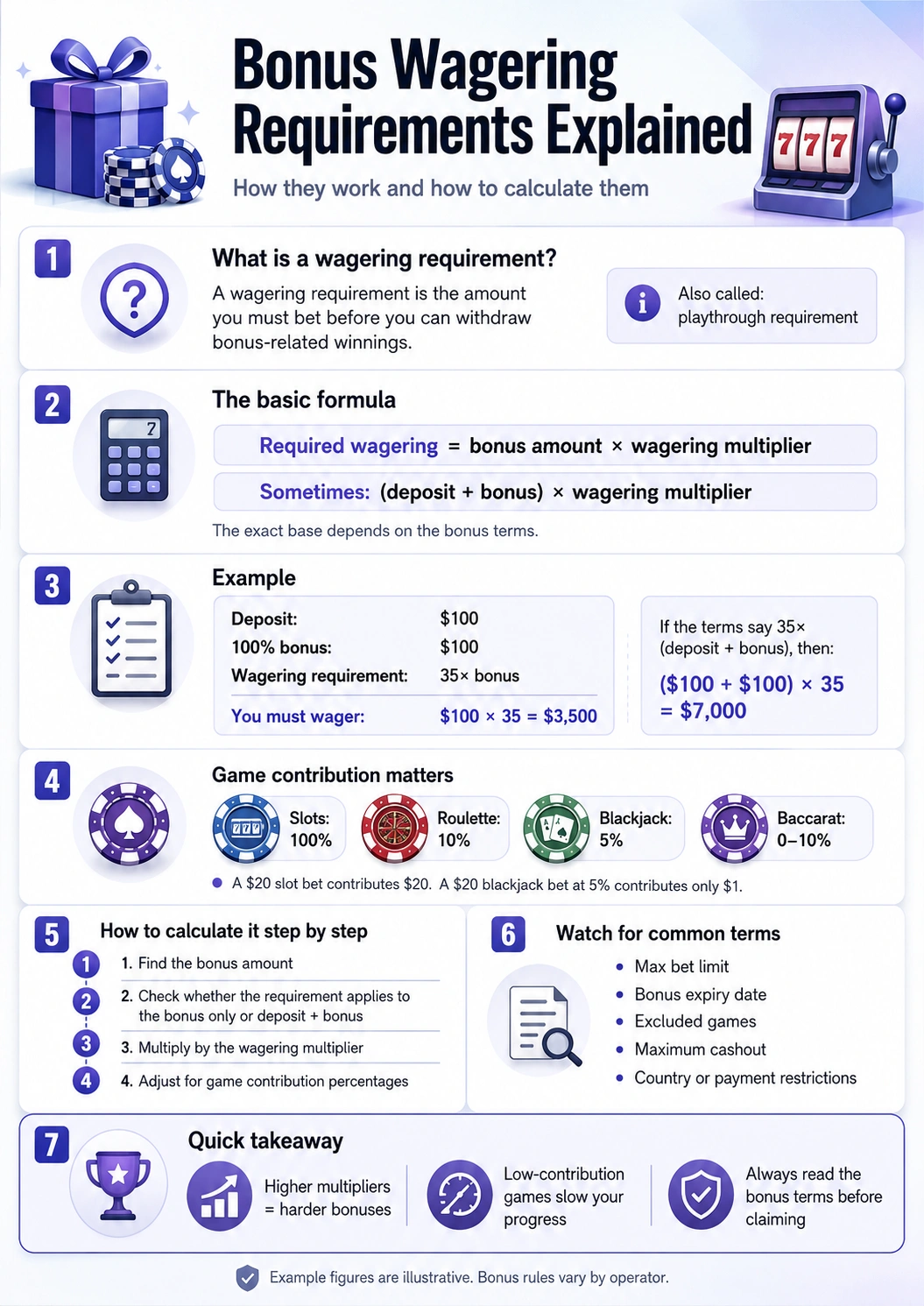
A wagering requirement (also called playthrough or rollover) is a condition attached to a casino bonus. Before the casino lets you cash out, you have to wager a set multiple of the bonus value in real bets.
The casino isn’t giving you free money — it’s giving you bonus credits that behave like real money inside the games but stay locked until you’ve played through them enough times. The wagering requirement is the lock.
You’ll usually see it written one of these ways:
- “Wagering requirement: 40x”
- “40x (B)” — meaning 40 times the bonus only
- “40x (D+B)” — meaning 40 times deposit plus bonus
- “Rollover: 35x”
- “Playthrough: 30x”
Those last three labels matter more than most players realize, and we’ll come back to the (B) vs (D+B) distinction below because it can double the amount you owe.
How do wagering requirements work?
The multiplier tells you how many times you have to bet the qualifying amount. Bet that total in cumulative wagers — across as many spins or hands as it takes — and the bonus converts to withdrawable cash.
Here’s the part that trips people up: wagering is cumulative turnover, not money you lose. Every bet you place counts toward the requirement, win or lose. If you bet $1 on a slot spin, that’s $1 toward your wagering, whether you win $50 or nothing.
So a 40x wagering requirement on a $50 bonus doesn’t mean you need $2,000 in your pocket. It means $2,000 has to pass through the games as total bets. As long as you keep winning some spins back, the same money cycles through repeatedly until the turnover target is hit.
That said, the longer you have to play, the more the house edge grinds against you. A 40x requirement on slots means you’re feeding the game’s built-in margin over and over — which is the entire reason wagering requirements exist.
Bonus-only vs deposit + bonus: the distinction that doubles your cost
This is the most important thing in the article, so read it twice.
A “40x” requirement can mean two very different things depending on whether it applies to the bonus only or to the deposit plus bonus.
Say you deposit $100 and get a 100% match, giving you a $100 bonus and $200 total in your account.
| What 40x applies to | Calculation | You must wager |
|---|---|---|
| Bonus only (B) | 40 × $100 | $4,000 |
| Deposit + bonus (D+B) | 40 × ($100 + $100) | $8,000 |
Same headline number — 40x — and one version asks you to bet twice as much as the other. Bonus-only terms are far more player-friendly. Deposit-plus-bonus terms are common at casinos that want the offer to look generous while being much harder to clear.
Always check which one applies before you opt in. If the terms don’t say, assume the worse one.
How to calculate your wagering requirement (step by step)
Three numbers tell you everything: the bonus amount, the multiplier, and whether it’s (B) or (D+B).
Step 1 — Find the qualifying amount. Bonus only → use the bonus. Deposit + bonus → add them together.
Step 2 — Multiply by the wagering number. That’s your total required turnover.
Step 3 — Sanity-check it against your bankroll and the time limit. Can you realistically bet that much before the bonus expires?
Worked example 1 — a good offer
- Deposit: $50
- Bonus: $50 (100% match)
- Wagering: 25x (B)
- Required turnover: 25 × $50 = $1,250
$1,250 in slot turnover is achievable in an evening or two without huge stakes. This is a clearable bonus.
Worked example 2 — a bad offer in disguise
- Deposit: $50
- Bonus: $50 (100% match)
- Wagering: 45x (D+B)
- Required turnover: 45 × $100 = $4,500
Same deposit, same bonus, but you now owe 3.6 times more turnover than example 1. The headline (“100% up to $50!”) is identical. The fine print is what separates a fair offer from a trap.
Quick rule of thumb: total required turnover under ~$1,500 per $50 of bonus is reasonable. Over ~$3,000 per $50, you’re unlikely to walk away ahead.
Why game weighting changes everything
Here’s a detail that catches even experienced players: not every game contributes 100% toward your wagering requirement.
Casinos weight games by contribution rate because some games have a much lower house edge than others. Letting blackjack count fully would let players clear bonuses with almost no risk to the casino — so table games are weighted down or excluded entirely.
Typical contribution rates look like this (always check the specific casino’s table — they vary):
| Game type | Typical contribution | What $100 of bets counts as |
|---|---|---|
| Slots | 100% | $100 |
| Keno / scratch cards | 100% | $100 |
| Bingo | 50–100% | $50–$100 |
| Video poker | 10–20% | $10–$20 |
| Roulette | 10–25% | $10–$25 |
| Blackjack | 5–10% | $5–$10 |
| Baccarat | 0–10% | $0–$10 |
| Craps | 0–10% | $0–$10 |
| Live dealer table games | Often 0% | $0 |
This is why almost everyone clears wagering on slots. If your 40x requirement is $2,000 and you play blackjack at 10% weighting, you’d actually need $20,000 in blackjack bets to satisfy it. On slots at 100%, it’s the full $2,000 and no more.
If a bonus says “table games excluded” or weights them at 0%, betting on them does nothing for your wagering — and at some casinos it can void the bonus entirely.
The other terms that decide whether a bonus is winnable
Wagering is the headline term, but four others quietly determine whether you can actually keep your winnings.
Maximum bet while wagering. Most bonuses cap your bet size — often $5 or $6 per spin or hand — while a wagering requirement is active. Place one bet over the cap, even by accident, and many casinos will void the bonus and any winnings from it. This is one of the most common reasons withdrawals get rejected.
Time limit. Bonuses expire. You might have 7, 14, or 30 days to complete the wagering. A $4,000 turnover requirement with a 3-day limit is functionally impossible for most players — and that’s by design. Check the clock before you opt in.
Maximum cashout. Some bonuses, especially no-deposit and free-spins offers, cap how much you can withdraw no matter how much you win. A “max cashout 5x bonus” or a flat “$100 max withdrawal” means a lucky $2,000 hit still only pays you the cap. The rest is removed.
Sticky vs non-sticky bonuses. A non-sticky (or “parachute”) bonus lets you withdraw your own deposit and winnings if you clear the wagering, and the bonus is removed but your real-money winnings stay. A sticky bonus is play-only: the bonus amount itself can never be withdrawn — only winnings generated above it — and if your balance drops to your bonus floor, that money simply disappears when you cash out. Sticky bonuses are much harder to profit from.
So are wagering requirements ever worth it?
Sometimes. A bonus is worth claiming when the math and the terms line up — not just when the headline percentage looks big.
A bonus tends to be worth taking when:
- The wagering is bonus-only, not deposit + bonus
- The multiplier is roughly 35x or lower for match bonuses (lower is better)
- Slots contribute 100% and you actually enjoy playing them
- The time limit is realistic for the turnover required
- There’s no punishingly low max cashout
- The max bet cap is one you won’t accidentally breach
A bonus is usually not worth it when it stacks the worst version of each term: high multiplier, deposit + bonus, short time window, low cashout cap, and table games excluded. That combination is engineered to look generous and pay out rarely.
And the honest answer that most bonus guides won’t tell you: even a “good” wagering requirement still carries a house edge. Bonuses extend your playtime and your entertainment, but the math is built so the casino expects to come out ahead across all players over time. Treat a bonus as more time to play, not as a reliable way to make money.
Common wagering requirement mistakes
These are the errors that turn a winnable bonus into a rejected withdrawal:
- Not checking (B) vs (D+B) and underestimating the turnover by half.
- Playing excluded or low-weighted games, then wondering why the wagering bar isn’t moving.
- Exceeding the max bet during wagering — often the difference between a paid and voided withdrawal.
- Running out of time because the deadline was never realistic for the required turnover.
- Forgetting the max cashout and expecting to keep a five-figure win from a $10 no-deposit bonus.
- Withdrawing early on a sticky bonus and losing the locked bonus portion they thought was theirs.
Reading the full bonus terms takes five minutes. Clearing a bonus you didn’t understand can take a week and still end in a rejected payout. The five minutes is cheaper.
A note on playing responsibly
Bonuses are designed to keep you playing longer, and longer play means more exposure to the house edge. Set a deposit limit and a time limit before you start, and never chase a wagering requirement with money you can’t afford to lose. If gambling stops being entertainment, take a break.
If you’re worried about your own play or someone else’s, support is available — organizations like BeGambleAware, GamCare, and the National Council on Problem Gambling offer free, confidential help. Most licensed casinos also provide deposit limits, cool-off periods, and self-exclusion tools in your account settings.
Frequently asked questions
What does 40x wagering mean?
It means you must place total bets equal to 40 times the qualifying amount before you can withdraw bonus winnings. If 40x applies to a $50 bonus, that’s $2,000 in cumulative wagers. Whether it applies to the bonus alone or to deposit plus bonus determines the real figure.
How do I calculate wagering requirements?
Multiply the multiplier by the qualifying amount. For bonus-only terms, use the bonus value; for deposit-plus-bonus terms, add your deposit and bonus first. Example: 35x on a $100 bonus (B) = $3,500 in required turnover.
How do I calculate wagering requirements?
Multiply the multiplier by the qualifying amount. For bonus-only terms, use the bonus value; for deposit-plus-bonus terms, add your deposit and bonus first. Example: 35x on a $100 bonus (B) = $3,500 in required turnover.
Is bonus-only or deposit-plus-bonus wagering better?
Bonus-only is significantly better for the player. Deposit-plus-bonus roughly doubles the turnover you owe for the same headline multiplier, so always check which one a bonus uses before opting in.
Do all games count toward wagering requirements?
No. Slots usually contribute 100%, while table games like blackjack, roulette, and baccarat often contribute 10% or less — and some are excluded entirely. Playing a low-weighted game means far more turnover is needed to clear the same requirement.
Do all games count toward wagering requirements?
No. Slots usually contribute 100%, while table games like blackjack, roulette, and baccarat often contribute 10% or less — and some are excluded entirely. Playing a low-weighted game means far more turnover is needed to clear the same requirement.
What is a good wagering requirement?
For match bonuses, 35x or lower applied to the bonus only is generally considered fair. Anything above 50x, or applied to deposit plus bonus, becomes hard to clear and rarely pays off.
Can I lose my winnings if I break the bonus rules?
Yes. Exceeding the maximum bet, playing excluded games, or missing the time limit can void the bonus and any winnings tied to it. This is one of the most common reasons for withdrawal rejections.
This article is for informational purposes only and does not constitute gambling or financial advice. Online gambling is restricted or illegal in some jurisdictions; always check the laws and licensing in your region, and gamble responsibly.
