Ad Tracker Software for iGaming: A 2026 Operator’s Guide
You’re probably dealing with this already. Finance says affiliate commission should be one number. BI shows a different NGR figure. The affiliate manager is stuck in the middle, trying to explain why the tracker credited players that the operator backend doesn’t value the same way. At the same time, traffic quality is slipping, a few partners are challenging deductions, and compliance wants a cleaner audit trail before the next review.
That’s usually the point where operators realize their generic ad tracker software was built for a simpler business model. It can count clicks and conversions. It can’t reliably support long player lifecycles, revenue-share accounting, approval workflows, or regulated data handling across multiple brands and jurisdictions.
In iGaming, a tracker isn’t just a marketing tool. It sits inside revenue attribution, partner payments, fraud control, and compliance operations. If the architecture is wrong, every downstream process gets noisier.
The Hidden Costs of Generic Ad Trackers in iGaming
A common failure pattern looks like this. An affiliate sends traffic to Brand A and Brand B under different commercial terms. The generic tracker records clicks and registrations well enough, but it doesn’t understand the operator’s actual revenue logic. Bonus deductions live in one system. Negative carryover rules live in another. Currency handling sits somewhere else. By payout time, nobody trusts the numbers.
That mismatch is expensive long before it becomes a dispute. Teams start exporting CSVs, reconciling by hand, and applying one-off fixes. Fraud review moves into spreadsheets. Affiliate managers delay approvals because they don’t want to validate bad numbers. Strong partners notice quickly. Weak partners exploit the gaps.

The broader software market is moving in the opposite direction. The global affiliate tracking software market reached $4.27 billion in 2025 and is projected to reach $6.84 billion in 2030, with 10.9% CAGR, reflecting a shift toward real-time tracking systems that support instant validation across multi-brand and multi-currency environments, according to The Business Research Company’s affiliate tracking software market report.
Where generic tools break first
Generic platforms usually fail in three places:
- Revenue accounting: They can log a conversion, but they don’t natively model operator-specific NGR logic or commission conditions cleanly.
- Traffic quality control: They detect surface-level anomalies, but they’re not built around affiliate traffic patterns common in high-risk GEOs.
- Compliance operations: They may store events, but they rarely provide the onboarding controls, approval gates, and auditability regulated teams need.
Generic ad tracker software fails quietly. The click data looks fine until commission accounting, fraud review, and compliance all need the same source of truth.
Why this becomes a trust problem
In e-commerce, a conversion is often the end of the story. In iGaming, registration is only the beginning. Player value unfolds over time, and the affiliate relationship depends on whether the platform can preserve attribution through that lifecycle while matching the operator’s commercial agreement.
When the tracker can’t do that, operators don’t just lose reporting accuracy. They lose partner trust, internal confidence, and control over payout integrity.
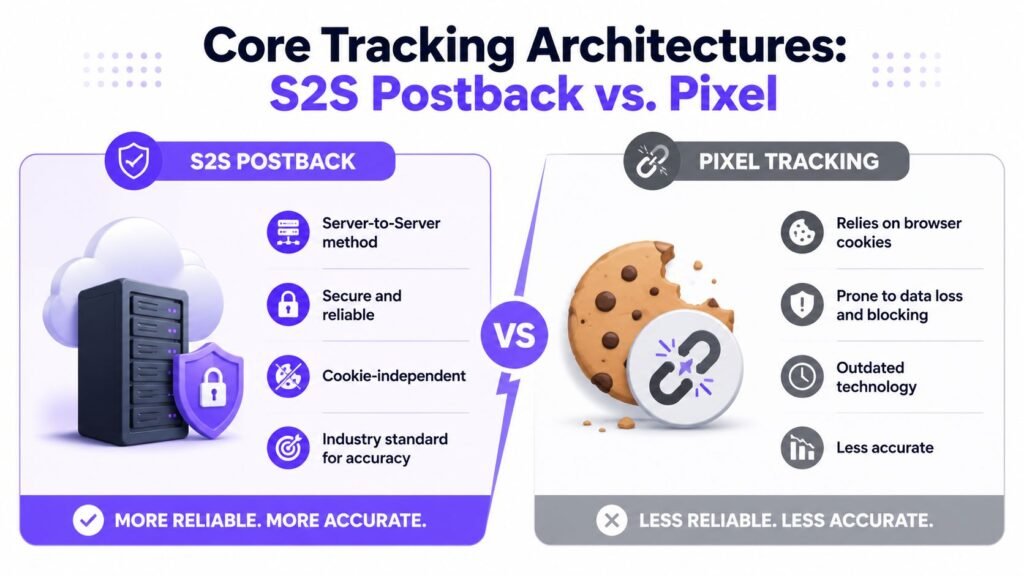
Core Tracking Architectures S2S Postback vs Pixel
If you still rely on browser pixels for affiliate attribution, you’re building on the least dependable layer in the stack.
Pixel tracking is like sending a paper receipt through the player’s browser and hoping it arrives intact. Server-to-server tracking is a direct confirmed handoff between systems. One depends on browser state. The other depends on infrastructure you control.
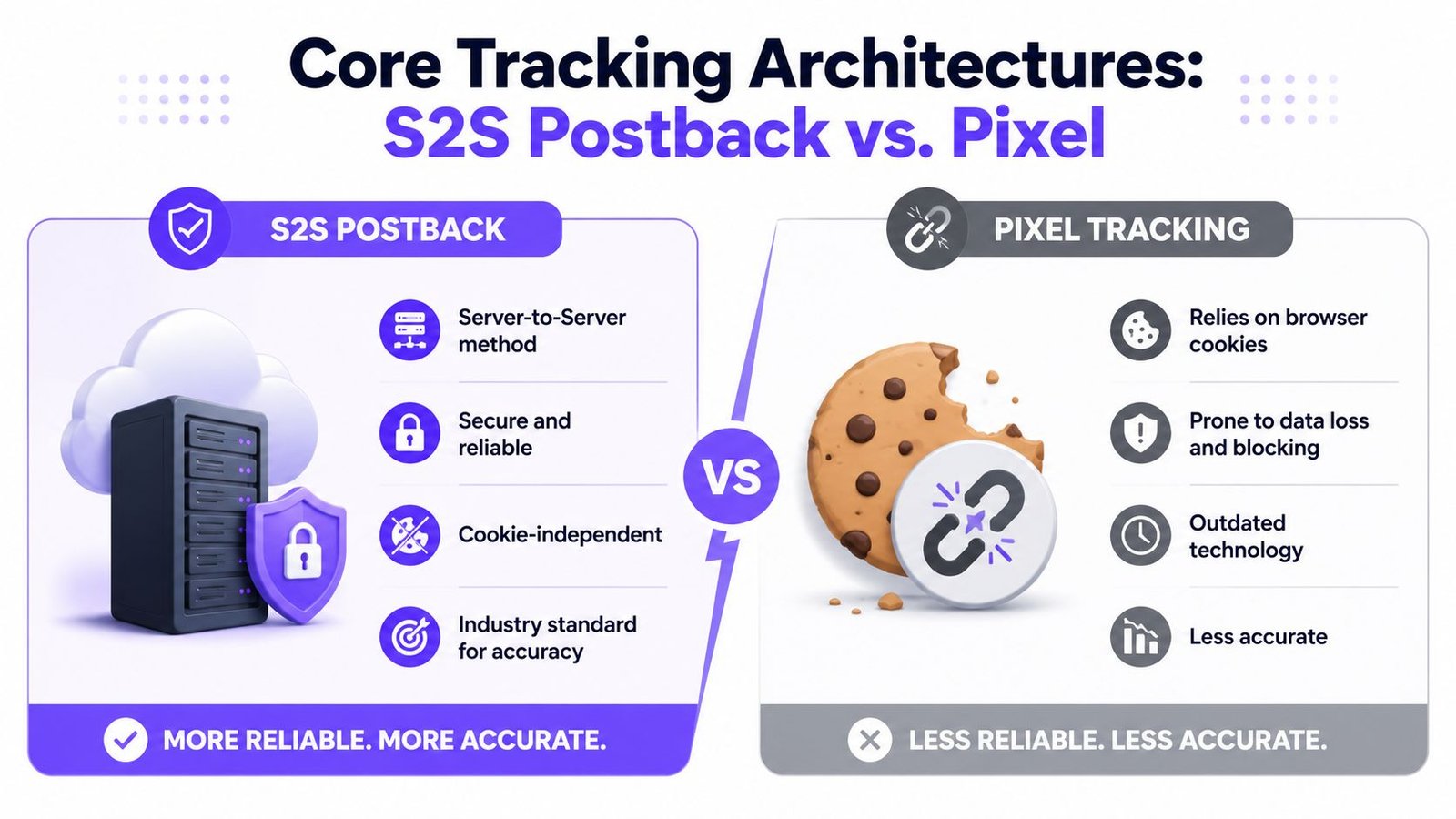
Why pixels break in iGaming
Browser-based tracking struggles with the exact conditions iGaming creates every day:
- Cross-device journeys: A player clicks on mobile, registers later, and deposits from desktop.
- Long attribution windows: Revenue events can happen well after the original click.
- Privacy controls: Browsers, consent setups, and ad blockers interrupt client-side scripts.
- Brand complexity: One operator may route traffic across multiple products, markets, and domains.
That’s why regulated iGaming has standardized around S2S. In this market, ad tracker software universally relies on server-to-server postback integration, which produces a 30 to 50% increase in attributed First-Time Depositors compared to cookie-based tracking, because attribution persists at the server level independent of browser state, as described in NowG’s iGaming affiliate marketing system guide.
What S2S actually changes?
With S2S, the click carries an identifier, usually through SubIDs or equivalent parameters. When the player registers, completes KYC, or deposits, the operator backend sends those events directly to the tracking platform. The browser doesn’t need to remember anything for the attribution chain to stay intact.
That matters for more than FTD counts.
Practical rule: If commission depends on player lifecycle events, attribution must be owned by backend systems, not left to the browser.
A purpose-built iGaming stack uses that event chain to support:
- Player-level continuity across registration, deposit, and later value events.
- Reliable RevShare accounting because downstream revenue events remain tied to the original affiliate source.
- Multi-brand consistency when traffic enters one domain and monetizes under another product path.
- Faster fraud response because click and conversion events can be reviewed in near real time.
The architectural trade-off
Pixels are easier to launch. That’s why generic tools still sell them as “simple setup.” But easy setup creates expensive ambiguity later. When attribution breaks, nobody can reconstruct the player journey with confidence.
S2S takes more planning. You need backend event definitions, postback mappings, parameter discipline, and testing around registration, deposit, KYC, and rejection scenarios. But once that plumbing is in place, the tracker stops acting like a marketing widget and starts acting like transactional infrastructure.
That’s the key distinction. In regulated iGaming, ad tracker software isn’t there just to count acquisition. It has to survive compliance review, commercial reconciliation, and partner payout scrutiny.
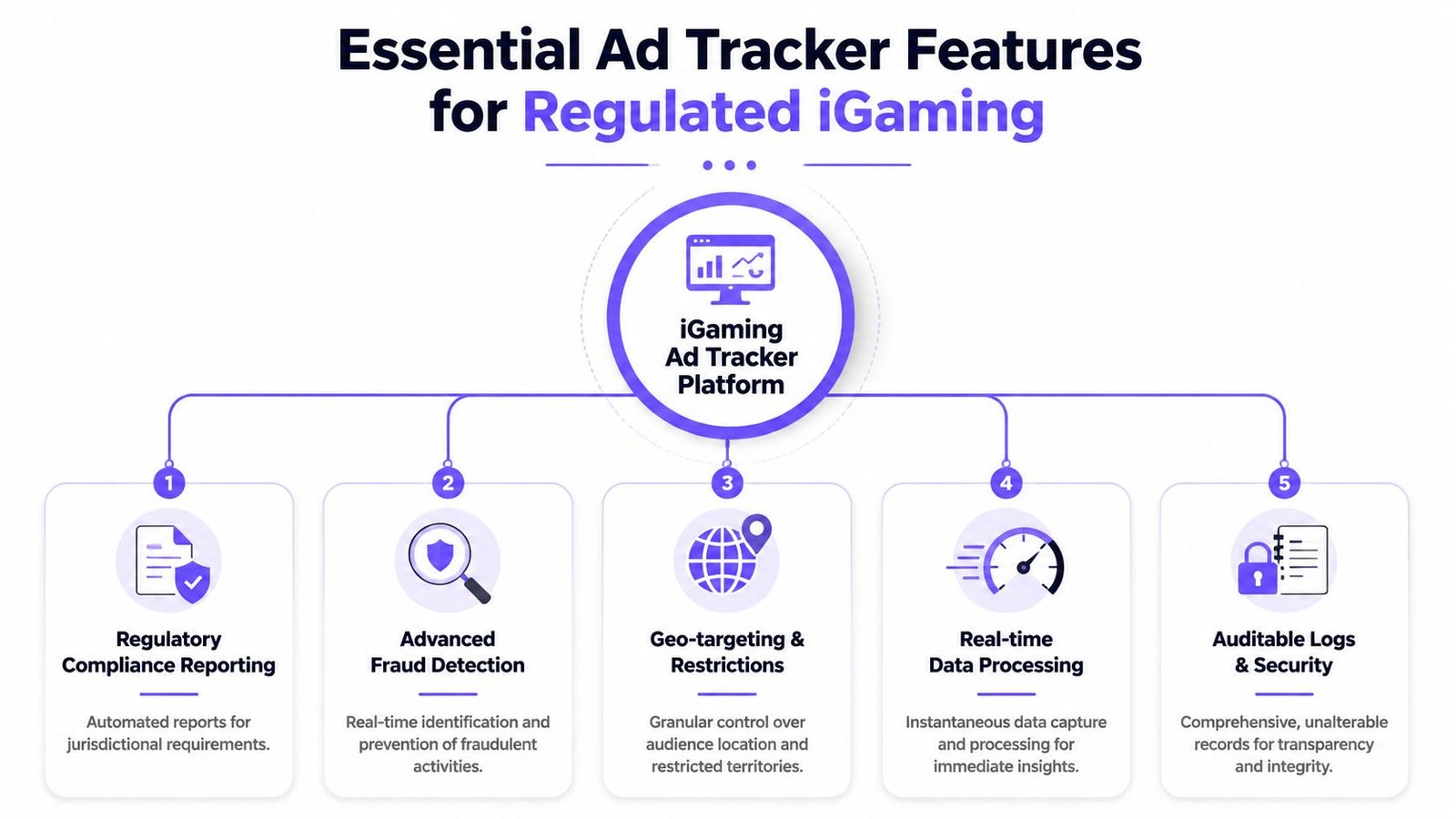
Must-Have Features for Regulated iGaming Markets
Architecture is only the base layer. Operators also need feature depth that reflects how affiliate programs run under regulatory pressure.
A platform can advertise AI, automation, and dashboards all day. If it can’t stop bad traffic early, document who approved an affiliate, and give finance a defensible ledger, it isn’t ready for regulated iGaming.
Fraud controls that act before spend is wasted
In this vertical, basic bot filtering isn’t enough. Advanced ad tracker software needs native antifraud controls that identify bots, proxies, and datacenter IPs before budget accrues. In high-risk GEOs, those controls can prevent up to 25% of fraudulent spend, and strong systems can automatically pause or blacklist sources based on KPIs such as FTD quality, as outlined in Scaleo’s review of iGaming tracking solutions.
The operational difference is simple. Manual review happens after spend. Native traffic filtering acts during spend.
Real-time reporting that operations can trust
Batch reporting causes avoidable mistakes. If the affiliate team sees yesterday’s traffic, but media buyers are still spending today, bad sources stay live too long and good sources stay throttled.
For iGaming, real-time reporting isn’t a dashboard preference. It’s how teams handle source quality, deal exceptions, and partner questions while traffic is still active.
Multi-brand and multi-currency handling
Operators rarely run a single clean funnel. They manage casino and sportsbook offers, multiple brands, mirrored market structures, and partner deals that vary by GEO and product. Generic trackers usually bolt this together through tags and naming conventions. That works until payout logic depends on brand-level revenue treatment or local currency reconciliation.
Purpose-built systems treat brands, currencies, and partner deal logic as native entities. That’s the difference between querying the system and repairing the system.
Compliance and auditability
Most general content about ad tracker software talks about ROAS and pixels while barely addressing compliance tooling. In regulated markets, that omission is dangerous. Teams need consent records, audit logs, locality controls, and a clear answer to where affiliate and player-adjacent data is processed. If your current setup relies on separate plugins or internal workarounds, the architecture is already telling you it wasn’t designed for this sector.
A useful reference point for teams reviewing these obligations is this guide to GDPR and data residency for iGaming affiliates.
Compliance failures usually start as workflow gaps. Missing approval history, inconsistent documentation, and unclear data handling become legal problems later.
APIs and postbacks that connect the stack
A proper iGaming tracker doesn’t live alone. It has to exchange data with CRM, BI, finance, payments, KYC, and operator backend systems. If the vendor treats API access as an afterthought, expect reconciliation pain.
The practical requirement is straightforward:
- Inbound event capture: registrations, deposits, KYC states, revenue events
- Outbound reporting: affiliate stats, deal data, payout values, fraud statuses
- Webhook support: real-time operational triggers
- Data model consistency: shared identifiers across acquisition and revenue systems
Commission flexibility without spreadsheet logic
Commercial structures in iGaming are negotiated, not standardized. The platform has to support CPA, RevShare, Hybrid, and CPL with tiering and custom logic, because flexible commission structures are mandatory to mirror partner agreements, as noted in AFF.TECH’s guide to choosing an iGaming affiliate platform.
If commission exceptions still live outside the tracker, the tracker isn’t running the program. Your operations team is.
A Vendor Evaluation Checklist for Operators
Most demos are designed to make weak platforms look complete. The interface is clean. Reports load fast. The sales team says the platform supports “custom setups.” None of that tells you whether the system can survive real iGaming operations.
The right evaluation method is to ask questions that expose architecture, accounting depth, and workflow maturity. If a vendor can’t answer in operational terms, assume the feature is shallow.
Compliance is one of the first pressure tests. iGaming affiliate platforms must manage onboarding documentation, approval gates, and ongoing monitoring to meet regulatory standards in sensitive jurisdictions like the EU and UK, according to Track360’s affiliate software evaluation guide. If the demo only shows reporting and links, you’re not looking at the full operating system.
The questions that actually matter
Ask the vendor how they calculate revenue-share payouts when bonus deductions, negative carryover, or brand-specific rules apply. Ask whether those rules are configurable inside the platform or handled offline. Ask what happens when a player changes product, currency, or brand path after acquisition.
Then move to workflow control. How is affiliate onboarding documented? Who can approve a partner? Can the platform record why an account was approved, rejected, or restricted? Can compliance review those actions later without relying on email history?
For feature benchmarking, operators often compare systems against broader affiliate management platform capabilities before they drill into tracker-specific depth.
iGaming Ad Tracker Vendor Evaluation Checklist
| Category | Evaluation Question | Required Capability |
|---|---|---|
| Tracking architecture | Does the platform support backend-driven attribution across click, registration, KYC, deposit, and revenue events? | Native S2S postback framework with event mapping |
| Revenue logic | Can NGR formulas reflect operator-specific deductions and exceptions? | Configurable revenue and commission logic |
| Commission models | Can the system support partner-specific CPA, RevShare, Hybrid, and tiered deals? | Flexible commercial engine without spreadsheet overrides |
| Fraud control | How does the platform identify low-quality or automated traffic? | Native filtering, rule-based actions, source suppression |
| Compliance workflow | How are onboarding documents, approval gates, and monitoring handled? | Embedded review workflow with audit history |
| Auditability | Can legal, finance, and affiliate teams inspect decision history? | Immutable logs for changes, approvals, and payout-impacting events |
| Multi-brand operations | Can one account manage multiple brands, products, and currencies cleanly? | Unified tenant structure with brand-level controls |
| Integration depth | How does the tracker connect to BI, CRM, finance, and operator backend systems? | API access, postbacks, and webhooks |
| Reporting integrity | Can teams reconcile affiliate stats with operator-side data without manual patching? | Shared identifiers and exportable reporting schema |
| Reliability | What happens during event spikes, failed postbacks, or delayed operator responses? | Queueing, retry logic, alerting, and operational visibility |
If a vendor answers critical questions with “our team can customize that,” ask whether the capability exists in product or depends on services. That distinction decides your long-term operating cost.
What to ignore in a demo
Nice charting. Generic attribution views. Slideware about AI. Those things matter far less than payout integrity, workflow control, and traceable data lineage.
Operators don’t need ad tracker software that looks modern. They need one that can be defended in front of finance, affiliates, and regulators.
Planning Your Integration and Migration
Replacing a tracker feels risky because the current one is already wired into links, partner portals, reports, and payout processes. But most failed migrations happen for procedural reasons, not technical ones. Teams rush event mapping, skip parallel validation, or underestimate affiliate communications.
The cleanest migrations are phased and boring. That’s a good thing.

Phase one and two
Start with data scoping. Decide what historical information needs to move and what only needs archival access. Generally, not every raw event is necessary in the new platform on day one. They do need active affiliates, commercial terms, current links, source identifiers, and a clear mapping between operator events and tracker events.
Next comes technical setup. Define click IDs, SubIDs, event names, postback timing, rejection states, and currency handling. This is also where teams should review integration requirements for affiliate and operator systems so backend, BI, and affiliate teams are working from the same event model.
Phase three and four
Affiliate communication is usually underplanned. Partners need to know whether links are changing, whether reporting access is moving, and which cutover date matters for their traffic. Good affiliates don’t mind operational change. They mind ambiguity.
Then run the new and old systems in parallel where possible. Compare click counts, registrations, deposits, and commercial outputs. Don’t expect perfect parity if the old architecture was flawed. Do expect explainable variance. If you can’t explain differences, don’t cut over yet.
A simple migration sequence works well:
- Map active commercial relationships before moving any tracking logic.
- Validate event delivery with test traffic across core player actions.
- Migrate top affiliates first if a full parallel rollout isn’t practical.
- Reconcile outputs daily during the transition window.
- Retire legacy links carefully after partner confirmation and internal signoff.
Final cutover discipline
The last phase is decommissioning. Archive legacy reports, document final reconciliation, and remove hidden dependencies like old payout exports or finance-side formulas. Many operators think migration ends when new links go live. It doesn’t. It ends when the old system is no longer affecting decisions.
The safest migration isn’t the fastest one. It’s the one where every discrepancy has an owner before affiliates ever notice it.
KPI Dashboards and Performance Queries
Once the tracking layer is correct, reporting stops being a blame-reduction exercise and becomes a decision system.
That’s where specialized ad tracker software pulls away from generic tools. Instead of just showing clicks and conversions, it gives affiliate managers, BI analysts, and finance teams a common operating view of acquisition quality and downstream value.
Ad analytics software that underpins modern tracking is projected to reach $20.33 billion by 2035 at 12.9% CAGR, driven by AI-based attribution and the ability to track KPIs such as CTR, conversion rates, and customer lifetime value, according to Future Market Insights’ ad analytics market analysis.
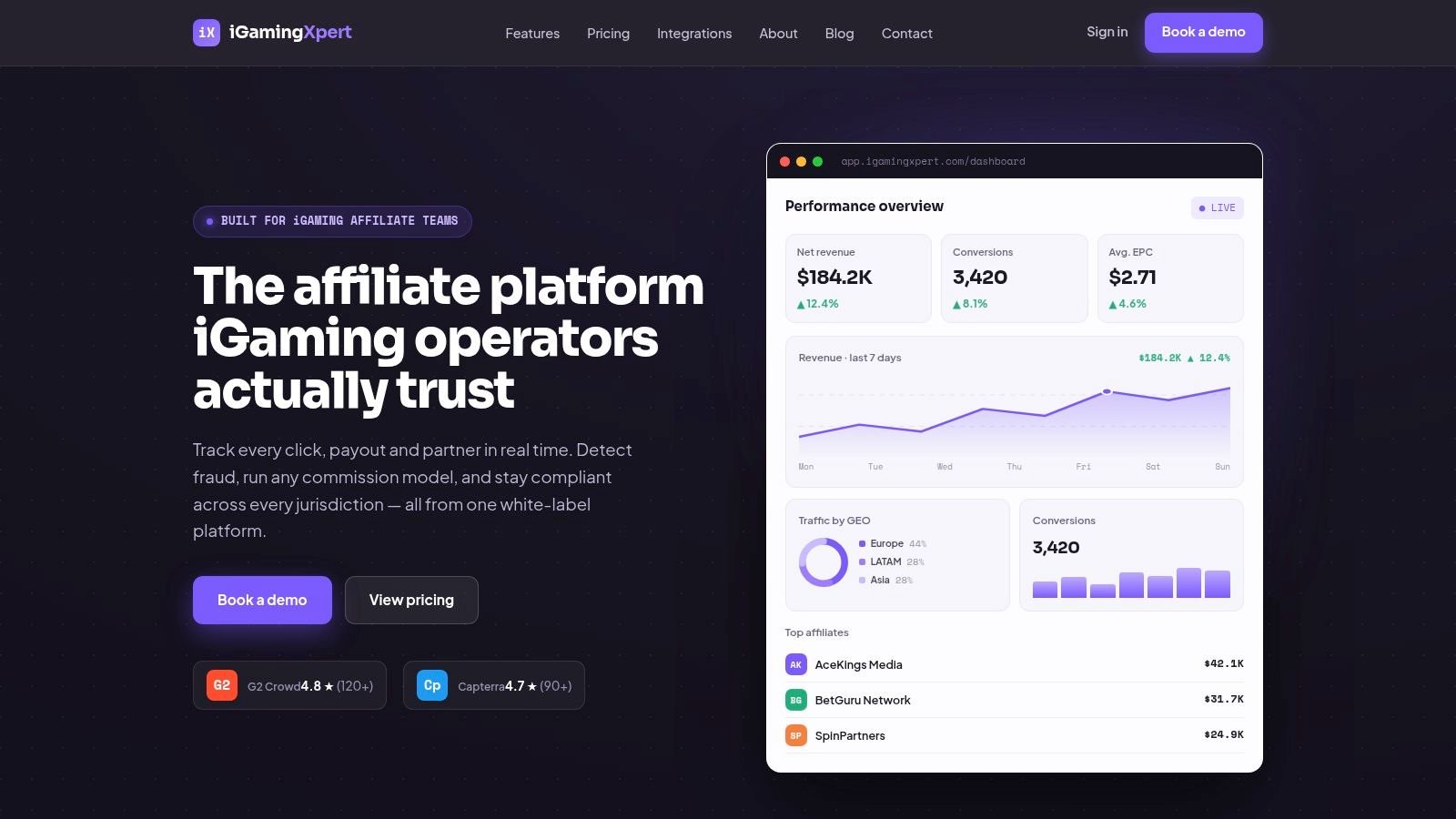
What a useful dashboard actually shows
A strong operator dashboard usually brings these views together:
- Affiliate quality by source: not just volume, but whether a source produces players who reach valuable lifecycle milestones
- Brand and GEO breakdowns: where registrations convert into deposits cleanly and where they stall
- Revenue cohort trends: how player value behaves after acquisition, by affiliate and campaign
- Deal performance: whether CPA, RevShare, or Hybrid structures are aligned with actual player quality
- Exception monitoring: rejected events, delayed postbacks, unexplained revenue shifts, and source anomalies
Generic dashboards often stop at acquisition metrics. That’s too early in the chain for iGaming.
Sample analyst queries
The exact schema differs by platform, but the questions should look familiar. Analysts need to join click, player, event, and payout data without heroic cleanup.
SELECT
  affiliate_id,
  brand_id,
  geo,
  COUNT(DISTINCT click_id) AS clicks,
  COUNT(DISTINCT player_id) AS registrations
FROM tracking_events
WHERE event_date >= CURRENT_DATE - INTERVAL '30 day'
GROUP BY affiliate_id, brand_id, geo;
SELECT
  affiliate_id,
  campaign_id,
  COUNT(DISTINCT CASE WHEN event_type = 'deposit' THEN player_id END) AS depositing_players,
  SUM(revenue_amount) AS attributed_revenue
FROM player_lifecycle_events
WHERE event_date >= CURRENT_DATE - INTERVAL '30 day'
GROUP BY affiliate_id, campaign_id;
SELECT
  affiliate_id,
  deal_type,
  currency,
  SUM(commission_amount) AS projected_payout
FROM commission_ledger
WHERE payout_period = DATE_TRUNC('month', CURRENT_DATE)
GROUP BY affiliate_id, deal_type, currency;
Why structure matters more than visuals
A dashboard can look polished and still be operationally weak. The actual test is whether teams can answer performance questions without exporting data into side spreadsheets.
If BI has to rebuild affiliate truth outside the platform, the tracker is acting as a reporting layer, not a data system.
Purpose-built reporting should let teams move from “what happened” to “which partner, GEO, and deal structure is producing durable value.”
The Strategic Shift to Purpose-Built Tracking
Most operators don’t change tracker architecture because they want a new dashboard. They change it because the old setup keeps creating operational drag. Commission disputes take too long to resolve. Fraud response is too slow. Compliance review depends on manual evidence gathering. Finance and affiliate teams work from different versions of the truth.
That’s the compelling case for purpose-built ad tracker software in iGaming. It closes the gap between acquisition reporting and operator reality.
Generic tools can still be useful in less regulated, shorter-cycle environments. But regulated iGaming asks more from the platform. It needs backend-grade attribution, configurable commercial logic, workflow controls for onboarding and monitoring, and data structures that survive audit and reconciliation. Anything less turns your internal team into the integration layer.
The strategic shift isn’t about buying more software. It’s about removing weak points from the affiliate operation. Better tracking protects payout integrity. Better fraud controls protect media efficiency. Better compliance tooling protects market access. Better reporting lets teams optimize based on player value instead of surface activity.
Operators that treat tracking as infrastructure usually run calmer programs. Partners trust the numbers more. Finance spends less time reconciling. Compliance has cleaner evidence. BI can analyze performance instead of repairing it.
That’s why this decision belongs at the operational core of the business, not in a narrow marketing tools review.
If your current setup still relies on generic tracking logic, disconnected reporting, or manual payout reconciliation, iGamingXpert is worth a close look. It’s built for regulated iGaming operators that need real-time tracking, commission accounting, fraud controls, and compliance workflows in one platform.
