Meaning of “Wagering Requirement” in Affiliate Contracts

- Eligible Stakes: This wagering requirement briefing defines how wagering terms alter payable NGR while keeping the commercial result tied to reproducible evidence.
- NGR Effect: Within the “Meaning of "Wagering Requirement" in Affiliate Contracts” workflow, review exceptions separately from clean traffic so one headline total cannot hide data loss, fraud or adjustment risk.
- Bonus Amount: For operators evaluating “Meaning of "Wagering Requirement" in Affiliate Contracts,” treat wagering requirement as a defined event or decision, with an owner and an effective rule version.
For operators researching meaning of "wagering requirement" in affiliate contracts, this guide defines how wagering terms alter payable NGR. The first warning sign in a wagering requirement implementation is rarely a missing dashboard tile; it is a result under “Meaning of "Wagering Requirement" in Affiliate Contracts” that cannot be reconstructed from its source event and rule version.
For meaning of "wagering requirement" in affiliate contracts, our platform-side check is simple: can an affiliate manager move from bonus amount to ngr effect without changing reports or asking engineering to rebuild the wagering requirement journey?
Key Definition: meaning of "wagering requirement" in affiliate contracts.
meaning of "wagering requirement" in affiliate contracts: Entities and states that define wagering requirement
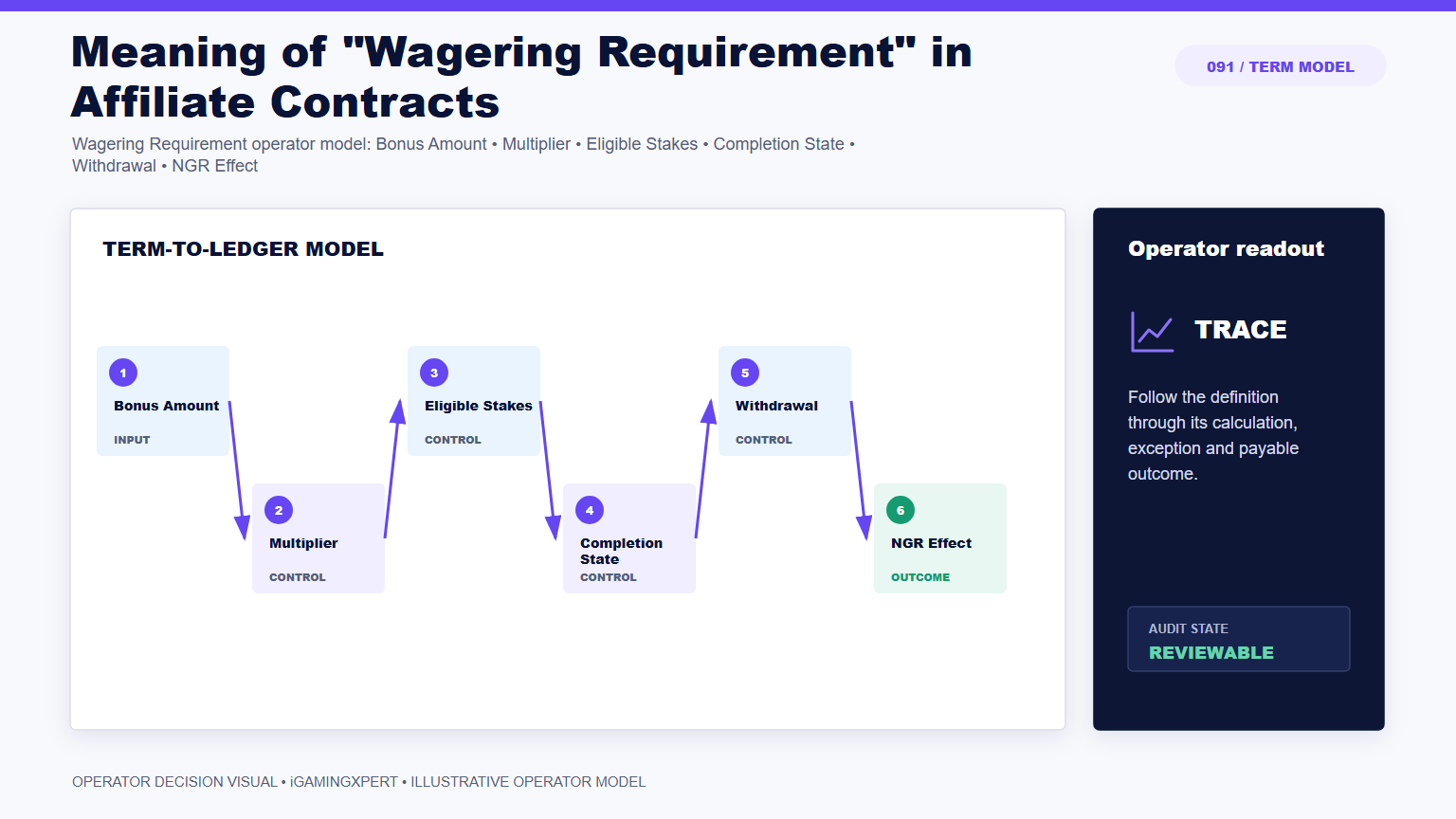
A useful semantic layer for meaning of "wagering requirement" in affiliate contracts separates multiplier, eligible stakes and completion state instead of collapsing them into a generic conversion field. We also keep source identifier beside the wagering requirement result, because a value without provenance cannot support a commission dispute or compliance review.
In our implementation reviews, the acceptance test for meaning of "wagering requirement" in affiliate contracts is whether the system can define how wagering terms alter payable ngr using the same definitions in the click log, player record, affiliate statement and management report. That joins the commercial vocabulary to the technical schema without pretending that withdrawal and ngr effect are interchangeable states.
The dashboard should therefore expose multiplier as the input, withdrawal as the governing control, and bonus amount as the reviewable outcome for meaning of "wagering requirement" in affiliate contracts. For meaning of "wagering requirement" in affiliate contracts, that shared vocabulary also keeps product-level variance from being mistaken for a tracking or commission defect.
A measurable acceptance test for wagering requirement
For meaning of "wagering requirement" in affiliate contracts, these figures are illustrative internal acceptance targets, not claimed industry-wide averages. We expose this wagering requirement scenario because it should be testable; each operator should recalculate the threshold by GEO, product, traffic source and contract model.
| Control | Example target | Relevant evidence |
|---|---|---|
| Ledger-to-report variance | ≤0.5% | bonus amount |
| Manual adjustment share | <2% | withdrawal |
| Rule-version coverage | 100% | NGR effect |
payable_commission = approved_base × commission_rate - adjustments
variance = abs(ledger_total - report_total) / ledger_total
Operator note: A meaning of "wagering requirement" in affiliate contracts benchmark is useful only when its numerator, denominator, exclusions and observation window are stored beside the wagering requirement result.
What changes the wagering requirement result
- Scope the rule for meaning of "wagering requirement" in affiliate contracts: Name the event, the player state, the time window, and the markets included.
- Assign ownership for meaning of "wagering requirement" in affiliate contracts: Give affiliate operations, finance, compliance, and engineering clear responsibilities.
- Capture the evidence for meaning of "wagering requirement" in affiliate contracts: Store the source ID, status, timestamp, and rule version beside the derived value.
- Define the exception for meaning of "wagering requirement" in affiliate contracts: Document reversals, duplicates, late events, and manual approvals before they occur.
Data fields and edge cases for wagering requirement
| Signal | What the platform should record | Why the manager needs it |
|---|---|---|
| Source | Partner, campaign, click, and market | Preserves attribution accountability |
| State | Registration, FTD, fraud, approval, and reversal | Prevents premature payout |
| Economics | Revenue, deductions, commission, and balance | Makes settlement reproducible |
For meaning of "wagering requirement" in affiliate contracts, we also recommend a visible exception queue. For meaning of "wagering requirement" in affiliate contracts, a timeout, duplicate webhook, missing source, or conflicting identity should become a named case with an owner and a next action. For meaning of "wagering requirement" in affiliate contracts, hidden exceptions create the appearance of automation while pushing the real work into spreadsheets and partner email. For meaning of "wagering requirement" in affiliate contracts, the queue is where unresolved evidence becomes an owned decision.
Monitoring wagering requirement in affiliate software
SaaS Warning: For meaning of "wagering requirement" in affiliate contracts, never use a derived number as the sole basis for payout when the source event, approval state, or deduction trail cannot be reconstructed. The control must also cover define how wagering terms alter payable NGR.
For meaning of "wagering requirement" in affiliate contracts, a monthly review should compare the platform with the PAM, CRM, fraud service, and finance ledger. For meaning of "wagering requirement" in affiliate contracts, the purpose is not to force every system to look identical; it is to explain why the systems differ and which one owns each decision. For meaning of "wagering requirement" in affiliate contracts, that is how teams protect trust while keeping the workflow flexible. Begin this review with meaning of "wagering requirement" in affiliate contracts.
Operator checklist for wagering requirement
- Baseline meaning of "wagering requirement" in affiliate contracts: Measure the existing result before changing the rule or workflow.
- Test one controlled change for meaning of "wagering requirement" in affiliate contracts: Use a bounded cohort and document the expected outcome.
- Reconcile meaning of "wagering requirement" in affiliate contracts: Compare source events with platform, finance, and partner views.
- Review downstream value for meaning of "wagering requirement" in affiliate contracts: Check retention, churn, chargebacks, and LTV rather than top-of-funnel volume alone.
- Version the decision for meaning of "wagering requirement" in affiliate contracts: Record the effective date, terms, owner, and reason for the change.
For meaning of "wagering requirement" in affiliate contracts, the commercial consequence should be stated plainly. define how wagering terms alter payable NGR. For meaning of "wagering requirement" in affiliate contracts, that is why the manager needs more than a definition: the rule must tell the team what to approve, what to hold, what to investigate, and what to optimize. For meaning of "wagering requirement" in affiliate contracts, a polished report that does not change an operating action is not a useful control.
For meaning of "wagering requirement" in affiliate contracts, when the model is working, the affiliate team can explain performance without hand-built narratives. Finance can reproduce the settlement. For meaning of "wagering requirement" in affiliate contracts, compliance can inspect the market and message controls. For meaning of "wagering requirement" in affiliate contracts, product and CRM teams can use the same source data to improve player quality instead of arguing over whose dashboard is correct. For meaning of "wagering requirement" in affiliate contracts, that shared evidence is the operating advantage.
For meaning of "wagering requirement" in affiliate contracts, the useful KPI is the one that changes an operator decision. For meaning of "wagering requirement" in affiliate contracts, pair the headline value with a leading signal, a lagging outcome, and an exception count so the team can see both movement and cause. The leading signal should reflect define how wagering terms alter payable NGR.
For meaning of "wagering requirement" in affiliate contracts, a partner-level cohort often reveals more than a blended average. For meaning of "wagering requirement" in affiliate contracts, compare acquisition source, market, device, deal version, approval state, and player tenure before deciding whether a change improved the program. For meaning of "wagering requirement" in affiliate contracts, the decisive split is the one that changes payout or action.
For meaning of "wagering requirement" in affiliate contracts, when a rule is changed, preserve the old result and the new result side by side for at least one settlement cycle. For meaning of "wagering requirement" in affiliate contracts, that makes it possible to distinguish a genuine improvement from a reporting shift caused by timing or classification. Record the change against meaning of "wagering requirement" in affiliate contracts.
For meaning of "wagering requirement" in affiliate contracts, the operating conversation should include the people who inherit the consequence. For meaning of "wagering requirement" in affiliate contracts, affiliate managers need a clear partner explanation, finance needs a clear commercial explanation, compliance needs evidence of control, and product teams need to know which event contract they must support. The consequence of meaning of "wagering requirement" in affiliate contracts should be assigned before launch.
For meaning of "wagering requirement" in affiliate contracts, scale adds pressure to every weak assumption. For meaning of "wagering requirement" in affiliate contracts, more brands create more exceptions, more currencies create more reconciliation work, and more partner tiers create more identity edges. For meaning of "wagering requirement" in affiliate contracts, a disciplined rule stays understandable even when the program becomes large. The scaling pressure for meaning of "wagering requirement" in affiliate contracts is define how wagering terms alter payable NGR.
For meaning of "wagering requirement" in affiliate contracts, the final review should ask whether define how wagering terms alter payable NGR is producing a better commercial outcome, a cleaner audit trail, or simply a more attractive dashboard. For meaning of "wagering requirement" in affiliate contracts, clarity is valuable only when it survives real traffic, real reversals, and real partner questions.
Primary references and implementation standards
For meaning of "wagering requirement" in affiliate contracts, we used the following regulator or primary technical documentation to anchor the wagering requirement definition and implementation boundary.
- UK Gambling Commission: safer and simpler gambling promotions
- UK Gambling Commission: wagering requirement risk proposal
The Bottom Line for Operators
Operators should treat meaning of "wagering requirement" in affiliate contracts as a controlled business rule supported by reliable first-party tracking, transparent commission logic, and player-quality evidence. Teams that need one place to manage affiliate relationships, attribution, fraud controls, and payouts can explore iGamingXpert.
For meaning of "wagering requirement" in affiliate contracts, keep the definition legible, the event history intact, and the exception path owned by a real team. Review meaning of "wagering requirement" in affiliate contracts on the cadence that matches its commercial risk.
