Cookieless Attribution for iGaming: The Operator’s Guide to Better Tracking

In practice, the best cookieless setups are stricter than the browser-era systems they replace. They do more filtering before credit is assigned, keep a cleaner audit trail, and give compliance teams a record they can defend. That is the standard that protects ROI in regulated affiliate programs.
Old affiliate tracking was often more precise than what replaces it. Cookieless attribution models currently land in the 50% to 85% accuracy range, versus the 85% to 90% range historically reached by third-party cookie systems, which forces operators to shorten attribution windows to 7 to 14 days instead of the longer windows many teams got used to in cookie-based setups, as outlined in Improvado’s cookieless attribution analysis.
For a regulated iGaming operator, that gap isn’t an academic problem. It changes who gets paid, which affiliates look profitable, and whether your BI team trusts reported FTD and revenue paths enough to scale spend. If a player clicks an affiliate review on mobile, registers later on desktop, and deposits after a compliance check, the old browser-led chain was already fragile. In a cookieless environment, any weak point in identity resolution, event collection, or consent handling breaks attribution faster.
That’s why the right response isn’t “find a new cookie replacement.” It’s to rebuild the attribution stack around first-party data, server-side event delivery, consented identity, and validation methods that can survive regulatory scrutiny.
The End of an Era for iGaming Affiliate Tracking
Browser-based affiliate tracking is no longer reliable enough for regulated iGaming.
The old model assumed one thing. A click happened, the browser stored it, and the partner could be credited later. That was workable when journeys stayed on one device and privacy controls were looser. It breaks down fast in a market where a player might click a review site on mobile, complete registration on desktop, pause during KYC, then return days later to make a first deposit after document approval.
In casino and sportsbook programs, attribution has to survive more than a signup. It has to hold through registration, KYC status changes, FTD, wagering or trading activity, and the commission rules attached to CPA, RevShare, or Hybrid deals. In regulated markets, weak attribution creates operational problems immediately. Finance questions the invoice. Compliance asks whether the audit trail is defensible. Affiliate managers get dragged into disputes they cannot settle with evidence.
Where the risk shows up first
The first breakpoints are usually obvious to the affiliate team because they hit payouts and partner relationships before they hit a dashboard:
- Commission disputes: The affiliate says the player was referred by them, but the operator cannot produce a clean click-to-FTD record.
- Cross-device loss: The player clicks on iPhone, registers on a laptop, deposits after identity checks, and the conversion no longer links back with enough confidence to support payment.
- Channel bias: Paid media platforms still claim view-through or click-through influence, while the affiliate platform loses the clearer path to the monetized event.
- Window inflation: Legacy 30-day or 45-day rules keep assigning credit after the original identity signal has gone stale.
That last issue is where many programs lose money. Once identity persistence weakens, long attribution windows stop being defensible. They do not just reduce reporting quality. They increase the chance that an old click gets paid even though the later registration and deposit cannot be verified to the same standard.
Practical rule: If browser persistence is still your source of truth for affiliate payouts, some partners are being over-credited and others are being undervalued.
This hits regulated operators harder than other verticals. A retail brand can tolerate some noise in top-of-funnel attribution. An iGaming operator cannot be as relaxed when commission payments, safer gambling controls, source-of-funds checks, and market-specific consent rules all sit on the same player journey. If your evidence chain is weak, the payout decision is weak too.
A lot of teams still frame cookieless attribution as a reporting upgrade. For affiliate programs, it is a controls issue as much as a measurement issue. The question is not whether a dashboard looks cleaner. The question is whether the program can defend who earned the player, why that partner was paid, and whether the claimed ROI survives audit, reconciliation, and partner challenge.
Operators that handle this well do not chase perfect identity. They set up attribution that is auditable, conservative where evidence is weak, and stable enough to support commissions without constant manual review. That is the standard now.
Understanding Cookieless Attribution Fundamentals
Cookieless attribution in iGaming is a rules engine, not a workaround. It decides which affiliate touchpoints can still be tied to registration, KYC, FTD, and revenue after third-party cookies stop carrying that journey for you.
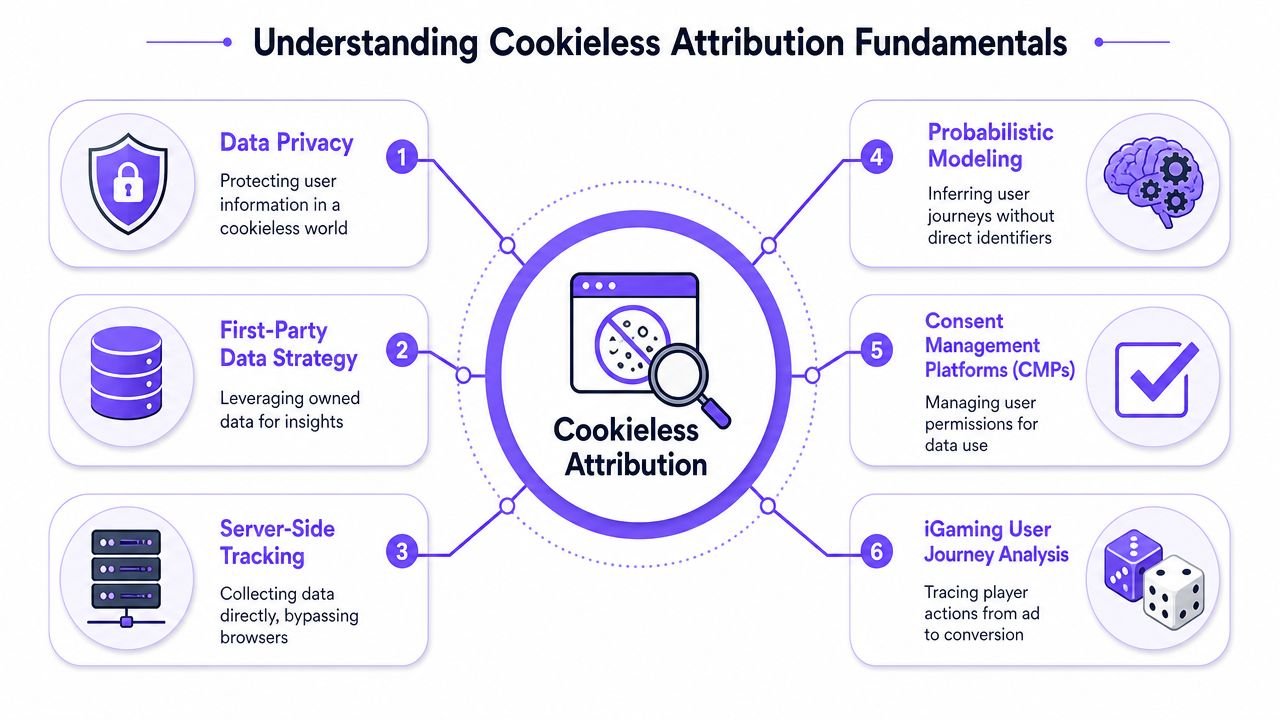
In practice, the model combines first-party identifiers, server-to-server event capture, consent records, and a set of attribution rules for unknown traffic. The goal is not to identify every visitor. The goal is to assign credit only where the evidence is strong enough to support reporting, payout, and audit.
Deterministic signals and probabilistic signals
Two signal types matter.
Deterministic attribution uses identifiers the operator can verify. That usually means an account ID, a stored click reference passed into registration, a consented hashed email, or another first-party identifier linked to the player record. In affiliate programs, this is the standard for payable events because it gives ops, BI, and finance one reference point to reconcile.
Probabilistic attribution estimates whether separate touchpoints belong to the same user before the player is known. It can use device traits, timing, geo, referrer patterns, and session context to fill early-funnel gaps. That has value for channel analysis. It is weak evidence for commission decisions in a regulated program, especially when an affiliate disputes ownership of a player.
A practical way to frame it with internal teams:
| Attribution type | What it relies on | Best use in iGaming | Main weakness |
|---|---|---|---|
| Deterministic | Authenticated or consented first-party identifiers | Registration to FTD and post-FTD revenue linking | Limited before signup or login |
| Probabilistic | Modeled similarity across touchpoints | Early-funnel analysis and traffic pattern review | Lower confidence for payouts, disputes, and audit trails |
Teams buying ad tracker software for affiliate attribution should judge it on that distinction first. If the platform treats modeled matches and verified player-linked events as if they carry the same weight, reporting will look cleaner than the payout logic behind it.
Identity graphs and first-party data
An identity graph is the matching layer that connects click data, landing events, registration records, CRM status, and deposit activity into one usable journey. For operators, the hard part is not the concept. The hard part is data discipline.
Affiliate click IDs need to survive redirects. Source parameters need consistent naming. Registration events need to capture the same reference keys used by the tracking layer. Consent status needs to be stored with enough detail to show what data could be used, and when. If any of those links break, the graph becomes a collection of partial guesses.
That is why cookieless attribution in regulated iGaming cannot rely on browser fingerprinting as a replacement for proper first-party design. Fingerprinting may help flag suspicious patterns or duplicate traffic. It is a poor foundation for commercial attribution when the operator may later need to justify why one partner was paid for a player and another was not.
Affiliate teams do not need perfect identity resolution. They need enough verified continuity between click, registration, and payable event to defend a commission outcome.
Why server-side beats browser-only tracking
Browser pixels still have a role at the click and landing stage, but they are easy to lose. Consent prompts suppress them. Ad blockers interrupt them. Safari and Firefox shorten storage windows. Mobile app handoffs often break them entirely. In iGaming, those failures show up fast when a player clicks an affiliate link on mobile, completes registration later on desktop, and deposits after KYC approval.
Server-side tracking improves the evidence chain because registration, KYC, FTD, and revenue events can be sent directly from operator systems instead of waiting for the browser to fire correctly. That does not fix bad setup. Click capture still has to be clean, parameter mapping still has to be consistent, and affiliate IDs still have to pass through the funnel without corruption. But once the player becomes known, server-side events are far more reliable for reconciliation than browser-only logs.
That distinction affects ROI. If the click side is uncertain, treat the result as directional. If the conversion side is tied to first-party records and server events, it can support payment decisions with much less manual review.
The Core Components of a Modern Attribution Stack
A modern iGaming attribution stack has two essential pillars. First-party data and server-side tracking. If either one is weak, every downstream report becomes a debate instead of a decision tool.
First-party data has to be operational, not theoretical
A lot of operators say they have first-party data when what they really have is a registration table and a CRM. That’s not enough.
For cookieless attribution models to work in affiliate programs, the operator needs a structured record of the player journey across owned systems. At minimum, that means preserving source and campaign context at landing, carrying that context into registration where consent allows, and binding commercial events like FTD, redeposit, and net gaming revenue to a player ID that analytics and finance can both trust.
That foundation should include:
- Registration-linked identifiers: Consent-aware user records that can connect acquisition source to known player status.
- Event taxonomy: Clear definitions for click, signup, KYC approved, FTD, qualified player, and revenue events.
- Consent state storage: A record of what the player permitted, when, and for which data uses.
- Data minimization rules: Only keep what the affiliate, BI, and compliance workflows need.
Server-side tracking is where reliability improves
The architecture’s advantages become clear. Server-side tracking improves data accuracy by 12.6% by bypassing browser restrictions and ad blockers that invalidate traditional third-party cookie data, according to Secure Privacy’s analysis of cookieless tracking technology.
For an affiliate team, that means fewer missing registrations, cleaner deposit event delivery, and less dependence on whatever happened inside the player’s browser at the moment a script tried to fire.

A practical stack usually looks like this:
| Stack layer | What it does | Why affiliates care |
|---|---|---|
| Click capture | Records affiliate source and campaign parameters | Establishes the payable origin point |
| Server-side event bus | Sends registration, deposit, and revenue events from backend systems | Reduces browser-related event loss |
| Identity resolution | Maps anonymous sessions to known player records when possible | Recovers multi-session journeys |
| Attribution engine | Applies credit rules across touchpoints | Determines payouts and ROI views |
| Audit and compliance logs | Preserves consent and data handling records | Defends decisions in regulated markets |
Operators evaluating tracking infrastructure should focus on whether the platform supports reliable postback and server-to-server event handling rather than just pixel deployment. A useful reference point is this guide to affiliate ad tracker software for regulated programs, which reflects the kind of operational stack modern programs now need.
Operator view: If a conversion matters enough to pay commission on it, it should exist as a server-validated event, not only as a browser pixel fire.
How to Implement a Cookieless Attribution Strategy
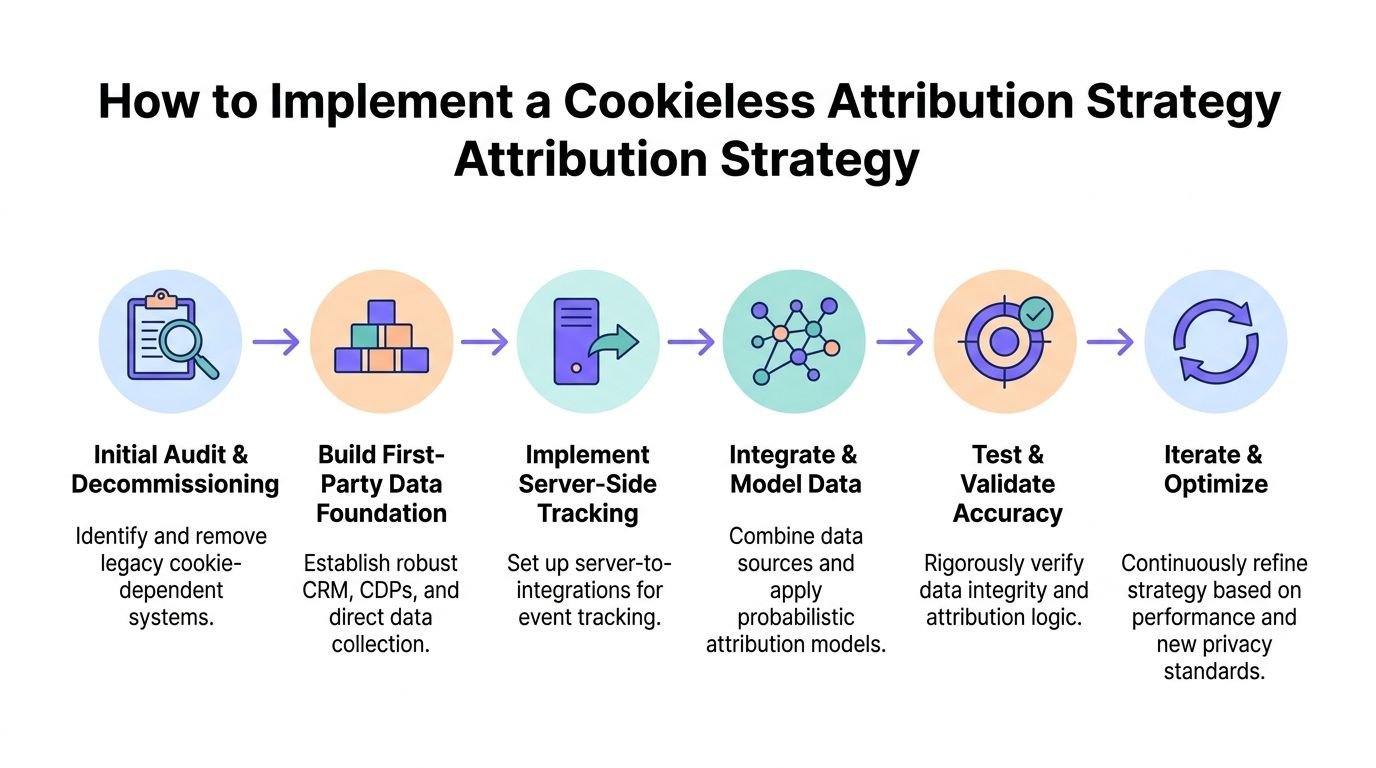
Cookieless attribution in iGaming succeeds or fails in implementation. The model on the slide deck matters far less than whether registration, KYC, deposit, and revenue events can be tied back to an affiliate click in a way that survives consent controls, app handoffs, and finance review.
Start with a dependency audit
Map every point where attribution still relies on the browser to remember who sent the player. In regulated affiliate programs, weak points usually show up in old CPA pixels on registration confirmation pages, JavaScript tags firing on deposit success pages, broken click IDs during app redirects, and reporting jobs that treat the browser session as the source of truth.
The audit should answer a simple operational question. If Safari blocks storage, the user declines optional tracking, or the player moves from mobile web to app before FTD, what still gets recorded?
Capture at least these failure points:
- Browser-side ad tags: Meta Pixel, LinkedIn Insight Tag, and similar page-based trackers
- Affiliate conversion pixels: Client-side confirmation methods that fail when the thank-you page does not load as expected
- Session-linked reporting: Logic that assumes click, signup, and deposit happen in one browser journey
- Duplicate attribution paths: Multiple tools writing conversion credit with different timestamps or matching rules
That audit gives engineering a decommission list. It also gives affiliate ops a risk list for disputed commissions.
Define the event chain around payable states
Cookieless attribution gets messy when teams track too much and own too little. For iGaming, the cleanest approach is to build the event model around states that affect payout, player quality, or regulatory reporting.
A practical baseline looks like this:
- Affiliate click captured with source parameters and click ID
- Landing page session created
- Registration started
- Registration completed
- KYC or account verification completed
- First deposit confirmed
- First wager placed
- Net revenue or other RevShare inputs posted
Each event needs a named owner. Web or app teams own click capture and session continuity. Platform or backend teams own account, KYC, wallet, and wager events. Affiliate ops owns the mapping between validated states and commission rules. Compliance needs access to the consent and processing record behind each attributed conversion.
If nobody owns an event, expect reconciliation issues later.
Shift conversion events to server-side delivery
Registration and FTD should come from backend systems, not from front-end tags. That is the practical break with cookie-first tracking. Once the event is created by the account platform or wallet service, it can be matched to the affiliate source record using first-party identifiers, click IDs, login states, or approved identity rules.
For affiliate teams, the key distinction is not academic. Networks, ad platforms, and internal systems all accept different event formats and expect different timing. This guide to postback vs callback tracking is a useful reference when you need to separate affiliate postbacks from internal webhooks and platform API updates.
A working flow usually looks like this:
- The click handler stores affiliate ID, campaign parameters, timestamp, and click reference
- Registration creates a known player record and links it to the captured source where policy allows
- KYC and deposit services emit validated status changes to the attribution layer
- The attribution service applies credit rules only after the qualifying event is confirmed
- The commission system reads from validated conversion states, not from page fires
This reduces event loss. It also gives finance a cleaner audit trail when an affiliate challenges a reversal or a delayed FTD.
Pick an attribution model that matches how players actually convert
Model choice should reflect player behavior and deal structure, not generic marketing preference.
A sportsbook brand running short-window CPA deals around a major tournament may get enough signal from last-touch rules if most players click, register, deposit, and bet in one session. A casino program with SEO affiliates, review portals, PPC brand bidding, email, and CRM prompts usually needs a model that preserves some credit for introducers without handing all value to the final touchpoint.
Use commercial logic to choose:
| Model | Best fit | Caution |
|---|---|---|
| Last touch | Short CPA paths, low-touch acquisition flows | Often overpays closers and undervalues introducers |
| Position-based | Mixed affiliate journeys with clear introducer and closer roles | Needs written payout policy and BI sign-off |
| Time-decay | Longer gaps between click, registration, and deposit | Easy to misconfigure if deposit lag differs by market |
In practice, many operators start with a simpler payable model and a separate analytical model. That keeps partner payments predictable while BI tests whether assist credit changes channel economics.
A commission model should be simple enough to defend to affiliates and strict enough to survive an audit.
Run parallel reporting before changing partner payments
Do not switch payouts the moment server-side events start landing. Run the new method beside the legacy setup long enough to compare click volumes, registration rates, FTD counts, duplicate conversions, and unattributed revenue by partner and by market.
The vulnerabilities of regulated programs become apparent. One market may require tighter consent gating. Another may have heavier app traffic. A third may have affiliate landing pages that strip parameters on redirect. If you change commercial terms before those gaps are measured, the argument with partners starts before the data is stable.
Keep the parallel phase structured:
- Compare old and new attribution by affiliate, campaign, device type, and GEO
- Isolate discrepancies caused by consent status, app install flows, or delayed KYC
- Review unattributed FTDs with BI, affiliate ops, and compliance together
- Freeze payout logic until exception rates are understood and documented
- Publish a plain-language methodology note for affiliates and internal stakeholders
Operators that handle this well treat cookieless attribution as a platform migration with legal and commercial consequences. That mindset usually leads to better data quality, fewer commission disputes, and less friction between acquisition, BI, and compliance.
Validating Accuracy and Measuring True ROI
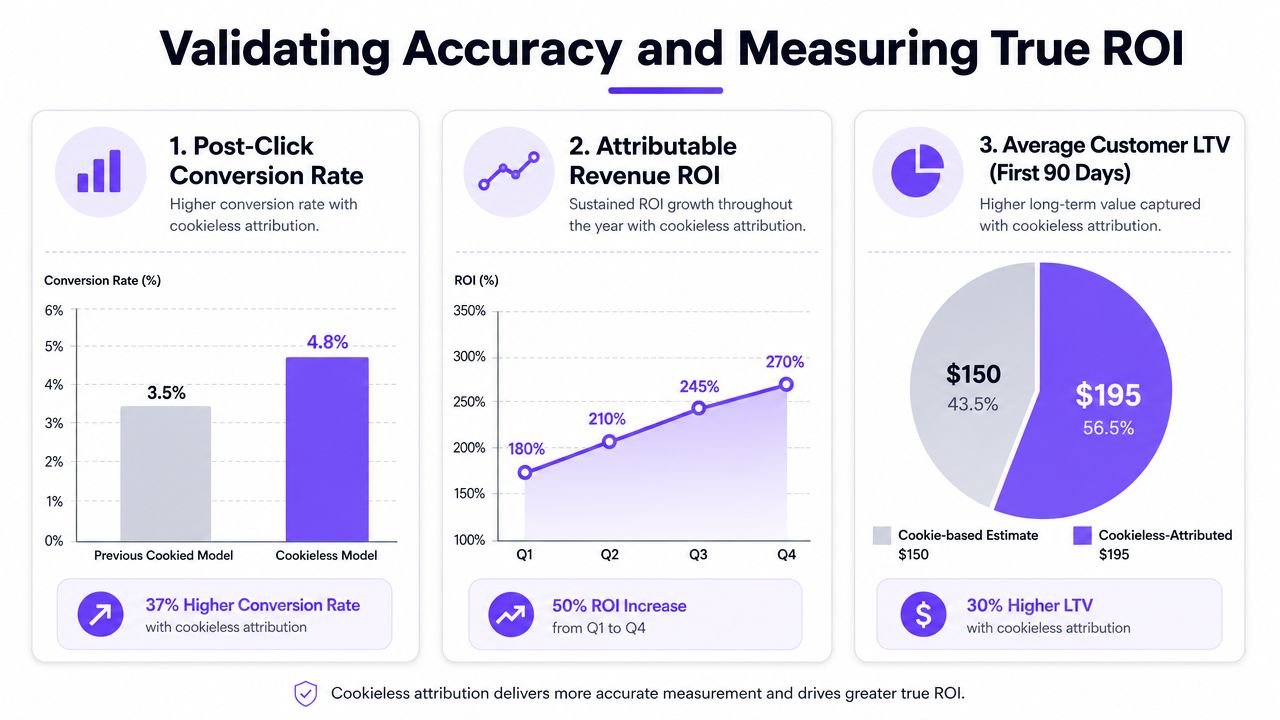
Cookieless attribution that cannot survive validation will break an affiliate program faster than a tracking outage. In regulated iGaming, bad measurement does not just distort reporting. It changes partner payouts, weakens budget decisions, and creates audit risk when finance, compliance, and affiliate ops all hold different numbers.
Validation has to sit outside the attribution model. Model output is only one view of performance. The operator still needs an independent way to test whether credited conversions were caused by the affiliate activity, whether those players passed KYC, deposited, and produced value after bonus cost, chargebacks, and retention curves are applied.
What validation should prove in an affiliate program
For iGaming, the test is simple. Did the partner bring in incremental, compliant, profitable players.
That breaks into four checks:
- Acquisition quality: Which affiliates bring first-time depositors who pass KYC and remain payable under market rules
- Incrementality: Which partners create new demand versus catching players already heading to brand, app store, or direct traffic
- Value quality: Which sources produce revenue after bonus abuse, payment failure, fraud review, and early churn are removed
- Measurement coverage: Where attribution loss is concentrated by GEO, device, app flow, consent state, and product
Teams usually get better decisions when they split reporting into three separate layers instead of forcing one dashboard to do everything:
| Layer | Question answered | Best use |
|---|---|---|
| Attribution reporting | Which touchpoints received credit | Daily partner management |
| Incrementality testing | Did the affiliate activity produce lift | Commission design and budget allocation |
| Aggregate channel analysis | How channels contributed over time | Forecasting and board-level planning |
Incrementality matters more than click-path visibility
Affiliate teams can see the click path. They still need to test causation.
A last-click report may show that a review site closed the FTD. That does not prove the review site created the player. In sportsbook and casino, this happens often with brand-bidding partners, odds comparison pages, and retargeting-heavy media buys that appear late in the journey. The conversion is real. The increment may be weak.
A practical test is to pause a partner cohort in one GEO, brand, or product line while keeping comparable traffic live elsewhere. Then compare validated registrations, FTDs, net gaming revenue, and early retention after normalizing for seasonality, major sporting events, and promo calendar changes. If attributed volume falls but total market-level acquisition barely moves, the partner was likely intercepting demand rather than creating it.
That finding should change payout logic.
ROI reporting has to match how iGaming finance works
Executives do not need another attribution slide. They need a number they can reconcile to finance.
For affiliate ROI, payout-grade reporting should tie credited conversions to validated player status and commercial outcomes. That usually means measuring some version of the following:
- Attributed registrations versus validated registrations
- Attributed FTDs versus payable FTDs
- Partner CPA versus net revenue after bonus cost
- Attributed revenue versus finance-recognized revenue
- Short-term value versus cohort value by source
This is also where market compliance affects ROI. Consent rules, retention limits, and residency controls can change what data is usable for measurement and for payment disputes. Operators working across regulated markets need reporting rules that align with their GDPR and data residency requirements for iGaming affiliates, not just with what the tracking vendor can collect.
Treat methodology changes like commercial changes
When the attribution method changes, reported performance will change too. Some affiliates will gain credit. Some will lose it. If the team presents those deltas as pure performance movement, trust disappears fast.
The safer approach is to label every metric by methodology, keep old and new views separated for a defined period, and mark which outputs are suitable for optimization versus payment. I have seen fewer disputes when operators state this plainly: browser-era numbers, server-side numbers, and modeled numbers are not directly comparable.
The goal is not perfect attribution. The goal is a measurement system that is accurate enough to defend partner payments, expose weak incrementality, and support budget decisions without creating a new compliance problem.
Navigating iGaming Compliance and Fraud Under Cookieless Models
Cookieless attribution gives regulated iGaming operators tighter control, not less. The gain is operational as much as technical. Tracking moves out of brittle browser logic and into systems that compliance, BI, finance, and affiliate teams can audit.
Compliance gets easier when attribution runs through controlled systems
In many affiliate setups, the weakest point is not the model. It is the number of places where tracking logic can break or collect data the wrong way. Landing pages, third-party scripts, affiliate tags, redirect chains, and pixel fires all create review overhead. They also create payment disputes, because nobody can reconstruct the exact path with confidence once traffic has passed through five vendors.
A server-side setup reduces that sprawl. Consent checks, event filtering, click validation, retention windows, and payout flags can be enforced in one place. That matters in regulated markets where the question is rarely just “did this partner drive the player?” More often, the question is “can we prove this source was recorded lawfully, stored in the right region, and retained for the right period?”
Operators working across multiple licences need those controls documented before the first dispute lands. Reporting and settlement rules should match your GDPR and data residency requirements for iGaming affiliates, not just your attribution vendor’s default settings.
Fraud does not disappear. It shifts to the points still open to manipulation.
Cookie loss removes some easy abuse cases, especially the old pattern of front-end claims with weak evidence behind them. It does not stop affiliates from trying to intercept late clicks, recycle user identities, or trigger claims on low-quality registrations that never become finance-valid players.
The practical fix is to pay only on backend facts that have passed product and risk checks. In iGaming, that usually means separating three states clearly: tracked registration, KYC-cleared account, and payable FTD or revenue event. If those states are blended together, fraud review gets messy and partner disputes get expensive.
The review process should focus on patterns that survive server-side attribution:
- Click-to-registration timing: traffic that converts too quickly, too uniformly, or only during short bursts often needs manual review
- Broken event chains: deposits, bonus awards, or revenue entries without a valid registration and source history should never be payable
- Duplicate identity signals: repeated devices, payment methods, hashed identifiers, or account patterns tied to multiple affiliate claims need suppression rules
- Late-touch hijacking: partners who appear almost exclusively at the final click before signup should be tested for brand bidding, incentive abuse, or click injection behavior
Model design changes fraud incentives
Commission logic teaches affiliates how to behave. A last-click-heavy setup invites end-of-journey interception. A model that gives analytical credit to assisting touches can improve channel visibility, but it should not become the only authority for settlements.
That distinction matters in regulated iGaming. Probabilistic or modeled attribution is useful for optimization, forecasting, and partner reviews. It is weaker as a standalone basis for payment approval, especially when a partner challenges the decision or a market regulator asks for evidence. The safer approach is simple. Use modeled credit to understand influence. Use validated server-side events and contract rules to approve commission.
I have seen this reduce friction fastest when operators write the hierarchy down in partner terms and internal SOPs: analysis metrics can be estimated, payable metrics cannot. Once that rule is explicit, affiliate managers stop arguing about model theory and start reviewing actual validation failures, duplicate claims, and disallowed traffic sources.
