Tax Withholding on International Affiliate Payouts

- Risk – Tax residency: Treat international affiliate tax withholding rate as an owned operating process, not a report someone checks after month-end.
- Workflow – Entity type: Join entity type to the relevant click, player event and rule version with stable identifiers.
- Measure – W-8BEN or local form: Measure coverage of w-8ben or local form, then route ambiguous cases in international affiliate tax year-end record to a named reviewer.
For an affiliate manager, international affiliate tax tax residency is not an isolated setting. The international affiliate tax entity type chain includes policy, data capture, calculation and accountable action. Tax Withholding on International Affiliate Payouts is our practical audit field guide for building that chain without confusing a platform feature with a legal or commercial requirement. Explain W-8BEN forms and cross-border tax rules for global payouts.
Key Definition: Tax Withholding on International Affiliate Payouts is the operator-controlled process for applying explain w-8ben forms and cross-border tax rules for global payouts while preserving a reviewable record of the data, rule and decision involved.
Tax Withholding on International Affiliate Payouts: the operating question behind the keyword
Search phrasing makes Tax Withholding on International Affiliate Payouts sound like a single answer. In the international affiliate tax tax residency operating model, the answer changes with licence scope, traffic source, commission contract, player state and the timestamp at which a decision is made. We define the international affiliate tax entity type policy boundary before configuring its tracking boundary.
That international affiliate tax w-8ben or local form boundary prevents silent scope drift. An affiliate approved for tax residency within international affiliate tax treaty check may still reuse a link outside an accepted brand, geo or channel. The international affiliate tax withholding rate event stream should preserve the affiliate ID, campaign ID, landing-page version, player jurisdiction, consent state and the entity type rule version. Those dimensions let a later international affiliate tax year-end record report explain whether the conversion was eligible.
When our clients integrate an event API for international affiliate tax tax residency, we separate observed facts from decisions. Clicks, registrations, deposits, chargebacks and w-8ben or local form captures are events; eligibility, attribution, commission and escalation are decisions derived from them. This separation lets the international affiliate tax entity type result be recalculated when a contract or interpretation changes.
An illustrative International Affiliate Tax benchmark, with assumptions exposed
The following international affiliate tax entity type values are a worked operating scenario, not claimed network-wide statistics. We use a modeled international affiliate tax w-8ben or local form example because a benchmark without cohort definitions can mislead more than it helps. This international affiliate tax treaty check scenario uses reference batch IX-1166 and a fixed observation window.
| Control or measure | Modeled value | How we use it for Tax Withholding on International Affiliate Payouts |
|---|---|---|
| Evidence coverage | 74% | Share of active campaigns with complete creative, URL, geo and approval evidence |
| Open exceptions | 12 | Items awaiting owner action after automated screening |
| Median review SLA | 4 hours | Internal operating target, not a statutory deadline |
control_coverage = complete_evidence_records / active_campaigns
rule_version = "118.1"
result_status = validate(inputs, cohort, policy)
The useful international affiliate tax withholding rate question is not whether the modeled value looks good. It is whether the international affiliate tax year-end record numerator, denominator, exclusions and time boundary remain identical when teams compare affiliates. In our international affiliate tax tax residency platform reviews, most apparent performance disagreements reduce to one of those four definitions.
International Affiliate Tax edge cases to test before launch
For international affiliate tax entity type, test duplicate events, events arriving out of order, a missing click ID, a changed affiliate contract, a blocked geo, a deleted or restricted player record, currency conversion, a manual override and a retry after a timeout. Not every case applies equally to international affiliate tax w-8ben or local form, but documenting its expected state prevents ad hoc decisions during a live incident.
We also test international affiliate tax treaty check reversibility. A international affiliate tax withholding rate reviewer should see the prior state, the reason for change and the financial or compliance impact without editing raw history. Where personal data affects international affiliate tax year-end record, keep only the lawful minimum audit or suppression record and make that boundary explicit.
Pro tip: add a synthetic affiliate and synthetic player journey to international affiliate tax tax residency production monitoring. That synthetic international affiliate tax entity type path verifies the integration without waiting for a real customer to expose a broken step.
The six control points in our International Affiliate Tax map
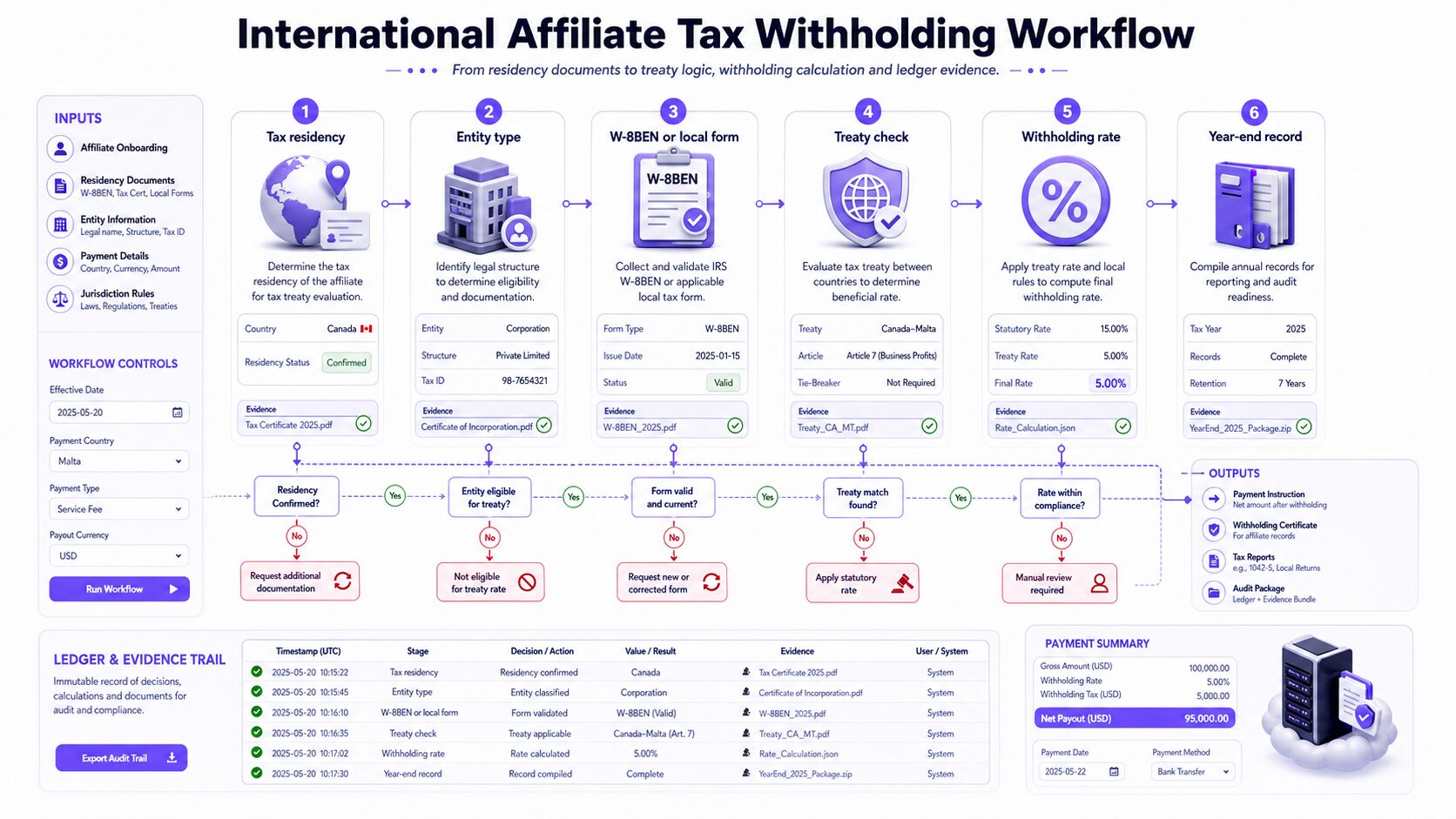
Our visual models cross-border payout tax workflow using residency documentation, treaty logic and ledger evidence. The international affiliate tax w-8ben or local form map is intentionally operational: every node should correspond to a field, rule, queue or review state that an affiliate manager can inspect.
- Tax residency. For international affiliate tax w-8ben or local form, this is a distinct control state with its own owner, timestamp, evidence link and pass, review or fail outcome.
- Entity type. For international affiliate tax treaty check, this is a distinct control state with its own owner, timestamp, evidence link and pass, review or fail outcome.
- W-8BEN or local form. For international affiliate tax withholding rate, this is a distinct control state with its own owner, timestamp, evidence link and pass, review or fail outcome.
- Treaty check. For international affiliate tax year-end record, this is a distinct control state with its own owner, timestamp, evidence link and pass, review or fail outcome.
- Withholding rate. For international affiliate tax tax residency, this is a distinct control state with its own owner, timestamp, evidence link and pass, review or fail outcome.
- Year-end record. For international affiliate tax entity type, this is a distinct control state with its own owner, timestamp, evidence link and pass, review or fail outcome.
The international affiliate tax treaty check sequence is not cosmetic. Evidence captured after a international affiliate tax withholding rate decision cannot reliably prove what the reviewer saw beforehand. We therefore time-stamp the international affiliate tax year-end record input, applicable rule and output separately.
What the International Affiliate Tax data contract must contain
The data contract for international affiliate tax tax residency should specify required fields, accepted values, event time, processing time, idempotency key and the owner of every exception queue. A international affiliate tax entity type field that merely exists is not necessarily trustworthy; it also needs provenance and a validation rule.
For international affiliate tax w-8ben or local form, we begin with event_id, event_type, occurred_at, affiliate_id, click_id, player_key, brand_id, geo and rule_version. Attributes for tax residency, entity type and w-8ben or local form sit inside a versioned payload. That international affiliate tax treaty check envelope keeps reporting stable while the workflow evolves.
SaaS warning: never overwrite the raw international affiliate tax withholding rate event with its latest interpreted status. Preserve the source event, append its decisions and record who or what changed the international affiliate tax year-end record outcome.
Build International Affiliate Tax around accountability, not screenshots alone
A international affiliate tax tax residency screenshot is useful evidence, but it is weak without the URL, capture time, geo, device, affiliate owner and policy version. Our preferred international affiliate tax entity type record links the rendered creative to the campaign and to the approval or exception that followed. That turns a international affiliate tax w-8ben or local form picture into an auditable sequence.
- Define international affiliate tax treaty check scope. Record jurisdictions, brands, channels and affiliate entities covered by the international affiliate tax withholding rate control.
- Set international affiliate tax year-end record preventive gates. Block unapproved international affiliate tax tax residency combinations before a tracking link or creative goes live.
- Monitor international affiliate tax entity type continuously. Re-crawl pages and re-evaluate international affiliate tax w-8ben or local form campaign evidence after changes.
- Assign international affiliate tax treaty check remediation. Give each international affiliate tax withholding rate exception a severity, owner and due date.
- Retain the international affiliate tax year-end record decision trail. Keep international affiliate tax tax residency evidence for the period required by the relevant rule and business need.
How we stage a International Affiliate Tax implementation
Days 1-5: baseline. For international affiliate tax w-8ben or local form, sample live records, quantify missing identifiers and list every current manual adjustment. Preserve the international affiliate tax treaty check baseline query so the post-launch comparison uses the same definitions.
Days 6-12: contract. Agree the international affiliate tax withholding rate event schema, rule precedence, data retention, access roles and exception states. Use synthetic international affiliate tax year-end record records to test each accepted and rejected path before connecting money movement or enforcement.
Days 13-21: shadow mode. Run the new international affiliate tax tax residency logic beside the existing process without allowing it to trigger irreversible actions. Review international affiliate tax entity type mismatches daily, classify their causes and change either the implementation or the documented rule.
Days 22-30: controlled cutover. Enable international affiliate tax w-8ben or local form for a limited brand, geo or affiliate cohort, monitor both operational and financial guardrails, then expand only after the acceptance criteria hold for a complete reporting cycle.
The International Affiliate Tax dashboard we would give an affiliate manager
For international affiliate tax treaty check, one screen should answer five questions: what changed, how much is affected, which rule applied, who owns the next action and whether the evidence is complete. A international affiliate tax withholding rate chart without those answers belongs in analysis, not in the operating queue.
We pair a international affiliate tax year-end record trend with a case list. Its international affiliate tax tax residency trend shows volume, rate and a stable denominator; its list exposes individual records with filters for brand, geo, affiliate, channel, rule version and severity. Restrict international affiliate tax entity type export permissions, while preserving searches, approvals and material configuration changes in the audit record.
Primary references used for this operating note
- IRS: reporting payments to independent contractors
- IRS: Form W-8BEN instructions
- IRS: Form 1099-MISC and 1099-NEC instructions
Final operator view
International Affiliate Tax works when policy, event data, commercial logic and evidence share the same identifiers. That international affiliate tax w-8ben or local form standard is how we design affiliate operations that can survive both scale and scrutiny.
Explore how iGamingxpert affiliate software can centralise international affiliate tax treaty check, its evidence and its operator reporting without turning each exception into a spreadsheet project.
