10 Best Affiliate Tracking Platform Options for 2026

iGaming affiliate tracking requires a focus on reconciliation, fraud prevention, and audit-ready compliance over basic click tracking, with iGamingXpert, Scaleo, Affise and Income Access (Paysafe) emerging as leading solutions tailored for regulated markets. While iGamingXpert offers modern, unified architecture with built-in GDPR and data residency controls for high-volume operators, Income Access provides established, multi-brand support and optional managed services. Scaleo is designed speficially for iGaming and has AI agents.
Affiliate tracking software is expanding quickly across digital commerce, but market growth is only a loose indicator for iGaming buyers. The more useful question is operational fit. Across the operator and network environments monitored by iGamingXpert, which process over $2.4B in annual volume, platform performance diverges less on basic click tracking than on reconciliation accuracy, fraud handling, and the ability to produce regulator-ready records under audit.
That distinction matters because an iGaming affiliate platform sits inside revenue attribution, partner accounting, and compliance operations at the same time. A weak implementation does more than create reporting noise. It can misstate affiliate margin, overpay on low-quality traffic, and leave compliance teams rebuilding consent history and event chains from fragmented logs.
An affiliate tracking platform functions as the control layer for partner acquisition. At a minimum, it should record clicks, registrations, first-time deposits, and downstream revenue with low latency, calculate commission logic correctly, and give affiliates a portal they consider credible. For regulated gambling operators, those baseline functions do not determine platform quality on their own.
Our benchmarking across iGamingXpert client environments points to a clearer evaluation model. Generic affiliate software is usually assessed on feature breadth. iGaming teams tend to succeed or fail on a narrower set of operational requirements that have direct financial and regulatory consequences.
- Tracking integrity: S2S postbacks, pixel support, event-level logging, and timestamp consistency that preserve attribution during browser privacy changes and cross-device journeys.
- Commission precision: CPA, RevShare, Hybrid, tiered structures, negative carry settings, deal exceptions, and reconciliation logic that match real commercial terms.
- Fraud prevention: Bot screening, duplicate conversion controls, geo and device mismatch checks, and rule-based review before traffic becomes payable commission.
- Partner operations: White-label portals, link generation, reporting access controls, and payout visibility that reduce disputes and support scale.
Regulated iGaming adds a second set of requirements that many broad-market reviews underweight.
- Compliance evidence: GDPR workflows, consent records, audit logs, and retention controls that can be exported and reviewed by internal teams or regulators.
- Data residency: Infrastructure and storage controls aligned with jurisdiction-specific requirements for player and behavioral data.
- Portfolio management: Multi-brand, multi-market, and multi-currency administration from a single system instead of isolated setups that increase reconciliation overhead.
Many reviews stop at whether a platform tracks clicks and conversions. That approach overlooks the core problem. Operators need to know whether attribution remains accurate when data residency rules, approval workflows, audit-log retention, finance reconciliation, and affiliate disputes all intersect. That is the standard used in this guide, and it is the only useful standard for EU, UK, and North American iGaming programs operating under sustained regulatory scrutiny.
1. iGamingXpert
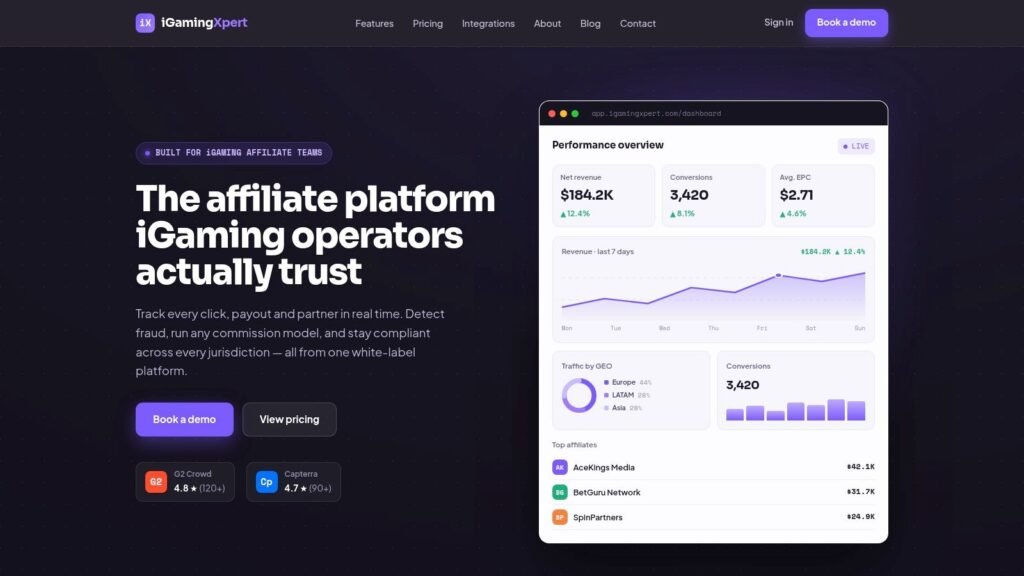
iGamingXpert is the clearest example of what an iGaming-native affiliate tracking platform looks like when the architecture starts with operator risk, not generic partner marketing. It consolidates tracking, commission accounting, fraud controls, reporting, payouts, and compliance workflows into one white-label system built for regulated gambling operators and affiliate networks.
Its core strength is operational unification. Instead of stitching together a tracker, finance spreadsheet, payout layer, and portal, operators get one environment for clicks, conversions, revenue, and partner accounting. That matters because digital marketing agencies and e-commerce platforms account for over 70% of affiliate tracking software usage in 2024, which means many mainstream tools are still shaped by non-gambling workflows rather than the reporting and reconciliation complexity iGaming teams live with every day, according to affiliate tracking adoption data from We Can Track.
Why it stands out in regulated markets
iGamingXpert’s strongest differentiator is that compliance isn’t bolted on. GDPR controls, consent capture, audit logs, and data residency configuration are part of the product model. For operators dealing with multi-jurisdiction programs, that’s the difference between “privacy friendly” marketing language and an auditable system that legal and compliance teams can use.
The platform also supports multi-brand and multi-currency operations across 180+ countries, with a REST API, real-time webhooks, postbacks, and pixel tracking for event delivery across the wider stack. That design aligns with a market where cloud-based infrastructure already holds a 92.8% share of the global iGaming platform market in 2024, largely because operators need centralized control across brands, currencies, and regulated geographies.
Practical rule: In iGaming, the best tracker isn’t the one with the most dashboard widgets. It’s the one finance, affiliates, and compliance can all trust without exporting the same data into three separate systems.
Operator fit
iGamingXpert reports $2.4B in annual tracked volume, 99.99% uptime targets, and sub-40 ms event latency targets on its website. It also supports CPA, RevShare, Hybrid, and CPL structures, plus sub-affiliate hierarchies and master-affiliate oversight, which makes it suitable for operator programs and network models alike.
A few tradeoffs are clear.
- Best for enterprise and regulated programs: The feature depth is strongest where auditability and multi-entity reporting matter.
- Less transparent on pricing: Commercial terms require a sales conversation, which may slow evaluation for smaller teams.
- Potentially too much platform for very small operators: If a program is early-stage and lightly regulated, some of the control surface may be more than it needs.
The result is straightforward. If you want a purpose-built affiliate tracking platform for regulated iGaming rather than a horizontal tool configured into shape, iGamingXpert is the most complete option on this list.
2. Income Access (Paysafe)

Income Access remains one of the longest-standing names in iGaming affiliate infrastructure. That history matters because affiliates already know the brand, and operators with sportsbook, casino, and lottery portfolios often value familiar reporting conventions over newer UX patterns.
Its appeal is less about novelty and more about operating depth. Income Access combines software with the option to layer in network reach and managed services, which can help operators that don’t want to build every function internally. For teams running multiple brands and geographies, the centralized back office is still a practical strength.
Where it still fits well
Income Access handles the structures iGaming teams negotiate.
- Multi-brand administration: It supports centralized control across brands, channels, and geographies.
- Commercial flexibility: CPA, RevShare, and Hybrid models are standard, which is still the minimum requirement for regulated gambling programs. Operators comparing deal structures can use this guide to managing hybrid CPA and RevShare models as a useful benchmark.
- Broader service layer: The ability to combine software, network access, and agency support can reduce internal staffing pressure.
That bundled approach can be a decisive advantage for operators that want operational support as much as technology.
Watch the tradeoff
The main drawback is that legacy maturity often shows up as workflow friction. Teams used to newer SaaS products may find the interface and administrative flow less efficient than newer platforms built around live dashboards and more modern user patterns.
Income Access is strongest when operator stability matters more than interface elegance.
Pricing also tends to sit above what smaller programs can justify. If you need deep iGaming heritage and potentially managed support, that premium may make sense. If you want a faster-moving, product-led platform with stronger compliance visibility built into the day-to-day workflow, other options on this list are likely to feel more current.
3. NetRefer
NetRefer has long been positioned as an enterprise iGaming platform rather than a general affiliate tool trying to serve gambling as one vertical among many. That shows up in the product’s configurability, especially around role-based access, partner portal controls, and reporting depth.
For operators with mature internal teams, NetRefer can be attractive because it exposes enough administrative structure to mirror the complexity of a real-world affiliate program. Casino and sportsbook programs with multiple entities, varied local rules, and layered partner agreements tend to need exactly that.
Why enterprise teams still shortlist it
NetRefer’s practical strength is report maturity. Teams that care about granular KPIs, configurable workflows, and custom integrations usually find more room to shape the system around their operating model than they would in lighter products.
A few specific advantages stand out.
- iGaming-first product design: Its reporting and workflow model is closer to regulated gambling operations than to retail affiliate programs.
- Configurable access controls: Useful for separating finance, affiliate, BI, and compliance permissions.
- Predictable commercial structure: Fixed subscription pricing is often easier for procurement teams to model than highly customized usage-based terms.
That combination makes NetRefer a serious option for top-tier operators that prioritize governance and structured implementation.
Best used with technical ownership
NetRefer isn’t a “switch it on and go” product for many teams. The same customization depth that enterprise buyers like can also create a heavier setup burden, especially if internal admins don’t have strong process discipline.
In practice, that means NetRefer fits best when an operator already knows how it wants to run the affiliate department. Teams that are still defining reporting logic, commission governance, or integration patterns may find the platform powerful but demanding. The product rewards operational maturity more than experimentation.
4. MyAffiliates

MyAffiliates is widely recognized in iGaming because it solves a common operator problem cleanly. One affiliate program rarely maps to one brand. Casino groups and sportsbook portfolios need umbrella-level management, and MyAffiliates has long centered that requirement.
The platform is particularly useful for operators that want unified reporting across multiple gaming brands without building a custom reporting layer around fragmented systems. It also gives substantial weight to reconciliation and finance-facing workflows, which is often where affiliate tools reveal whether they were built for operators or just for marketers.
What makes it practical
MyAffiliates balances partner-facing and operator-facing functionality well.
- Umbrella management: Multiple brands can sit under one system with consolidated reporting.
- Commission flexibility: It supports the standard iGaming range of commission plans and financial reconciliation.
- Affiliate usability: Media management, creatives, and the affiliate portal are all part of the core experience.
That combination helps when an operator needs one system that affiliate managers, finance staff, and partners can all use without constant manual intervention.
Where caution is warranted
MyAffiliates is operator-friendly, but it isn’t necessarily lightweight. Complex migrations can take time, especially for programs moving from homegrown tools or older legacy platforms with inconsistent historical data.
It also doesn’t publish pricing publicly, so buyers need a scoping conversation before they can model total cost. That’s normal in this category, but it does slow initial comparison. For established operators that need a proven multi-brand platform, MyAffiliates remains a credible short-list option.
5. Cellxpert
Cellxpert sits in an interesting position because it serves both iGaming and financial services. That overlap matters. Both sectors deal with regulated acquisition, partner oversight, and pressure to separate quality traffic from traffic that only looks good at the click level.
The product leans into real-time multi-brand reporting, granular partner controls, and a self-service affiliate hub. For operators that want a more modern user experience without giving up regulated-market discipline, Cellxpert is one of the cleaner options in the market.
Compliance fit is part of the appeal
Cellxpert’s strongest angle is workflow alignment with regulated operations. It doesn’t market itself as a generic creator platform or broad partner ecosystem first. It focuses on performance reporting, control surfaces, and partner governance that compliance-sensitive teams utilize.
That makes it well suited for operators that want:
- Real-time dashboards: Faster intervention when partner traffic quality shifts.
- Granular controls: More precise governance across brands, markets, and partner types.
- Self-service access: Affiliates can manage creatives, links, and payment visibility without constant manual support.
A modern interface matters here more than it sounds. Better visibility reduces the chance that account managers rely on exported spreadsheets to answer simple partner questions.
If a platform’s live view isn’t trustworthy, teams revert to offline reconciliation. That’s usually where reporting delays and partner disputes start.
The main limitation
Like most enterprise-oriented products in this category, Cellxpert doesn’t publish public pricing. It also tends to require guided onboarding when the deployment involves complex data models or integrations. That isn’t a flaw. It’s the profile of a platform aimed at regulated organizations rather than low-touch self-serve buyers.
6. PartnerMatrix (EveryMatrix)
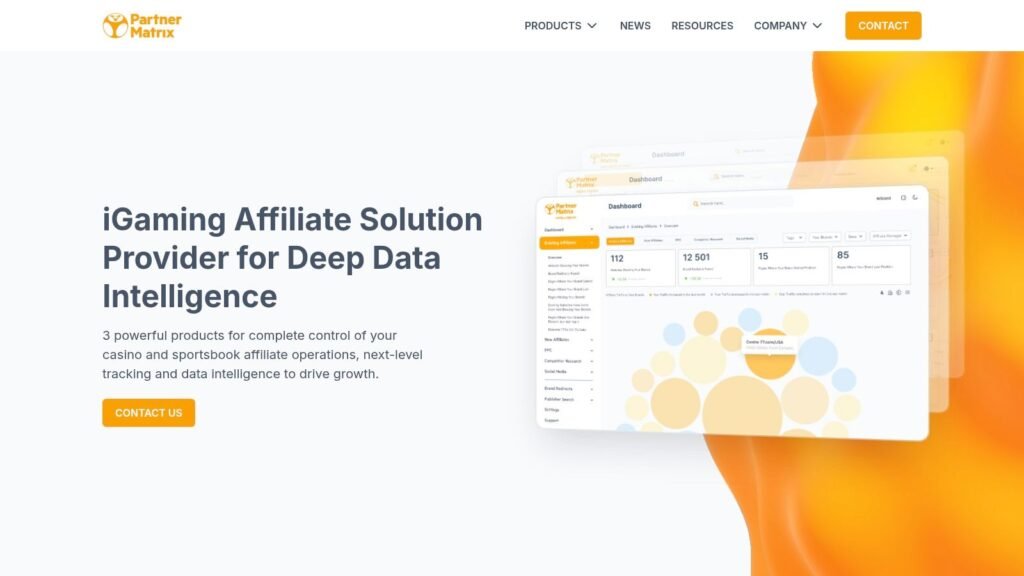
PartnerMatrix benefits from being part of the EveryMatrix ecosystem. For operators already using EveryMatrix infrastructure, that can remove a lot of integration friction and shorten the path from traffic event to revenue visibility.
The suite is modular. There’s the core affiliate platform, an intelligence layer for analytics, and an agent system for offline or agent-led acquisition. That last point is unusually relevant in iGaming, where not every acquisition path is purely digital and not every market operates with the same partner mechanics.
Why modularity matters here
PartnerMatrix gives operators options rather than forcing one deployment shape. That’s useful when the affiliate program spans direct online affiliates, media partners, and agent-led channels that need different tracking and governance treatment.
The practical benefits include:
- Real-time analytics and fraud monitoring: More responsive optimization and traffic oversight.
- Multi-brand, multi-geo support: Better fit for operators with regionally segmented business units.
- Agent-system capability: Relevant if acquisition includes offline or hybrid partner models.
That modular approach is one of its strongest differentiators compared with tools that only assume a standard digital affiliate workflow.
Best fit scenario
PartnerMatrix is most compelling if you already value or use the EveryMatrix stack. As a standalone evaluation, it’s still credible, but the ecosystem fit is part of the product’s real advantage. Pricing is customized, so buyers need to validate whether they’re paying for modular flexibility they’ll use.
For operators with mixed acquisition models and a broad gaming product mix, that flexibility can be worth it. For simpler affiliate programs, it may feel broader than necessary.
7. Affilka by SOFTSWISS
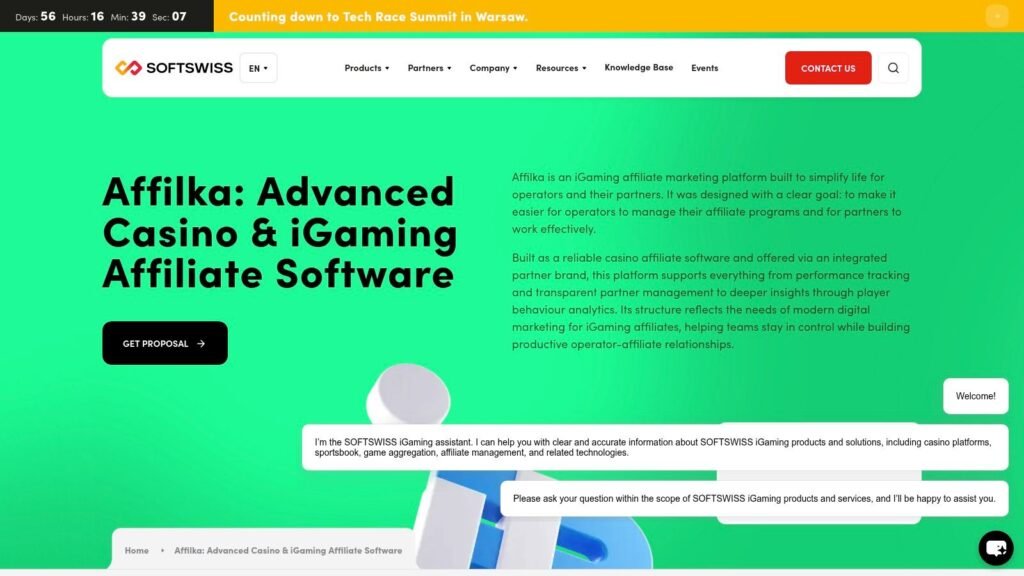
Affilka by SOFTSWISS is one of the more accessible iGaming-native platforms on this list. It’s designed around casino and sportsbook affiliate workflows, but it presents them in a way that feels less heavy than some of the older enterprise systems.
A major reason operators consider it is onboarding simplicity. SOFTSWISS has positioned Affilka around straightforward setup, a modern affiliate portal, and no setup fees, which can make it attractive to mid-market teams that want iGaming-specific functionality without a more involved enterprise implementation.
Where it performs well
Affilka covers the mechanics most operators need from day one.
- Standard iGaming commission models: CPA, RevShare, and Hybrid are supported.
- White-label affiliate experience: Useful for operator branding and partner trust.
- Ecosystem integration: Especially strong if the wider stack already includes SOFTSWISS components.
That ecosystem fit can make deployment significantly smoother for operators already aligned with the broader platform family.
What to keep in mind
Affilka is usable outside the SOFTSWISS stack, but the strongest operational advantage appears when the rest of the environment already lives nearby. If your CRM, gaming platform, and reporting environment are elsewhere, the product still works, but some of the convenience premium may diminish.
Pricing specifics aren’t publicly listed, so direct validation is necessary. Even so, for operators that want a modern iGaming-focused affiliate tracking platform without the feel of a legacy enterprise deployment, Affilka is a sensible candidate.
8. Scaleo

Across the operator programs benchmarked by iGamingXpert, tracking reliability drops fastest where platforms still depend too heavily on browser-side logic. That is why Scaleo deserves attention from technical affiliate teams. Its iGaming edition is built around real-time reporting, server-to-server postbacks, targeting controls, and an interface that is easier to work with than many legacy affiliate systems.
For iGaming operators, that architectural choice matters more than the marketing copy. Attribution in regulated gambling is already complicated by cross-device journeys, geo-specific offer rules, and compliance constraints around traffic sources. A platform that treats postback tracking as a core design principle usually holds up better under those conditions. Teams comparing implementation models should understand the operational difference between postback and callback tracking in affiliate attribution, especially before mapping events into CRM and BI workflows.
Where Scaleo fits best
Scaleo is usually a better fit for operators that want a configurable tracking layer without buying into a heavier enterprise stack or a network-led operating model.
A few capabilities stand out:
- Server-to-server and pixel tracking: Useful for improving measurement resilience when browser restrictions interfere with client-side attribution.
- Granular targeting logic: Relevant for iGaming programs where conversion quality can vary sharply by country, brand, device type, or traffic segment.
- API and webhook support: Helpful for pushing affiliate events into internal reporting, fraud checks, and finance reconciliation processes.
That combination makes Scaleo more attractive to technically involved affiliate managers and product teams than to operators that rank marketplace access, managed services, or bundled partner recruitment higher.
What to verify before procurement
Scaleo’s public pricing references are not always consistent, so commercial validation should happen early. Operators should also test how well the platform supports their approval workflows, event mapping, and exception handling for negative carry, hybrid deals, and country-level compliance restrictions.
The other consideration is market footprint. Scaleo offers modern mechanics, but it does not carry the same incumbent presence in iGaming as platforms built specifically around long-standing operator networks. For teams that already have affiliate acquisition under control and need cleaner infrastructure, that is rarely a problem. For teams expecting the platform itself to contribute to partner discovery, it can be.
9. Everflow

Everflow is the most horizontal platform in this list, but that isn’t a weakness by default. For some operators, especially those managing affiliates alongside paid media and other acquisition channels, a broader partner and attribution stack can be useful.
Its advantage is cross-channel visibility. Everflow doesn’t just think in terms of affiliate links. It also supports integrations for paid channels, cohorting, first-party tracking options, reporting exports for BI teams, and Everflow Pay for partner invoicing and payouts. If your affiliate department sits close to a broader performance marketing organization, that architecture can reduce stack sprawl.
Where it can outperform narrower tools
Everflow is worth serious attention when the requirement is “one system for affiliate plus in-house media measurement.” That’s not the same problem most legacy iGaming tools were designed to solve.
A few points stand out:
- Cross-channel attribution: Useful when operators want affiliate data in the same analytical frame as Google, Facebook, or TikTok activity.
- Strong analytics layer: Better fit for BI-heavy environments.
- Payout workflow support: Helpful for finance process consolidation.
For technical teams reviewing implementation design, this comparison of postback vs callback tracking is useful context because Everflow’s value depends heavily on getting event architecture right from the start.
Where the fit becomes weaker
Everflow isn’t iGaming-specific in its default product logic. That means gambling compliance requirements usually need to be configured rather than presented as native vertical workflows. In heavily regulated environments, that can increase implementation work and governance overhead.
It also operates on custom pricing with a minimum commitment, so it’s best suited to operators that already know they need enterprise-scale breadth rather than a narrow affiliate-only solution.
10. Affise

Affise sits in a different category from the iGaming-native platforms ranked above. Across programs we review at iGamingXpert, the strongest fit appears in operators that prioritize API control, custom data flows, and partner program flexibility over built-in gambling workflows. That tradeoff can work well, but only when the implementation team is prepared to define the governance model itself.
The product is strongest at the infrastructure layer. Affise supports S2S postbacks, configurable attribution logic, white-label partner interfaces, automated billing processes, and granular permissioning. For affiliate networks, multi-brand operators, or acquisition teams that already run a broader partner ecosystem, that architecture can reduce manual reconciliation and make custom reporting easier to maintain.
A second differentiator is partner recruitment. Affise Reach adds discovery capabilities that matter more than many platform comparisons admit, especially for operators entering new geographies or rebuilding supply after compliance-driven partner churn. In practice, recruitment tooling has outsized value when the affiliate team is measured on new depositing player volume, not just reporting accuracy.
Where Affise fits best in iGaming
Affise tends to score better in iGaming reviews where the buyer has technical depth in-house and does not need every gambling-specific control to be native on day one.
- Flexible attribution setup: Useful for operators managing mixed CPA, hybrid, and multi-touch partner arrangements.
- Permission and workflow control: Helpful in environments with separate views for finance, affiliate managers, and external partners.
- API-led implementation model: Better suited to teams that plan to push affiliate data into BI, CRM, or internal risk systems.
Cookie loss and browser restrictions make that architecture more relevant. Operators that still depend too heavily on client-side methods usually see attribution quality degrade over time, particularly across longer consideration cycles and cross-device journeys. For teams assessing whether Affise’s server-side model is enough for their setup, this guide to cookieless attribution for affiliate programs provides useful technical context.
The constraint operators should assess early
Affise can support iGaming programs effectively, but compliance coverage is not framed around gambling operations by default. That changes the implementation burden. Teams must confirm how promo controls, auditability, jurisdiction-specific restrictions, and exception handling will be managed before launch, not after partner volume scales.
That is the main reason Affise often performs better for advanced operators than for teams seeking an out-of-the-box iGaming operating model. In our evaluation framework, it is a strong platform for customization-heavy environments and a weaker fit where regulatory process design needs to be embedded directly in the product.
Top 10 Affiliate Tracking Platforms Comparison
| Platform | Core features | UX & Quality (★) | Price & Value (💰) | Target Audience (👥) | Unique Selling Points (✨) |
|---|---|---|---|---|---|
| iGamingXpert 🏆 | Real-time tracking, multi-brand & multi-currency, flexible CPA/RevShare/Hybrid/CPL, fraud & compliance, API/webhooks | ★4.8/5 · 99.99% uptime · <40 ms latency | 💰Custom/tiered, consolidates multiple tools for ROI | 👥 Operators, affiliate managers, networks, compliance teams | ✨Compliance-first, $2.4B tracked annually, white‑label portal, sub-affiliate hierarchies |
| Income Access (Paysafe) | Centralized admin, deep reporting, flexible commissions, optional managed services/network | ★≈4+ · Mature/legacy workflows | 💰Premium, software + optional managed services | 👥 Regulated operators seeking agency/network support | ✨Longstanding iGaming expertise + managed agency options |
| NetRefer | Extensive KPIs/reports, customizable workflows, role-based portals, enterprise support | ★≈4+ · Enterprise-grade reporting | 💰Fixed subscription, predictable budgeting | 👥 Top-tier regulated operators | ✨iGaming-first DNA with predictable pricing and onboarding support |
| MyAffiliates | Multi-brand umbrella, real-time data, financial reconciliation, 24/7 support | ★≈4+ · Operator-focused UX | 💰Setup + monthly, transparent fee model | 👥 Multi-brand operators needing reliable ops | ✨Transparent pricing language + 24/7 support |
| Cellxpert | Real-time dashboards, granular deals, compliance tooling, self‑service affiliate hub | ★≈4+ · Modern UI/UX | 💰Custom pricing, demo required | 👥 Regulated gaming & financial services operators | ✨Compliance-friendly for gambling/finance with modern UX |
| PartnerMatrix (EveryMatrix) | Modular suite (Affiliate, Intelligence, Agent), real‑time analytics, fraud monitoring | ★≈4+ · Integrates with EveryMatrix stack | 💰Custom, modular packaging | 👥 Operators aligned with EveryMatrix or multi‑geo programs | ✨Modular design + Agent System for offline acquisition |
| Affilka (SOFTSWISS) | iGaming tracking, white-label portal, flexible payouts, SOFTSWISS integrations | ★≈4+ · Streamlined onboarding | 💰No setup fees; pricing varies | 👥 Operators on SOFTSWISS stack or external setups | ✨No setup fees + deep SOFTSWISS ecosystem alignment |
| Scaleo | S2S postbacks & pixel, granular targeting, multi-brand, API/webhooks | ★≈4+ · Contemporary UX, strong docs | 💰Competitive, confirm directly | 👥 New programs, technical teams, fast deployments | ✨Quick time‑to‑value and excellent technical documentation |
| Everflow | Cross-channel attribution, cohort analytics, fraud tools, Everflow Pay payouts | ★≈4+ · Enterprise scale, SOC2‑aligned | 💰Custom; 6‑month min commitment | 👥 Programs combining paid media + affiliates | ✨Cross-channel + managed payouts (Everflow Pay) |
| Affise | Campaign tracking, anti-fraud, white-label portals, API-first | ★≈4+ · Network & agency features | 💰Transparent tiers (varies) | 👥 Networks, agencies, performance teams | ✨Partner discovery (Affise Reach) and automated billing/payouts |
From Evaluation to ROI Activating Your Platform
Affiliate marketing spend is scaling faster than many operator workflows. The channel was valued at $27.8 billion in 2023 and is projected to reach $71.74 billion by 2034, with a 15.2% CAGR. In the United States, spending reached $9.56 billion in 2023 and is projected to rise to $12 billion in 2025, with the market accounting for a 38% global share from the same source. For iGaming operators, that growth changes the cost of a poor platform decision. A tracking error that looked tolerable at low scale becomes a recurring margin leak once partner volumes, regulatory checks, and payout complexity increase.
Our benchmark data at iGamingXpert supports that pattern. Across more than $2.4B in annual tracked volume, the strongest programs are rarely distinguished by feature count alone. They outperform because attribution logic, compliance controls, finance rules, and fraud response are aligned before traffic scales. Operators that treat platform selection as a procurement exercise often discover the true cost later, during reconciliation disputes, player-value disputes, and audit requests.
What to ask before you sign
A useful evaluation process stress-tests operating fit, not just the UI.
- Attribution method: Ask how the platform handles server-to-server tracking, click ID retention, event deduplication, and fallback logic when browser-level identifiers drop.
- Compliance evidence: Ask what consent and processing records are stored, how data residency is configured, and how quickly the team can reconstruct an affiliate conversion path for a regulator or payment partner.
- Fraud response window: Ask which controls act before commission liability is created, including device risk, duplicate account patterns, velocity anomalies, and postback manipulation.
- Commercial logic across entities: Ask how the platform maps one affiliate across multiple brands, licenses, currencies, and commission models without forcing manual finance work.
The technical direction of the category makes those questions more than operational preference. The affiliate marketing tracking software market is projected to reach nearly USD 1.74 billion by 2033 at roughly a 10.89% CAGR, driven by the shift from cookie-based tracking toward server-to-server attribution and more automated decisioning. For regulated operators, that shift has a direct implication. Tracking architecture is now part of risk control, not just partner reporting.
Implementation determines whether the ROI shows up
Migration should be run like a data controls project with commercial dependencies. In practice, that means sequencing the work so attribution accuracy, payout logic, and affiliate trust are validated before the old environment is retired.
- Data mapping and cleansing: Standardize affiliate IDs, campaign taxonomies, CPA and rev-share terms, negative carry settings, and historical revenue relationships.
- Technical configuration: Set up postbacks, APIs, event schemas, pixel contingencies, and downstream reporting before live traffic is redirected.
- Partner transition: Give affiliates updated links, reporting expectations, and payment rules early enough to prevent reporting disputes in the first settlement cycle.
- Parallel validation: Run the new platform against the legacy setup long enough to identify discrepancies by source, device, geo, and event type.
- Go-live control period: Review variance, missing events, approval timing, and finance exceptions aggressively in the first weeks.
In iGaming, implementation quality carries more weight because attribution paths are noisier. Mobile traffic dominates many affiliate portfolios, user journeys often cross app and web environments, and registration, KYC, first deposit, and wagering events may sit across different systems. That is one reason our internal benchmarks show that operators get faster payback from platforms that reduce manual reconciliation, not just from platforms that add more dashboards.
Real-time event processing has outsized value in sports betting and casino acquisition because latency limits fraud intervention and weakens live decision-making, a point illustrated by Ververica’s analysis of millisecond-level event streaming in sports betting.
KPIs that actually change decisions
Clicks, registrations, and headline CPA figures are too shallow for mature affiliate programs. The more informative set is downstream and financial.
Track player LTV by affiliate cohort, FTD-to-depositor conversion rate, bonus cost relative to net gaming revenue, bet-to-revenue variance, approval reversal rate, and EPC after deductions. Those metrics isolate whether a partner is producing retained value or sending volume that deteriorates after fraud checks, bonus abuse, or low-quality retention curves are applied. On iGamingXpert data, that distinction is often where apparent top performers fall several places once net contribution is measured instead of front-end conversion.
Ownership also matters. Teams get better outcomes when AI and ML initiatives are defined around measurable operating targets such as earlier fraud detection, lower approval error rates, and cleaner traffic scoring, rather than broad innovation goals. SoftServe’s perspective on AI adoption in casinos, iGaming, and sports betting makes the same point from a product and delivery angle.
A platform produces ROI when it reduces uncertainty across four functions. Acquisition trusts attribution. Finance trusts commissions. Compliance can reconstruct the record. Affiliates trust the ledger enough to keep sending high-intent traffic.
If your program is outgrowing spreadsheets, disconnected trackers, or generic partner software, iGamingXpert is one of the few platforms built specifically for regulated gambling from the ground up. It gives operators a single system for real-time tracking, commission accounting, fraud prevention, data residency control, and affiliate self-service, without forcing compliance and reporting into separate tools.
