7 Anti-Fraud Tools for Affiliate Marketers That Really Save Revenue in 2026

Top anti-fraud solutions for iGaming affiliate marketers focus on detecting bonus abuse, multi-accounting, and synthetic traffic rather than just standard click fraud. Top dedicated tools include Track360, Anura, TrafficGuard, Sumsub, and integrated iGaming platforms like PartnerMatrix or Scaleo.
Invalid affiliate traffic is a large enough problem that one industry source estimates it makes up roughly 45% of affiliate traffic globally. In iGaming, wasted media spend is only part of the cost. It distorts the operating metrics affiliate teams use to judge GEO quality, negotiate commission terms, approve CPA payouts, and decide which partners are driving first-time depositors.
Generic anti-fraud tools often underperform in iGaming because the funnel is longer and economically uneven. A click has little value on its own. Registration quality matters more. First-time deposit matters more than registration. Active player value determines whether the acquisition source was profitable at all. Fraud follows that same structure. Bot traffic inflates click and registration volume. Cookie stuffing hijacks attribution close to conversion. Multi-accounting, bonus abuse, and synthetic identities degrade FTD quality. KYC manipulation can keep that traffic looking acceptable until retention, chargebacks, or withdrawal reviews expose the pattern.
The iGaming environment is more complex.
Inside iGamingXpert, the more useful lens is conversion integrity at each stage of the funnel: click to registration, registration to deposit, and FTD to active player. That framework changes how anti-fraud software should be evaluated. A tool that is strong at filtering invalid clicks but weak on attribution abuse will protect top-line reporting while still allowing commission leakage. A tool that catches bot sessions but cannot help explain post-FTD quality decay will miss the fraud types that matter most to operator economics.
Platform-side analysis usually makes these gaps visible early. Reg-to-Deposit compression by affiliate, EPC divergence by GEO, abnormal conversion timing, and weak post-FTD activity are stronger fraud indicators than raw registration growth. If a partner scales clicks and sign-ups while deposited-player value deteriorates, the issue is often traffic quality rather than reach. If EPC improves in a GEO while conversion rate declines, analysts should test for attribution theft, cookie interference, or branded search cannibalization before rewarding the affiliate with more budget.
The primary gain from fraud tooling is better control over conversion points that determine payout and lifetime value. For iGaming affiliate managers, that means choosing tools based on what they protect in the funnel, what evidence they produce for disputes and reversals, and how well they fit the operational realities of Reg-to-Deposit, FTD validation, and active player quality.
1. iGamingXpert

At scale, affiliate fraud is rarely a click-quality problem alone. It shows up as distorted Reg-to-Deposit rates, inflated FTD counts, weak retained-player value, and payout disputes that take longer to resolve than the traffic was worth in the first place. That is why iGamingXpert stands out. It was built around the operating model of regulated iGaming programs rather than around traffic filtering in isolation.
The distinction matters in day-to-day affiliate management. A bot filter can block invalid sessions, but it does not help much if the actual loss comes from attribution abuse, duplicate accounts, bonus hunting, or partner traffic that converts to registration and then collapses before deposit. iGamingXpert combines tracking, attribution, fraud controls, commission accounting, compliance records, and partner management in one white-label system. For teams handling multiple brands, currencies, and deal structures, that consolidation closes the gaps where conversion fraud usually survives.
Its architecture is also aligned with how iGaming programs make approval decisions. The platform supports real-time reporting, multi-brand and multi-currency operations, CPA, RevShare, Hybrid, and CPL models, plus sub-affiliate and multi-tier setups. Operationally, that matters more than a long feature list. Fraud reviews in this sector are tied to whether a registration should become an approved FTD, whether a CPA should be released, and whether a partner should stay on the same commercial model after quality review.
Best fit in the funnel
iGamingXpert is strongest when you assess fraud by conversion point instead of treating every anomaly as the same event.
At the click-to-registration stage, it helps screen invalid or low-intent traffic before that traffic pollutes channel reporting. That includes patterns commonly associated with bot traffic, duplicate sessions, and source-quality manipulation.
At the registration-to-deposit stage, the value is attribution integrity. Server-to-server postbacks and pixel-based tracking help reduce loss from broken browser attribution, while affiliate-level reporting makes it easier to isolate sources with strong registration volume but weak deposit completion. In practice, that is often where managers first spot incentive abuse, misdeclared traffic sources, or funnel leakage caused by poor player quality rather than weak landing pages.
At the FTD-to-active-player stage, the platform is more useful than many standalone fraud tools because it lets managers compare EPC, conversion timing, GEO performance, and downstream value by partner, brand, and campaign. That is the level where non-obvious fraud patterns appear. A source can look acceptable on registrations and still destroy margin if deposited players churn immediately, show abnormal activity curves, or never reach expected value bands.
Payout control is the final layer. Audit logs, consent capture, and compliance workflows give teams evidence for reversals, holds, and partner disputes. In regulated markets, that documentation is often as important as the initial fraud flag.
Why experienced affiliate teams use it
The platform fits operators that need auditable decisioning across several brands or regulated GEOs, not just a traffic-scoring widget. That makes it particularly useful for programs where fraud review sits inside broader approval workflows and where commercial terms need to change based on player quality. If an affiliate produces registrations but weak retained-player value, the right response is often to reprice the deal, hold specific cohorts for review, or shift from CPA to Hybrid. iGamingXpert gives managers the reporting and controls to make those decisions inside the same system.
That operating logic also aligns with the broader shift toward AI-assisted fraud review described in this analysis of AI for affiliate conversion fraud in iGaming. The practical benefit is not just faster detection. It is faster classification of which conversion point was compromised and what commercial action should follow.
I would rank iGamingXpert highly for operators and networks that need one system for tracking, compliance, fraud review, and payout governance. It is less suitable for very small programs that want a lightweight self-serve tool with simple public pricing. The implementation burden is higher than with a standalone click filter, but so is the control you get over the metrics that determine affiliate profitability.
2. 24metrics
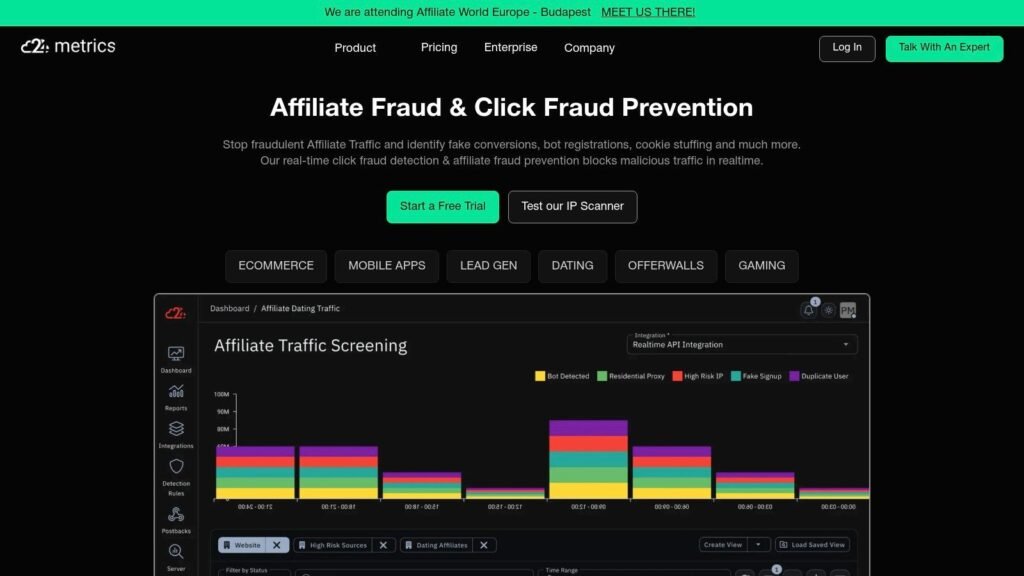
24metrics fits affiliate teams that need event-level fraud filtering without replacing their existing platform. In practice, that matters most for programs already happy with tracking and payouts, but struggling to defend reversals tied to low-quality traffic or manipulated attribution. The product focuses on clicks, impressions, and conversions, then attaches rejection logic a manager can effectively use in partner reconciliation.
That audit trail is its core value.
In iGaming, fraud rarely appears as a single obvious bot burst. More often, it shows up as mixed-quality traffic that inflates registrations, distorts Reg-to-Deposit rates, and weakens FTD qualification. 24metrics is useful at those earlier conversion points because it combines device fingerprinting, proxy and residential IP detection, and environment checks with readable rejection codes. If a partner sends signups through VPN-heavy traffic, spoofed devices, or cookie stuffing tactics, you can isolate the pattern before those events contaminate downstream CPA calculations.
Relative to the iGamingXpert model in the previous section, the distinction is clear. iGamingXpert governs the full affiliate operation, including qualification and payout controls. 24metrics works earlier in the chain. It helps teams protect traffic integrity before bad inputs reach the platform logic that decides whether a registration becomes a payable FTD or an active player cohort.
That makes 24metrics strongest at the click-to-registration and registration-to-deposit stages of the funnel. It is less focused on retained-player quality than on whether the conversion path itself was legitimate. For affiliate managers, that is often the right priority. Once bad traffic starts shaping reported conversion rates, every later decision gets worse, from source allocation to CPA approvals.
Its native integrations with trackers and MMPs also reduce implementation friction. Teams can add screening without replatforming, then connect those signals to a broader ad tracker software stack for affiliate teams if they need clearer attribution analysis across sources. For operators in regulated EU markets, its GDPR positioning and hosting model may also matter during vendor review.
Where it helps, and where it doesn’t
I would use 24metrics in programs where the main operational problem is incoming traffic quality, not affiliate platform governance. It improves review speed, gives analysts evidence for reversals, and reduces the manual work involved in checking suspect conversions one by one.
- Strong point: transparent rejection reasons and exportable logs support disputes with affiliates and media partners.
- Strong point: cookie stuffing, spoofing, and proxy-based abuse are addressed directly, which matters for attribution integrity as much as bot filtering.
- Watch-out: usage-based pricing can become expensive on very high event volumes.
- Watch-out: rule tuning takes time. Teams that set thresholds too aggressively can block borderline but legitimate users, especially in GEOs where shared devices or VPN usage are common.
Problems with affiliate conversion integrity make AI-based prevention practical, not theoretical. The operational question is whether a tool can classify suspicious events fast enough to stop them from affecting attribution, qualification, and payout logic. 24metrics can do that at the front of the funnel. It is a strong fit if your biggest risk sits before FTD approval, not after player value analysis has already started.
3. TrafficGuard

TrafficGuard fits programs where the actual loss sits between registration attribution and deposit attribution, not just at the click layer. In iGaming, that distinction matters. A bot click is easy to reject. A legitimate-looking click followed by cookie stuffing, click injection, or last-touch overwrite is harder, because it distorts Reg-to-Deposit and FTD credit while leaving surface-level traffic metrics looking normal.
That is why I place TrafficGuard closer to the attribution-control end of the market than the pure IVT-filtering end. Its affiliate workflow validates impressions, clicks, and conversions in sequence, which is the right model for sportsbook and casino funnels where fraud often appears after the initial visit. If your paid media and affiliate channels overlap, that sequencing helps isolate whether the problem is traffic acquisition, conversion event contamination, or partner credit reassignment.
From an operator’s perspective, the value is operational. TrafficGuard gives affiliate teams evidence for reversals, partner-level invalid traffic reporting, and controls that can support automated rejection in supported environments. That matters because payout disputes are rarely about whether fraud exists. They are about whether the manager can tie a suspicious conversion pattern to a specific source, timestamp, and attribution event.
The strongest use case is conversion theft. I would use TrafficGuard in programs where one affiliate’s click share rises, another affiliate’s EPC compresses, and deposit volume stays flat. In the iGamingXpert view of the funnel, that usually signals leakage around the conversion points that matter most commercially: Reg-to-Deposit, FTD approval, and the handoff into Active Player qualification. Tools that only score clicks do not explain that pattern well. TrafficGuard often can.
Its performance also depends on tracking discipline. Teams that have not cleaned up postback logic, callback timing, and source-level parameter mapping will get weaker results from any misattribution-focused platform. If you need to tighten that foundation first, this guide to postback vs callback tracking in affiliate systems is the more relevant starting point.
There are limits. Pricing for the affiliate module is not public, and integration depth appears narrower than some affiliate managers will want from a self-serve rollout. If your affiliate platform or MMP is outside the supported setup, expect custom implementation work and a longer validation cycle.
I would not pick TrafficGuard as the first tool for a small program dealing mainly with obvious bot bursts or low-grade proxy traffic. I would pick it for larger affiliate operations where stolen attribution is already visible in the ledger, FTD disputes are increasing, and analysts need partner reconciliation data strong enough to survive a clawback challenge.
4. FraudScore

FraudScore has been around long enough to earn trust with networks that need breadth more than branding. It covers click spam, emulator traffic, proxy and VPN abuse, duplication patterns, and incentivized behavior. That mix makes it useful for affiliate managers who run both web and app funnels and need one taxonomy across them.
Its SmartReject logic is the practical centerpiece. Real-time scoring across clicks and conversions is useful, but only if the platform can convert that score into an enforceable action. FraudScore does that with automated decisioning, API access, and reporting designed for network-level rollups.
Best for network operators
This tool is strongest in environments where a manager is policing multiple affiliates or sub-networks at once. The reporting layer is set up for aggregate visibility, so you can compare fraud reasons by partner cluster rather than reviewing each source one by one.
That matters because multi-tier structures are where low-quality traffic hides best. The top-level affiliate may look clean while a buried sub-source is inflating payouts through spoofed or duplicated traffic. If you’re running that kind of structure, understanding postback versus callback tracking isn’t a technical side issue. It’s core to proving whether a conversion should exist at all.
Operational strengths and limits
FraudScore is one of the easier tools here to budget because pricing tiers are published around monthly clicks and conversions. That’s rare in this category and helpful when procurement wants predictable cost modeling.
- What it does well: broad fraud-reason taxonomy, automated rejection logic, and rollup reporting for affiliate networks.
- Where it helps most: mixed desktop and mobile traffic, especially when web-to-app funnels create extra noise.
- Main drawback: the interface and taxonomy depth can overwhelm teams that don’t already have a disciplined review workflow.
- Budget note: annual terms usually produce the best entry pricing, while monthly flexibility can cost more.
I wouldn’t call FraudScore iGaming-native in the same way as a purpose-built affiliate platform. But as a scoring engine for networks dealing with many traffic sources and varied abuse patterns, it’s practical and mature.
5. Anura

Anura stands out for a narrower reason than some affiliate managers expect. Its strongest use case is not broad traffic hygiene at the click layer. It is protecting the points in the iGaming funnel where commission liability starts to harden, especially the jump from registration to FTD.
That distinction matters in iGaming. A bot click is cheap. A fake or manipulated conversion event is expensive, because it contaminates CPA, rev share forecasting, and partner trust at the same time. On the iGamingXpert side, that usually shows up as a mismatch between healthy Reg volumes and unstable FTD validation rates by source, device group, or geo cluster.
Where Anura fits in the funnel
Anura makes the most sense when your main problem sits around conversion attribution. That includes forced postbacks, fabricated lead events, spoofed device environments, and traffic that looks human at first review but breaks under session consistency checks.
I would place it in the Reg-to-Deposit control layer, with some value at the pre-click stage as well. If registrations are arriving in volume but approved FTDs collapse during reconciliation, the issue is often not low-intent traffic alone. It is traffic engineered to trigger tracked events without corresponding player intent.
That is a different operational problem from generic invalid traffic filtering.
Why affiliate teams buy it
The practical appeal is evidentiary strength. Teams that need to challenge partner invoices or reverse disputed conversions need more than a risk score. They need a defensible explanation for why the recorded event should not count toward payout. Anura’s model is better suited to that kind of review than tools built mainly for campaign-level click cleansing.
This is especially relevant in hybrid deals. If a partner is paid on registration volume with FTD quality thresholds layered on top, weak controls at the conversion stage can distort both sides of the contract. You end up overpaying on CPA events and misreading future player value because the acquisition cohort was never authentic.
Field insight: The costliest affiliate fraud usually does not arrive as obvious junk traffic. It appears as plausible registrations with just enough environmental consistency to pass a shallow audit, then fails when you compare event timing, fingerprint stability, and deposit follow-through.
Strengths and limits
Anura is a serious option for programs dealing with lead fraud, postback abuse, and disputed conversion credit, particularly where call-center or CRM handoffs create attribution gaps.
Its tradeoff is operational. Pricing is quote-based, and the best results depend on tuning rules to your actual payout logic, approval windows, and partner terms. Teams looking for a fast self-serve pilot usually get quicker directional answers elsewhere. Teams trying to reduce payment on conversions that should never have been attributed often get more value here.
For affiliate managers focused on Reg-to-FTD integrity rather than top-of-funnel click scrubbing, that is the right priority.
6. Opticks Security
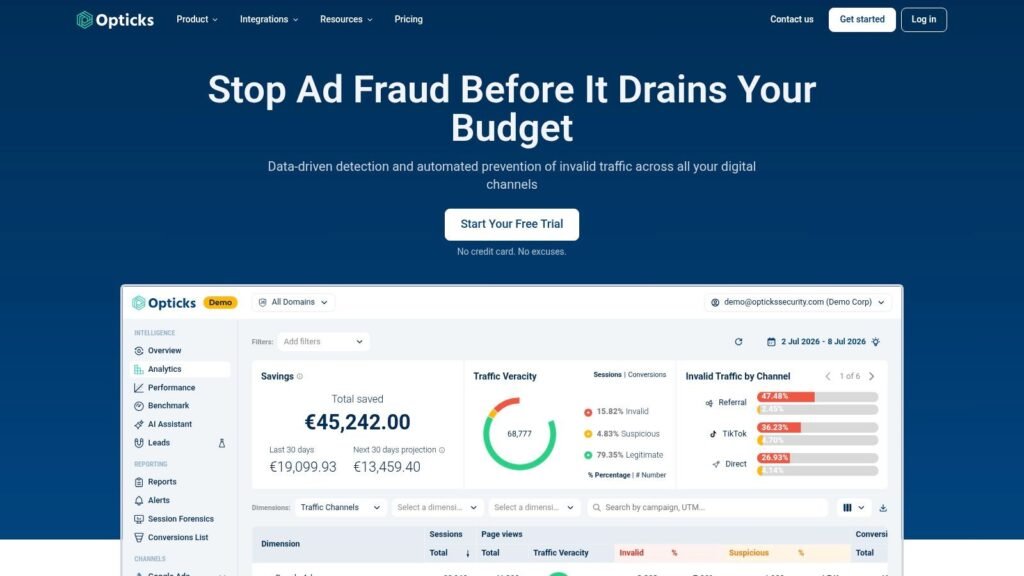
Opticks Security is the fastest pilot on this list for teams that want session-level forensics without a long procurement cycle. Public plans, a self-serve onboarding flow, and quick deployment via SensorJS or Google Tag Manager make it attractive when you need directional answers fast.
That speed has a use in affiliate management. Sometimes you don’t need a full replatform to identify whether a partner’s traffic is polluted. You need click-level evidence, session anomalies, and a benchmark layer that tells you whether one source behaves differently from the rest of the campaign mix. Opticks gives you that.
Best use in affiliate programs
I wouldn’t position Opticks as your single source of truth for affiliate fraud. It isn’t an affiliate management platform, and it won’t replace AMP-level reconciliation. What it does well is expose suspicious click behavior across channels, especially when affiliates use blended traffic sources across search, social, and referral paths.
That makes it useful for cross-channel validation. If an affiliate says their traffic is search-led but session forensics look more like automated social bursts or non-human navigation patterns, you have a basis for review before the problem reaches payout stage.
Where it helps, where it needs help
Opticks is a good fit for teams that want to test hypotheses quickly.
- Useful for: rapid pilots, click-level session review, and cross-channel anomaly checks.
- Useful for: advertisers who need a self-serve anti-fraud layer before committing to a larger stack.
- Less useful for: operators who need native affiliate payout holds, partner rollups, or integrated dispute workflows.
- Important limitation: tag-based forensics are useful, but some stacks still need complementary server-side checks to protect attribution end to end.
Because of that, I see Opticks as a smart adjunct tool. It can surface suspicious behavior early, but it works best when a stronger tracking and payout-control system sits behind it.
7. The ADEX ProShield

The ADEX ProShield is the most obviously aligned with iGaming-specific abuse patterns beyond simple click fraud. If you’re worried about fake users, geolocation mismatches, timezone inconsistencies, multi-accounting, hidden ad placements, and bonus abuse, this is where it gets interesting.
That matters because standard anti-fraud tools for affiliate marketers often stop at invalid traffic. In gambling, a user can be technically real and still be commercially fraudulent. Multi-accounting to exploit welcome offers, bonus abuse through coordinated identities, and affiliate-fed low-intent traffic that exists only to trigger CPA events all sit in that gray area. ProShield is designed to make allow or stop decisions before payout, which is the right control point.
Why it’s relevant to gambling operators
In 2025, online gambling fraud increased by 64% year over year, and affiliate fraud ranked among the top five schemes alongside bonus abuse and money laundering. That framing matters. It shows why iGaming fraud controls have to look beyond invalid clicks and into user authenticity, account linkage, and behavioral consistency.
ProShield’s environment, behavior, and device checks are aligned with exactly those risks. Its reporting is also built to support disputes and enforcement, which is useful when you need to justify a stop-payment or partner removal with something stronger than “traffic looked wrong.”
Best fit and limitations
I’d shortlist ProShield for operators that run aggressive CPA offers, bonus-led acquisition, or referral mechanics that attract serial abusers. It’s especially relevant when the same bad actor can present as multiple “new” players across devices or GEO signals.
Its main weakness is integration visibility. Pricing is quote-based, and there’s less public detail on native affiliate platform integrations than some teams will want before procurement. So I’d treat it as a specialized fraud layer, not a lightweight plug-in.
For iGaming programs dealing with identity-linked abuse rather than just top-of-funnel noise, that tradeoff can be worth it.
Top 7 Anti-Fraud Tools Comparison for Affiliate Marketers
| Product | Implementation complexity 🔄 | Resource requirements ⚡ | Expected outcomes ⭐📊 | Ideal use cases 💡 | Key advantages ⭐ |
|---|---|---|---|---|---|
| iGamingXpert | High, enterprise integrations, compliance configuration | Moderate–High, tailored onboarding, API/webhooks, white‑label work | ⭐⭐⭐⭐⭐ Real-time click-to-payout visibility; reduced fraud; auditable payouts | Regulated iGaming operators; multi-brand / multi-currency networks | Consolidated affiliate stack; compliance-first; low latency; strong uptime |
| 24metrics | Medium, integrates with trackers/MMPs; tuning advised | Variable, per-click pricing; quick tracker integrations | ⭐⭐⭐⭐ Real-time click/conversion screening; transparent rejection logs | Advertisers/publishers needing EU/GDPR-compliant click-fraud screening | Deep tracking integrations; transparent rejection reasons; fast reconciliation |
| TrafficGuard | Medium–High, omnichannel setup and AMP integrations; some custom work | Moderate, enterprise affiliate plans; platform-specific automations | ⭐⭐⭐⭐ Improved misattribution prevention; automated reversals; detailed reporting | Omnichannel advertisers; sports-betting; platforms needing clawbacks | Full-funnel verification; reversal automation; strong misattribution reporting |
| FraudScore | Medium, scoring taxonomy and SmartReject require onboarding | Moderate, published tiers by volume; API and network rollups | ⭐⭐⭐⭐ Real-time scoring and automated decisioning for clicks/conversions | Performance marketers and networks with mixed web/app funnels | Published pricing; SmartReject automation; broad traffic coverage |
| Anura | Medium, requires tuning; compliance workflows for legal teams | Moderate, sales-led audits/trials; quote-based pricing | ⭐⭐⭐⭐ Accurate detection with low false positives; compliance-focused outputs | Lead-gen and regulated verticals (TCPA risk, legal/compliance needs) | Pre/post-click analysis; verified outcome reporting; compliance emphasis |
| Opticks Security | Low, self-serve tag/GTM or SensorJS quick setup | Low, public plans, 7-day free trial, self-serve onboarding | ⭐⭐⭐ Fast pilots; cross-channel invalid-traffic prevention | Fast evaluations, small–mid advertisers, cross-channel validation | Self-serve trials; quick deployment; automated prevention on major platforms |
| The ADEX ProShield | High, custom work for iGaming abuse modes and integrations | Moderate–High, demo/enterprise onboarding; specialized checks | ⭐⭐⭐⭐ Upstream allow/stop decisions; evidence-ready reporting for disputes | iGaming operators, incentive/bonus-heavy apps, CPA networks | Focus on prevention before payout; dispute-focused evidence; bonus/multi-account detection |
From Fraud Data to Scalable Growth Strategy
Fraud rarely damages a single metric in iGaming. It usually hits three at once: Reg-to-Deposit conversion, FTD quality, and the proportion of new depositors who remain active long enough to carry value. That is the right lens for a final tool decision. A click filter can reduce invalid traffic, but it does not automatically protect CPA payouts if the actual problem sits at deposit verification, bonus abuse, or post-FTD churn.
The better question is operational. Which system helps the affiliate team identify the partners whose traffic survives KYC, reaches first deposit, and still produces commercially active players after the qualification window? That is the point where anti-fraud stops being a reporting function and starts shaping margin.
In practice, weak traffic quality shows up in predictable patterns. Registration-heavy partners with poor deposit progression often rely on low-intent paid traffic, incentivized users, duplicated identities, or misattributed sessions. Affiliates with lower registration volume can still outperform on net contribution if their FTDs clear validation and their cohorts retain beyond the first bonus cycle. Reviewing partners only on clicks, registrations, or raw EPC hides that difference.
That is why the iGamingXpert model is useful. It separates protection by funnel stage instead of treating fraud as one generic score. Reg-to-Deposit checks expose sources that overproduce signups without deposit intent. FTD verification catches duplicate accounts, affiliate self-referrals, bonus hunters, and suspicious device or IP clustering before commission release. Active Player monitoring adds the missing commercial layer by showing whether a source that looks clean at acquisition level is still failing on retention or value density.
The commercial impact is direct. A partner with unstable deposit quality may need a longer approval window, stricter source rules, or a lower CPA cap. A partner with consistent validated FTDs and stronger retained value can support Hybrid or RevShare terms with less payout risk. Finance teams usually accept those changes faster when the reasoning is tied to validated conversion points rather than broad fraud labels.
Pre-conversion controls still matter because downstream correction is expensive. As outlined in Tapfiliate’s guide to affiliate fraud prevention, real-time checks on IP reputation, device signals, and session behavior can stop invalid traffic before it contaminates attribution and commission reporting. In affiliate operations, that means fewer manual reversals, fewer partner disputes, and less time spent proving why a conversion should not be paid.
The strongest operating setup usually includes four controls working together:
- Server-to-server tracking to reduce cookie stuffing, postback manipulation, and attribution hijacking.
- Qualification windows that hold CPA approval until deposit, KYC, and early quality checks are complete.
- Partner vetting before scale, including source review, GEO fit, and historical traffic quality.
- Ongoing anomaly analysis across device clusters, VPN usage, bonus behavior, and source-level conversion ratios.
Regulated programs add another layer. Consent handling, verification thresholds, and payout timing often need to match local compliance requirements as well as fraud risk, a point discussed in iRev’s analysis of affiliate manager challenges in 2025. Tools that only block bots leave that operational burden on the affiliate and compliance teams.
iGamingXpert earns its place in this comparison because it connects fraud controls to tracking, commission logic, partner governance, and reporting in one workflow. That matters most in iGaming, where the commercial dispute is rarely about a click. It is usually about whether a registered user should count as a valid FTD, whether that player was duplicated or incentivized, and whether the payout model still makes sense once cohort quality is visible.
Scalable growth comes from protecting each conversion point, then pricing partners according to verified quality. Teams that do that well spend less on contaminated volume and more on affiliates who produce depositors that remain active. That is the difference between buying traffic and building a durable acquisition channel.
