How to Prevent Affiliate Conversion Fraud Using AI (in iGaming Industry)?

Summery: Preventing iGaming affiliate fraud requires real-time AI to analyze user behavior, device data, and traffic quality, countering sophisticated bots and click farms. Key strategies include behavioral analytics, device fingerprinting, and risk-based affiliate scoring to protect marketing budgets and ensure compliance.
Online gambling fraud grew 64% year-over-year in 2025, and affiliate fraud sits among the top five schemes alongside bonus abuse and money laundering, according to BluePear’s review of iGaming affiliate fraud. That changes the conversation. This isn’t a back-office cleanup task anymore. It’s a margin, compliance, and partner governance problem.
If you’re still reviewing suspicious affiliates after payout runs, you’re operating too late in the cycle. In regulated iGaming, the objective is to prevent affiliate conversion fraud using AI before attribution hardens into commission liability, before low-quality traffic contaminates your FTD funnel, and before a partner dispute turns into a compliance issue.
The shift isn’t from human judgment to automation. It’s from slow, manual triage to machine-led prevention with human review where it matters.
The Alarming Scale of Modern iGaming Affiliate Fraud
The biggest mistake affiliate teams make is treating fraud as a simple bot problem. In practice, the damaging schemes are mixed. Some are automated, some are coordinated by people, and the most expensive ones sit in the middle where software amplifies human intent.
What fraud looks like now
A modern iGaming affiliate fraud queue usually includes several patterns at once:
- Bot-led conversion spoofing: Traffic generates clicks and registration events that look active enough to earn commission, but never behaves like real depositing players.
- Cookie stuffing and click pollution: Attribution gets hijacked upstream so the wrong affiliate claims credit for a genuine player journey.
- Account farming: Supposedly separate users share highly similar device and network traits, then move through registration and deposit flows in suspiciously tight patterns.
- Bonus abuse rings: Acquisition quality looks acceptable at first, then downstream value collapses once players churn after extracting promotional value.
- Affiliate shaving and manipulation: The opposite problem also appears. Downstream conversion behavior can suddenly break from expected patterns, signaling that parts of the funnel are being distorted.
- AI-generated spam campaigns: In one uncovered 2025 operation, fraudsters used AI-generated content, automation, more than 500 fake social media accounts, and over 1,000 subdomains to manipulate rankings and drive traffic into iGaming promotions, as detailed by QuoIntelligence’s analysis of affiliate fraud campaigns.
That last category matters because many affiliate managers still evaluate quality through familiar surface metrics such as clicks, CTR, registration counts, or even headline conversion rates. Fraudsters know that. They fine-tune for looking good in the dashboard you already have.
Fraud doesn’t need to beat your full compliance stack. It only needs to beat the approval logic that decides who gets paid.
Why manual checks fail in iGaming
Manual review still has a role, but only after the system has narrowed the queue. Human analysts are good at contextual judgment. They’re bad at watching thousands of micro-signals across partners, brands, GEOs, and deal types in real time.
A spreadsheet-based process usually misses the combinations that matter most:
| Fraud pattern | What a manual check sees | What actually matters |
|---|---|---|
| Sudden traffic growth | More volume from a productive partner | Whether the growth matches historical user behavior and deposit quality |
| Strong registration numbers | Healthy funnel entry | Whether registrations cluster on reused device signatures or datacenter networks |
| Fast conversions | Efficient creative or strong intent | Whether the speed is too compressed to be human |
| GEO variation | Expanded reach | Whether location changes make physical user behavior impossible |
The cost isn’t limited to wasted commission
Fraud distorts partner rankings, corrupts optimization decisions, and sends teams toward the wrong commercial conclusions. A bad affiliate can look like a top affiliate for weeks if you only measure top-of-funnel activity.
That’s why good operators don’t ask, “How much fraud did we catch?” They ask, “How much bad traffic did we stop before it touched payout, reporting, or compliance?”
Moving Beyond Static Rules to Predictive AI Models
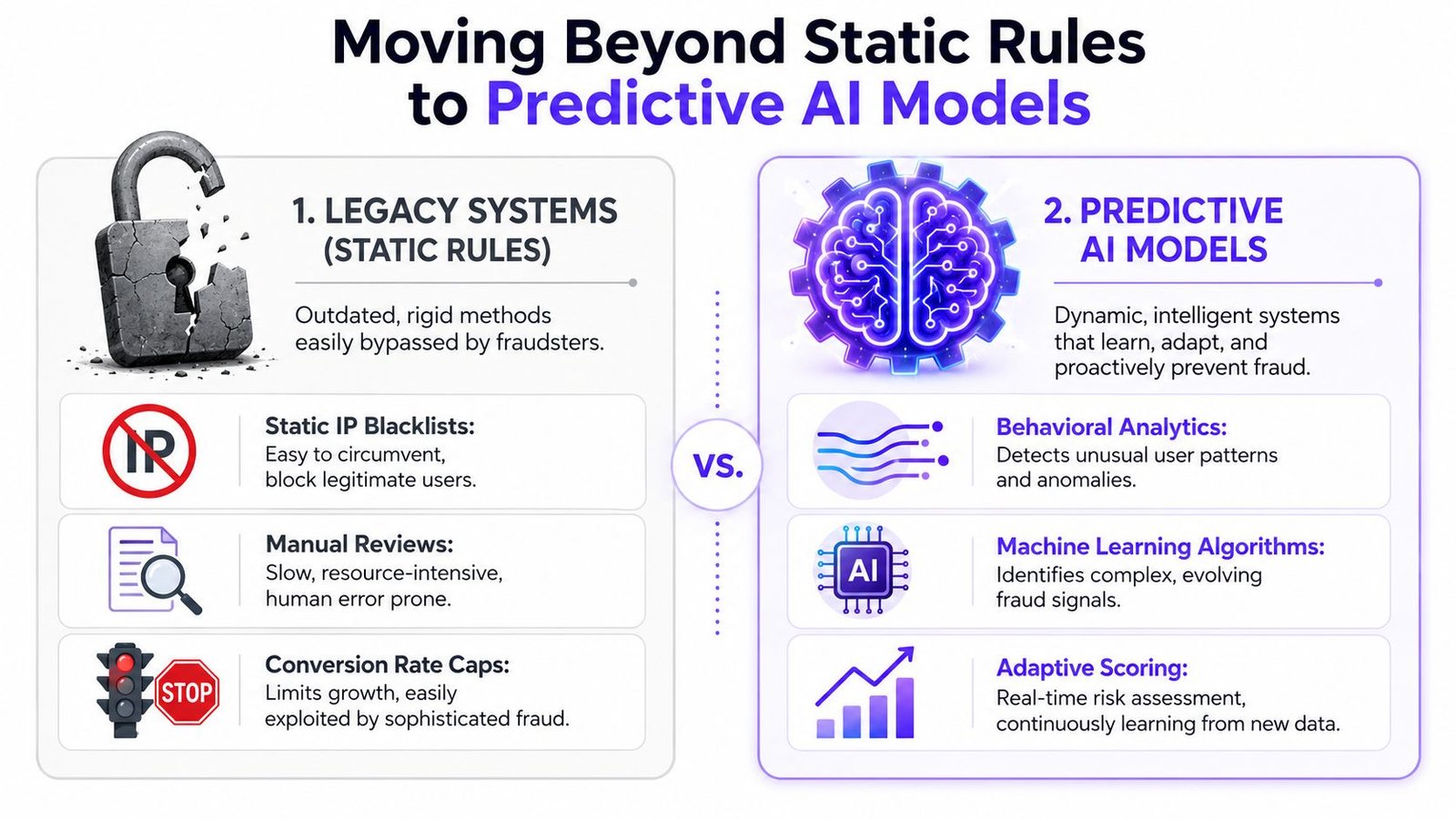
Static fraud rules still matter. You still want hard blocks for obvious duplicates, known bad sources, and clear policy violations. The problem is that static controls only catch what you’ve already defined.
That’s not enough when fraudsters keep changing the shape of the traffic.
Why rules plateau
Legacy fraud stacks usually rely on three things: IP blacklists, manual case reviews, and blunt performance thresholds. Each has value. None can model behavior well enough on its own.
A blacklist says, in effect, “we’ve seen this before.” A predictive model asks a harder question: “does this event behave like legitimate traffic for this affiliate, offer, GEO, and point in time?”
That distinction is why AI-driven fraud detection prevented up to 10% of fraudulent activities for 83% of marketers in 2026, according to WeCanTrack’s affiliate tracking statistics. In high-volume iGaming programs, that difference gets large quickly. The same source notes that for an operator tracking $2.4B in annual volume, preventing 10% of fraud equates to recovering up to $240 million that would otherwise leak into fraudulent payouts.
What predictive models see that static rules miss
Rules are event-based. AI is pattern-based.
A simple rule might flag a click from a risky source. A predictive model looks at the full context. It can compare current traffic against historical baselines and spot anomalies such as:
- Impossible travel patterns: The same user profile appears to operate across multiple countries within a timeframe that doesn’t make physical sense.
- Time-to-conversion variance collapse: Large clusters of conversions arrive with near-identical timing, which often points to scripting or automation rather than human decision-making.
- Statistically improbable spikes: Volume rises sharply, but the shape of the traffic doesn’t resemble that affiliate’s past mix or the cohort norm.
Practical rule: Keep deterministic rules for known bad behavior. Use machine learning for the gray area where fraud looks almost legitimate.
AI isn’t magic. It’s architecture.
The strongest systems don’t replace rules. They combine them with behavioral analytics and real-time scoring. That hybrid approach matters because fraud in iGaming isn’t uniform. CPA campaigns, RevShare partnerships, and hybrid deals each create different incentives for abuse.
Predictive AI models are effective because they learn the normal path first. Once the system knows how genuine traffic behaves for a given partner and offer, it can assign risk to deviations before the conversion reaches payout. This marks a significant operational shift. You stop treating fraud as a reconciliation task and start treating it as a routing decision.
Your Framework for AI-Driven Fraud Prevention
Operators that wait until payout reconciliation usually absorb the loss twice. First in CPA spend, then in analyst time, chargebacks, and regulator-facing documentation. An effective prevention framework changes the decision point. Risk is assessed before attribution is finalized, before the postback confirms value, and before a partner learns your control gaps.

Start with partner intake, not post-conversion review
The first control sits in onboarding. If a partner enters the program with unclear traffic sources, recycled creative, or a weak publisher footprint, the model starts from a bad prior and the fraud team inherits avoidable noise.
At approval stage, screen for media property ownership, declared acquisition channels, GEO fit, trademark abuse risk, and whether the partner can support transparent tracking. Ask for sample placements, source-level breakdowns, and the logic behind their user acquisition mix. Partners that cannot explain where traffic comes from, how it is monetized, and which sub-publishers are involved should not go live on CPA terms.
A practical intake model has three layers:
- Trust screening for ownership checks, site quality, compliance posture, and acquisition method disclosure.
- Commercial fit review for GEO match, offer relevance, expected deposit profile, and likely bonus sensitivity.
- Technical readiness check for click ID integrity, postback support, event coverage, and log-level transparency.
This step sounds basic. It prevents a large share of downstream disputes because weak partners often fail simple verification long before any model score is needed.
Build a data layer that joins acquisition events to player outcomes
Most fraud programs fail in the join logic. Acquisition data lives in one system, KYC and payments in another, and partner enforcement notes in a spreadsheet. That setup can catch obvious abuse, but it cannot support prevention decisions in real time.
The minimum viable data layer should connect four records at event level:
- Affiliate touchpoints: click ID, sub ID, creative, landing page, timestamp, IP, user agent, referrer, and attributed partner
- Conversion events: registration, KYC pass or fail, first deposit, payment method, bonus redemption, withdrawal attempt, and chargeback outcome
- Risk context: ISP and ASN type, proxy or datacenter status, device consistency, GEO alignment, session timing, and account linkage indicators
- Partner history: contract type, prior reversals, traffic-source declarations, baseline quality metrics, and enforcement history
That data has to arrive fast enough to influence routing. Teams evaluating ad tracker software for regulated affiliate programs should prioritize event completeness, timestamp precision, and real-time export support over dashboard polish.
Configure scoring by commercial model
Commercial structure changes attacker behavior. A CPA deal attracts registration stuffing, bonus hunting, and synthetic first-time deposit intent. RevShare shifts the abuse pattern toward low-value cohorts, collusion, and player accounts that look acceptable at signup but decay quickly after the first monetized event. Hybrid deals need both views.
A useful operating model is to score traffic at two levels. Event-level scoring decides whether to attribute, hold, or block the conversion. Cohort-level scoring decides whether a partner’s recent traffic mix justifies tighter caps, delayed approval, or manual review.
| Deal structure | Primary abuse risk | Best prevention focus |
|---|---|---|
| CPA | Registration inflation and fake FTD intent | Pre-attribution scoring, velocity controls, and stricter hold logic |
| RevShare | Low-value cohorts and manipulated retention quality | Cohort scoring, downstream player value checks, and source-level partner reviews |
| Hybrid | Mixed incentive abuse | Combined event scoring and ongoing cohort monitoring |
Many teams often overfit to one fraud type. The better approach is to tie thresholds to payout logic, not just to suspicious clicks.
Automate action paths, not just alerts
Analysts should review edge cases, not every conversion. The system needs predefined responses that map score bands to operational actions and preserve a clear audit trail for affiliate managers, compliance teams, and finance.
Use three response bands:
- Low-risk events: approve attribution and release the postback normally.
- Medium-risk events: hold attribution, require extra validation, cap commission eligibility, or queue the partner for source review.
- High-risk events: suppress confirmation, block the conversion from payout, and store the evidence package in the partner case file.
The evidence package matters in regulated iGaming. If a partner challenges a reversal, the team should be able to show the exact inputs behind the decision: click path, timing pattern, KYC outcome, device consistency, payment behavior, and prior related accounts. That is how AI becomes operationally useful. It does not replace fraud analysts. It reduces preventable payouts, shortens review queues, and gives commercial teams a defensible basis for enforcement.
Critical AI Signals That Unmask Sophisticated Fraud
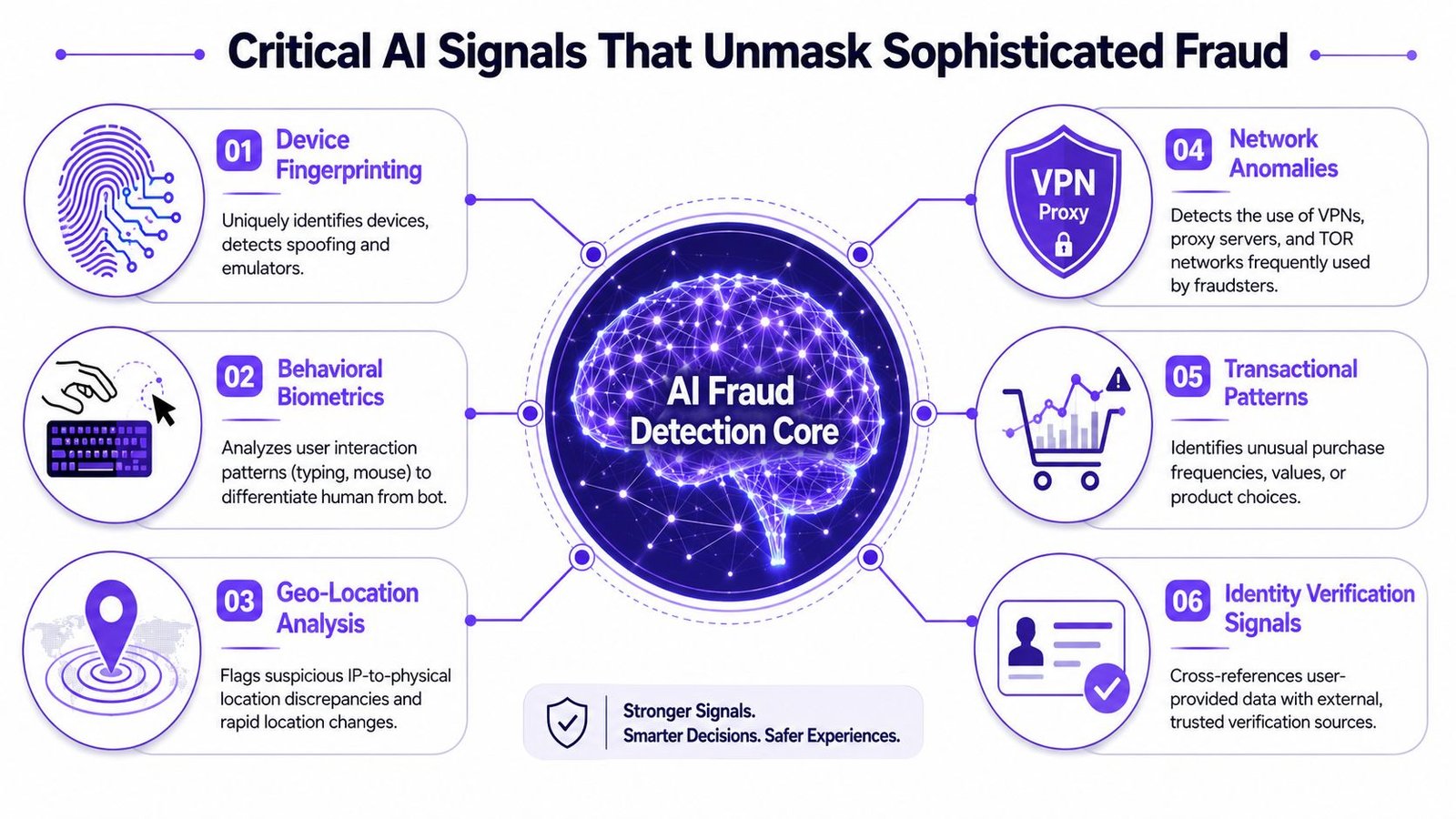
The useful question isn’t whether AI can score traffic. It’s whether the score is grounded in signals that reflect real abuse patterns. In regulated iGaming, the best systems rely on a large signal set and then compress it into a decision that operations teams can use.
Advanced AI systems analyze over 270 data signals per transaction and can reduce fraudulent losses by 40–60% in regulated iGaming markets, using a hybrid of deterministic rules and machine learning, as described in TrafficGuard’s breakdown of affiliate fraud detection.
The signals that matter most in practice
Some signals are noisy on their own. The value comes from combinations.
- ISP and ASN classification
When traffic resolves to hosting providers or datacenter infrastructure, the likelihood of automation rises sharply. This signal is especially useful when “users” arrive from infrastructure built for servers, not households. - Click-to-conversion latency
Very short latency can expose scripted paths. More importantly, compressed timing clusters across many conversions often reveal orchestration rather than individual user intent. - Composite device signatures
Fraud systems can cluster accounts that claim to be unique players but share the same composite browser, OS, canvas, font, and network profile. In practice, that’s one of the clearest indicators of account farming, as noted in iRev’s discussion of data and analytics in iGaming affiliate performance. - Geo-location contradiction
Geography isn’t just a compliance field. It’s a fraud signal. If user behavior implies movement that a real person couldn’t achieve in the observed timeframe, the event should never flow straight to approval. - Downstream funnel breaks
Some partners generate strong registration numbers but then produce weak deposit progression or unstable lead-to-FTD behavior. Those breaks often matter more than top-of-funnel conversion rates.
If you’re relying on browser-based events only, the tracking layer itself can become the blind spot. That’s why server-to-server tracking design and postback authentication are important in fraud prevention, not just attribution accuracy.
Signals should explain the business risk
Affiliate managers need something more useful than “AI flagged this conversion.” The system should tell them what kind of risk appeared.
A compact explanation model works better than a black-box score:
| Signal cluster | Likely fraud pattern | Operational response |
|---|---|---|
| Shared device signature plus rapid registration flow | Account farming or duplicate users | Hold attribution and require deeper partner review |
| Datacenter ASN plus low-latency conversions | Automated bot path | Auto-block before payout |
| GEO inconsistency plus repeated device reuse | Proxy-driven manipulation | Suppress commission and attach evidence |
| Registration strength but weak deposit continuity | Low-quality or manipulated acquisition | Reduce trust score for partner and expand monitoring |
If the fraud model can’t explain the signal path to an affiliate manager, the model is operationally incomplete.
Where AI still has blind spots
AI is strongest against repetitive machine patterns. It’s less reliable when humans deliberately mimic normal behavior. A known gap is human-driven fraud, where organized actors operate in ways that look organic enough to evade standard models. Data from 2026 industry reporting indicates that 68% of new fraud cases in regulated iGaming involve human-driven patterns that bypass standard ML classification models, according to Tapfiliate’s review of affiliate fraud prevention.
That’s why prevention has to combine model scoring, server-side authentication, and analyst review. If you only deploy ML without evidence trails and channel controls, advanced operators will learn the boundaries faster than you can retrain.
Ensuring Compliance and Auditability in Your AI System
In regulated iGaming, a blocked conversion is not the end of the process. It’s the start of an accountability requirement. Someone will ask why the event was blocked, what evidence supported the decision, whether the logic was applied consistently, and whether the operator can defend that outcome to a regulator or a partner.

Auditability is now a selection criterion
Many AI fraud vendors underdeliver. They promise accuracy, but they don’t provide enough evidence for regulated review.
74% of iGaming compliance officers reject AI fraud systems that lack documented model parameters and data lineage, and operators must prove blocked decisions were not discriminatory across 180+ countries, according to INTOSAI Journal’s examination of AI and fraud controls. That’s not a niche legal concern. It affects procurement, market access, and partner dispute resolution.
If your compliance team can’t reconstruct a fraud decision from logs, model documentation, and event history, your fraud stack is incomplete.
What an auditable AI workflow looks like
Use this checklist when reviewing your current setup:
- Documented input data
Keep a clear record of which event fields, device traits, location data, and partner attributes fed the decision. - Versioned model logic
Record which rule set or model version evaluated the event at the moment the block occurred. - Evidence preservation
Store the relevant telemetry, not just the final score. A score without evidence doesn’t help during a challenge. - Human review path
Define when an analyst can override or confirm a decision, and make sure the system logs that action. - Partner dispute procedure
Affiliate managers need a consistent way to respond when a partner disputes withheld commission.
A privacy-led architecture matters too. Teams working across jurisdictions should think carefully about GDPR data residency for iGaming affiliates, especially when fraud signals depend on user-level event data and cross-border reporting.
The strongest compliance posture isn’t “our AI is accurate.” It’s “we can show how this decision was made, what evidence supported it, and who approved the final action.”
Fairness and enforcement have to coexist
This is the trade-off many operators underestimate. Tight fraud controls protect margin, but opaque controls create partner distrust and regulatory exposure. Loose controls feel commercially friendly, but they allow abusive traffic to mature into payable liability.
The answer is explainable enforcement. Affiliates don’t need your full model. They do need a credible reason code, supporting evidence, and a consistent review standard. Regulators need even more than that. They need process integrity.
Frequently Asked Questions on AI Fraud Prevention
Should you build an in-house model or use a SaaS platform
Build in-house if you already have strong data engineering, fraud analytics, model governance, and compliance operations under one roof. Most operators don’t. They have partial data, fragmented workflows, and a fraud team that spends too much time chasing evidence across systems.
A specialized platform is usually the better choice when speed matters, multiple brands share the same stack, or compliance teams need one audit trail instead of several. The decision isn’t only about model quality. It’s about whether your team can maintain scoring logic, event pipelines, partner workflows, and evidence retention at production level.
How should you handle a long-term affiliate partner flagged for fraud
Don’t jump straight to accusation. Start with evidence. Show the partner the class of issue first, such as datacenter traffic, impossible location shifts, repeated device clustering, or inconsistent downstream quality. Then pause or hold the affected commissions while review is active.
Keep the message operational, not emotional. Strong affiliates usually understand that regulated operators need documented controls. Bad affiliates tend to resist detail, deflect, or change their explanation once they see the evidence set.
Can AI help with bonus abuse and player-level fraud too
Yes, but only if your risk workflow joins acquisition and player behavior. Many teams separate affiliate fraud from player fraud and end up missing the connection. The same signals that expose conversion manipulation can also support bonus abuse review, duplicate account investigation, and suspicious early deposit behavior.
That matters because the affiliate layer can be the entry point for broader abuse. If you only score the click and ignore the player lifecycle, you leave half the problem unsolved.
What should teams prepare for next
Prepare for more blended fraud. The clearest trend is not “more bots” on its own. It’s AI-supported acquisition manipulation combined with human-operated behavior that looks realistic enough to avoid simple classifiers.
Two areas deserve attention:
- Server-side trust controls because browser-only visibility is too easy to evade
- Explainable risk scoring because blocked decisions will face more scrutiny from partners and regulators
What does a healthy operating model look like
It’s usually a three-layer setup:
- Prevent obvious abuse automatically
- Score gray-area traffic in real time
- Escalate only the defendable edge cases to analysts
That structure keeps fraud teams focused on judgment instead of repetitive cleanup. It also gives affiliate managers a stronger position in partner conversations because they can rely on evidence, not instinct.
How do you know the program is improving
Look for cleaner attribution, fewer disputed commissions, more stable downstream quality, and a smaller gap between reported conversions and commercially valid players. The best fraud systems don’t just block bad traffic. They improve confidence in the numbers your acquisition team uses every day.
iGamingXpert gives regulated operators and affiliate networks a single SaaS platform for real-time tracking, commission accounting, fraud prevention, and compliance controls. If you want to prevent affiliate conversion fraud using AI without stitching together separate trackers, spreadsheets, and review tools, it’s built for the operational reality of iGaming.
