How to Manage Hybrid CPA and Revshare Models – Operators’ Perspective After 5 Years

💡 TL;DR:
Hybrid commission models in iGaming, which pair an upfront cost per acquisition (CPA) with ongoing revenue share (RevShare), produce superior net gaming revenue by balancing acquisition volume with player retention, unlike single-payout models which create financial, compliance, or partner-alignment risks. Successful execution requires replacing simple headline splits with disciplined, data-driven structures that use granular reporting, strict qualification rules, and net revenue definitions to manage margin risk.
To work with a hybrid strategy effectively, focus on adjusting commission structures using live data from your CRM and affiliate platforms to match traffic quality.
Operators using mixed commission structures generate materially higher net gaming revenue per active player than programs built on a single payout model, as noted earlier. That result matters because hybrid CPA and RevShare changes how an operator controls acquisition risk, cash flow, and partner incentives at the same time.
Affiliate teams often treat commission setup as a commercial choice between fixed cost and lifetime share. In regulated markets, that approach leaves money on the table and creates avoidable volatility. A pure CPA deal can buy volume quickly, but weak qualification logic turns that certainty into expensive churn. A pure RevShare deal aligns the affiliate with retention, but many high-value partners still want upfront cash flow, and finance teams still need clear payback visibility.
Hybrid models solve a more practical problem. They let operators pay for early conversion without ignoring long-term player value.
That only works if the model is run with discipline. The commercial terms need to reflect player quality, market-specific compliance costs, validation windows, negative carryover treatment, clawback rules, and source-level reporting. At scale, hybrid management is less about agreeing a headline split and more about building rules that hold up under real traffic conditions.
The operators that do this well – use live data from affiliate platforms, CRM, and payments systems to adjust deals before margin slips. That is the difference between offering hybrids as a sales tactic and running them as a controlled growth model.
Why Pure CPA and RevShare Are No Longer Enough
A mixed commission strategy produces materially better economics than a single-model program. The reason is simple. Affiliate traffic does not arrive with the same intent, compliance profile, or lifetime value, so one payout logic will always misprice part of the book.
SEO publishers, tipster brands, paid media affiliates, streamers, and sub-affiliate networks drive very different player behavior. If all of them sit on the same deal, margin starts leaking in predictable places. You overpay short-lived traffic on CPA, or you wait too long to reward partners that can scale quality volume quickly.

Pure CPA still has a place. It gives a clear acquisition cost, helps with launch planning, and keeps finance comfortable because payback starts with a fixed number. The trade-off is that weak qualification rules attract traffic designed to hit the trigger, not traffic designed to retain.
That problem shows up fast in regulated markets.
A player who clears a first deposit threshold can still be unprofitable once bonus cost, payment fees, safer gambling controls, fraud checks, and country-specific compliance overhead are applied. If the deal pays out on a shallow event, the operator absorbs all of that downside while the affiliate gets paid in full. At scale, that is not a commission issue. It is a risk allocation issue.
The same pattern appears across several traffic sources:
- Bonus-led traffic can pass entry checks and disappear after the first promotional cycle.
- Paid media affiliates can produce attractive FTD volume but weak day-30 value.
- Sub-affiliate networks can hide source-level quality issues if reporting is not granular enough.
A practical rule I use is straightforward. If a CPA trigger does not reflect real engagement, the operator is paying for qualification mechanics, not for profitable acquisition.
Pure RevShare corrects part of that by tying affiliate earnings to actual player value over time. The alignment is better, especially when retention is strong and fraud controls are tight. The problem is commercial speed. Good affiliates still manage cash flow. Many will not put your brand at the top of their inventory if every pound, euro, or dollar depends on future performance they cannot model with confidence.
That creates a second risk. The operator protects margin on paper, but loses distribution to brands willing to fund early acquisition more aggressively. In competitive regulated markets, that lost exposure matters.
This is why single-model thinking breaks down. CPA optimizes for certainty at the front. RevShare optimizes for alignment over time. Neither one handles the full job on its own when the program has to balance acquisition pace, retention quality, compliance cost, negative carryover exposure, and partner motivation across multiple GEOs.
Hybrid models solve that operational problem more precisely. They let the operator pay something upfront, keep the affiliate interested, and still attach a meaningful share of value to downstream revenue. More importantly, they create room for control. CPA can be reduced or gated by quality thresholds. RevShare can be adjusted by product mix, market conditions, or clawback logic. Negative carryover can be treated by partner tier instead of with a blanket policy that distorts incentives.
That is the shift mature programs make. They stop treating commission design as a simple commercial choice and start treating it as a live margin-management system, supported by real-time data from the affiliate platform, CRM, fraud tools, and payments stack. In regulated iGaming, that level of control is what turns hybrid from a sales concession into a durable growth model.
Deconstructing Hybrid Models The Core Mechanics
A true hybrid deal has two connected parts. First, a reduced fixed payment for a qualifying player. Second, an ongoing share of the net revenue from that same player. The key word is connected. Both elements apply to the same acquisition stream, and the operator uses the split to balance immediate cost with downstream value.
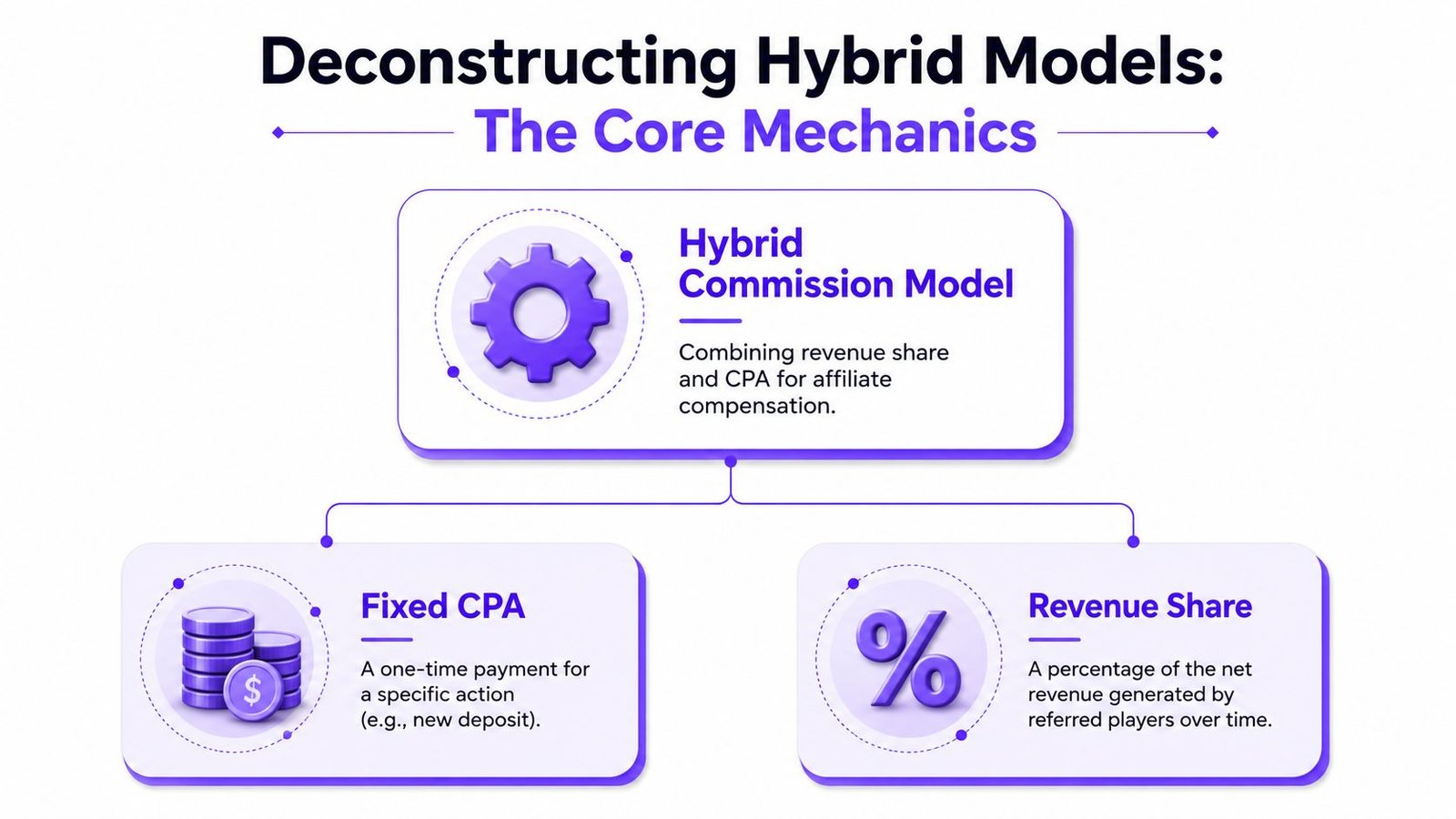
It’s comparable to portfolio construction. A pure CPA deal behaves like a short-term fixed-return instrument. A pure RevShare deal behaves like a long-duration variable-return asset. Hybrid combines the two so the operator doesn’t have to choose between immediate output and long-term yield.
What makes a structure genuinely hybrid
A lot of operators call a deal “hybrid” when it’s a CPA with a bonus ladder, or RevShare with a one-off launch incentive. That’s not the same thing. A proper hybrid model keeps a live revenue-sharing component attached to referred players after the upfront acquisition payment.
A standard example appears in iRev’s breakdown of affiliate payout models in online gambling: €60 CPA plus 20% RevShare, compared with standalone alternatives such as €120 CPA-only or 35% RevShare-only. That structure works because each component does a different job. The CPA helps the affiliate fund traffic. The RevShare keeps both sides focused on player quality after the first deposit.
Why the split changes behavior
Hybrid economics shape affiliate behavior more effectively than one-dimensional plans. A fixed payment alone pushes for qualification. A revenue share alone pushes for retention. Combining them gives the affiliate a reason to care about both.
That matters with mixed traffic sources:
| Structure | What it rewards most | Typical operator risk |
|---|---|---|
| Pure CPA | Immediate qualification volume | Overpaying for weak retention |
| Pure RevShare | Long-term player value | Slower affiliate adoption |
| Hybrid | Qualification plus retention | More setup and governance work |
The operational advantage is subtle but important. With hybrid, the affiliate still gets paid up front, but not enough to ignore downstream value. That reduces the appeal of sending low-intent users just to trigger a payout.
The best hybrid deals don’t just split commission. They split incentives correctly.
Two mechanics that operators often miss
When teams first learn how to manage hybrid CPA and RevShare models, they usually focus on the headline numbers and ignore the control layer. That’s a mistake.
Watch these two mechanics closely:
- Qualification logic: The RevShare portion should activate only when the player clears meaningful engagement conditions.
- Revenue definition: The share must apply to net revenue, not to broad topline activity.
Without those controls, a hybrid deal can look disciplined on paper and behave like inflated CPA in production.
Structuring Profitable and Fair Hybrid Deals
A hybrid deal becomes expensive long before it looks expensive on a rate card. The risk usually sits in the activation logic, the revenue definition, and the clawback terms. In regulated markets, those details decide whether the model scales cleanly across partners or creates a reporting dispute every month.
Start by pricing the deal against the pure CPA alternative you would realistically sign. That gives the commercial team a hard reference for payback, finance a clear exposure limit, and affiliate managers a range they can defend in negotiation.
A useful Tier 1 casino example appears in Scaleo’s practical guide to hybrid commission models. In that scenario, $80 CPA plus 25% RevShare, following a player generating $50 NGR within 60 days, reaches break-even in 4 months versus a pure $200 CPA model. The formula is straightforward:
Break-Even (months) = (Pure CPA − Hybrid CPA) ÷ (Monthly NGR × RevShare%)
Use that math before discussing percentages. If the break-even point arrives too early, the partner is effectively getting a rich CPA plus a long-tail override. That may be acceptable for proven SEO inventory with stable retention. It is rarely acceptable for volatile paid traffic, tipster bursts, or network traffic with weak sub-source transparency.
Build from defensible starting points
Practical starting ranges help, but they are only a first filter. The iRev example set points to Tier 1 iGaming structures around $80 to $120 CPA with 20% to 25% RevShare, while finance and broker traffic tends to sit lower because qualification and attribution work differently.
Those ranges should lead to a segmentation framework, not a universal card. I usually set bands by four inputs: GEO, product, traffic source, and confidence in tracking. A sportsbook partner in a high-tax market with heavy bonus cost should not sit on the same hybrid terms as a casino content site sending branded organic traffic. The headline split may look similar. The risk profile is not.
Integrated tracking matters here because manual spreadsheets hide bad assumptions for too long. A proper ad tracker for affiliate source and cohort analysis makes it easier to compare the same partner across campaigns, products, and post-FTD value windows before you commit to a wider rollout.
Use Qualification Gates to Protect Margin
The RevShare portion should start only after the player proves commercial value. Bare FTD is often too early, especially where bonus cost, payment fraud, or fast churn can distort month-one numbers.
Good qualification gates are strict enough to control exposure and simple enough for the partner to audit. Common approaches include:
- FTD thresholds: Require a minimum number of first-time depositors inside a defined period when traffic quality varies by sub-source.
- Revenue thresholds: Start RevShare only after the player or cohort reaches a set NGR level.
- Activity thresholds: Delay revenue sharing until the player shows sustained activity over an agreed period.
One gate is often enough. Two can work. More than that usually creates confusion, support tickets, and commission disputes.
The same discipline applies to clawbacks. Static clawback terms often fail in production because partner quality changes over time. Dynamic clawback adjustments, based on live fraud rates, chargeback patterns, or early retention decay, give operators a better way to protect margin without rewriting every deal from scratch. In regulated programs, that approach works only if the rules are documented clearly and applied consistently across comparable partners.
Define revenue with precision
Many hybrid disputes come from a loose definition of revenue, not from the percentage itself. RevShare should be tied to a clearly stated NGR formula that covers bonus deductions, taxes where applicable, payment costs if included, and the treatment of admin fees or jackpot contributions.
Negative carryover needs an explicit decision as well. If you allow it, say so plainly and define whether it applies at account level, brand level, or partner level. If you waive it, model the exposure before offering the concession. Waiving negative carryover can help recruit strong affiliates, but it shifts volatility back to the operator, especially in casino where a small number of winners can distort a monthly commission line.
Match commercial structure to what you can verify
The fairest hybrid deals are not the most generous. They are the easiest to administer and the hardest to manipulate.
Use a simple internal review before signing:
- Check source visibility. Limited sub-source data means lower upfront CPA and tighter gates.
- Review retention by cohort. Weak month-two and month-three value means the share should start later or sit lower.
- Measure bonus and promo cost. High incentive spend requires stricter qualification and a tighter NGR definition.
- Set clawback rules in advance. Fraud, duplicate accounts, payment reversals, and self-excluded users should be covered before launch.
- Confirm reporting cadence. Real-time or daily reporting supports more flexible hybrids. Monthly black-box reporting does not.
At scale, the goal is not to negotiate every partner from zero. The goal is to create controlled hybrid templates with room for exceptions, then govern them with live data. That is how a hybrid model stays fair to the affiliate, readable for finance, and profitable for the operator.
Essential KPIs for Hybrid Model Management
A hybrid deal can show strong FTD volume and still lose money by month three. That gap is why KPI selection matters more in hybrids than in pure CPA programs.
The common reporting failure is simple. Teams track qualification well, then treat post-FTD value as a finance problem instead of an affiliate management problem. In a regulated market, that creates slow reactions to churn, bonus abuse, negative margin cohorts, and partner disputes about payout quality.
Measure contribution, not just acquisition
FTDs still matter. They just sit at the top of the funnel, not at the end of the analysis.
The KPI stack for hybrid management should answer four operating questions. Did the partner deliver qualified players? Did those players retain? Did they produce clean NGR after bonus cost, payment issues, and adjustments? Did the final payout still leave enough margin once CPA and RevShare are combined?
That is the level where hybrid deals are won or lost.
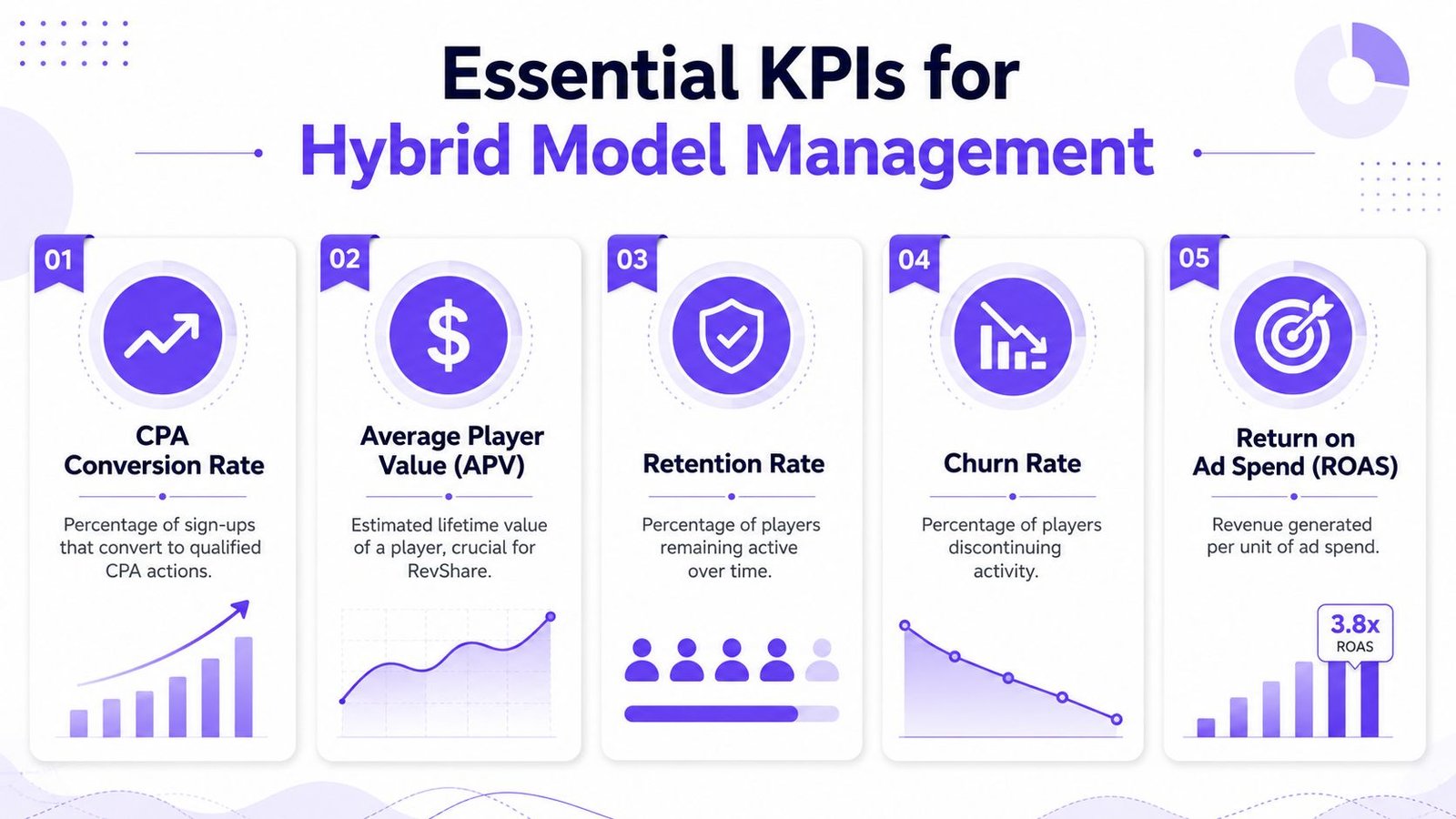
Prioritize these KPIs in the dashboard:
- Effective CPA over time: Measure acquisition cost after revenue accrual, reversals, and clawback logic. A partner can look efficient on day 7 and expensive on day 45.
- Average player value by cohort: Break this down by partner, GEO, product, and month of acquisition. Hybrid pricing should follow observed value, not headline volume.
- Retention and churn curve: Month-two and month-three activity usually tell you more than first deposit count about whether a hybrid split is too rich or too tight.
- NGR quality: Track bonus cost, payment reversals, chargebacks, and winner concentration. Gross revenue without quality controls gives a false read on partner value.
- Qualification-to-value ratio: Compare the number of users who cleared CPA conditions with the share who later produced enough NGR to justify the revenue share component.
- Payback period: Measure how long it takes for combined commercial spend to return to break-even. This is one of the fastest ways to spot hybrids that scale badly.
- Exposure to negative carryover by partner: Even before contract terms are adjusted, operators should see which cohorts create earnings volatility and which ones generate stable monthly contribution.
Put acquisition and revenue data in the same operating view
Hybrid reporting breaks when attribution sits in one system and revenue sits in another. The affiliate team sees traffic and deposits. Finance sees commission liability. Compliance sees account status in a separate workflow. Nobody sees the live economics of the deal in one place.
That is a process problem, not a reporting inconvenience.
A proper ad tracker software setup for iGaming campaigns should reconcile click, registration, deposit, net revenue, clawback events, and final payout at source level. Without that unified view, dynamic hybrids are managed with spreadsheets and lagging exports. At scale, that usually means overpaying average partners and underinvesting in the few that compound value.
I look for one practical outcome here. If a partner manager cannot explain current eCPA, current accrued RevShare, and expected margin on the same screen, the model is too hard to govern.
Use KPI patterns to change the deal, not just describe it
The point of KPI tracking is commercial action. Good teams use these signals to reprice, cap, pause, or expand hybrid terms before the margin problem becomes a quarterly finance issue.
| KPI pattern | Operational response |
|---|---|
| High qualification, weak retention | Cut upfront exposure, tighten qualification rules, or shorten the test window |
| Moderate volume, strong revenue depth | Shift more value into RevShare and review whether the CPA is still needed at the same level |
| Good retention, low source transparency | Keep the hybrid structure but delay full payout until validation clears |
| High bonus cost, acceptable retention | Adjust NGR definitions, promo eligibility, or CPA thresholds |
| Stable value and predictable payback | Extend terms carefully and reserve custom economics for verified scale |
A useful rule in practice is this. If a partner only works at FTD level, the hybrid is priced on hope, not on evidence.
The operators that manage hybrids well do not chase volume in isolation. They track contribution quality, payout timing, cohort behavior, and reporting integrity as one operating system. That is how hybrid models stay profitable when regulation tightens, traffic mix shifts, and affiliate portfolios grow beyond manual management.
Advanced Risk Management and Optimization
Operators that run hybrids at scale usually lose margin in two places. Event timing and contract wording. The commission split gets the attention, but negative carryover, clawback logic, bonus deductions, and validation rules decide whether the deal keeps paying back after month three.
Negative carryover changes the real share rate
Negative carryover needs to be priced into the deal before launch, not argued about after a high-value winner hits. A nominal RevShare rate can look strong and still produce weaker economics over time if losses roll forward and suppress future earnings. The BigBetty analysis of RevShare versus CPA models highlights that problem clearly, showing that 35% RevShare without carryover outperforms 40% with carryover over 12 months.
That trade-off matters more in regulated markets where product mix, bonus rules, and player protection controls can change net revenue behavior fast. If an affiliate sends a small number of high-stakes players, carryover can turn a healthy hybrid into a long recovery cycle. If the source drives steady recreational traffic, the same clause may be manageable. The point is to price the risk according to the traffic profile, not treat carryover as standard boilerplate.
In practice, I prefer to set carryover rules by partner type and GEO, then review them against cohort volatility each month.
Static clawbacks miss quality deterioration
A fixed validation window gives finance a simple rule. It does not give the operator enough protection when source quality shifts inside the month.
The stronger approach is a clawback-adjusted CPA tied to early-value events and churn signals. According to the Track360 write-up on AI-assisted affiliate commission models, real-time tracking supports dynamic validation periods of 15 to 30 days and can reduce acquisition costs by 25% to 40% versus static commission structures. That is the difference between paying for verified acquisition and paying for a deposit that never turns into usable revenue.
This matters most when affiliates scale quickly, media buying changes, or a source starts pushing incentivized traffic that still slips through a basic FTD rule. A player who deposits, clears the trigger, then refunds, self-excludes, fails KYC, or goes inactive immediately should not carry the same CPA value as a player who passes the early activity checks your margin model depends on.
Fraud controls need to sit upstream of accrual
Hybrid deals break when commission accrues before quality is confirmed. The gating logic should sit ahead of both the CPA release and the RevShare start date.
Use a qualification stack that matches your actual risk exposure. Common gates include minimum deposit, KYC completion, first wager or trade, no duplicate account flag, and activity inside a defined period after registration. Operators that miss this usually discover the problem in reconciliation, after the cost is already booked.
The same issue applies to data governance. If validation events, consent logs, and payout records are split across tools, teams struggle to defend payment decisions during compliance reviews or partner disputes. In regulated programs, GDPR and data residency controls for iGaming affiliates belong inside commission operations.
Dynamic deal adjustment beats annual repricing
The best hybrid programs do not wait for a quarterly review to fix a bad structure. They adjust terms as soon as cohort data proves the original pricing is off.
Track360 notes in its comparison of commission structures that operators often start with reduced CPA plus 20% to 25% RevShare, then move stronger partners into tiered bands of 25% to 40% as quality data builds. That progression works because it limits early downside while preserving upside for sources that provide depth, not just deposits. It also gives affiliate managers a fair basis for renegotiation. Terms rise because performance improved, not because the partner asked loudly enough.
A hybrid deal stays safe when payout logic follows verified player value, not just a first deposit event.
Platform Execution How to Automate Hybrid Models
Hybrid logic looks manageable in a spreadsheet when you have a handful of direct affiliates. It breaks when you add multiple brands, currencies, GEOs, validation windows, and exception rules. That’s the point where process design has to become system design.

The commission engine has to mirror the contract
Hybrid automation only works when the platform can represent the actual commercial terms. That includes reduced CPA, delayed RevShare activation, source-level qualifiers, sub-affiliate hierarchies, and exceptions for restricted markets or product lines.
When teams can’t model those conditions directly, they start handling part of the deal manually. That creates three predictable problems:
- Finance disputes because payout calculations don’t match contract terms.
- Affiliate distrust because self-serve reports differ from remittance totals.
- Compliance gaps because validation rules are applied inconsistently.
Real-time tracking changes what you can manage
Hybrid models depend on event timing. Did the player complete KYC? Did they place a first bet? Did they remain active during the validation window? Did the source clear the threshold required to trigger revenue share?
Those decisions need event-driven tracking, not delayed reconciliation. Operators that still rely on batched exports usually can’t support nuanced payout logic with confidence. They default to simpler deals because their tooling can’t carry the operational load.
That’s also why tracking architecture matters. Choosing between postback and callback tracking for affiliate attribution isn’t just a technical detail. It affects whether qualification events arrive reliably enough to automate hybrid triggers without manual intervention.
Why integrated execution matters
A dedicated affiliate platform becomes valuable when it removes seams between tracking, fraud control, commission accounting, and compliance logging. The point isn’t convenience. The point is consistency. If one system records the click, another records the deposit, and a third calculates payout, hybrid administration slows down and error rates climb.
In regulated iGaming, operators also need to handle:
| Operational need | Why it matters in hybrid management |
|---|---|
| Multi-brand reporting | One affiliate may send traffic to several brands under different terms |
| Multi-currency payout logic | CPA and RevShare obligations may settle differently by market |
| Fraud screening | Weak traffic should fail before payout accrual |
| Audit logs | Disputed commissions need traceable event history |
| Affiliate self-service | Partners need visibility into how hybrid earnings were calculated |
Genuine platform scale is demonstrated through evidence, not merely marketing language. iGamingXpert states $2.4B in annual tracked volume on its website, alongside real-time tracking, flexible commission models, fraud controls, compliance tooling, and multi-brand operations. At that level, hybrid management stops being a custom workaround and becomes a repeatable operating model.
Building Your Hybrid Model Implementation Roadmap
Most operators don’t need a full commission redesign overnight. They need a controlled sequence that replaces weak deals first and builds confidence with real partner data.
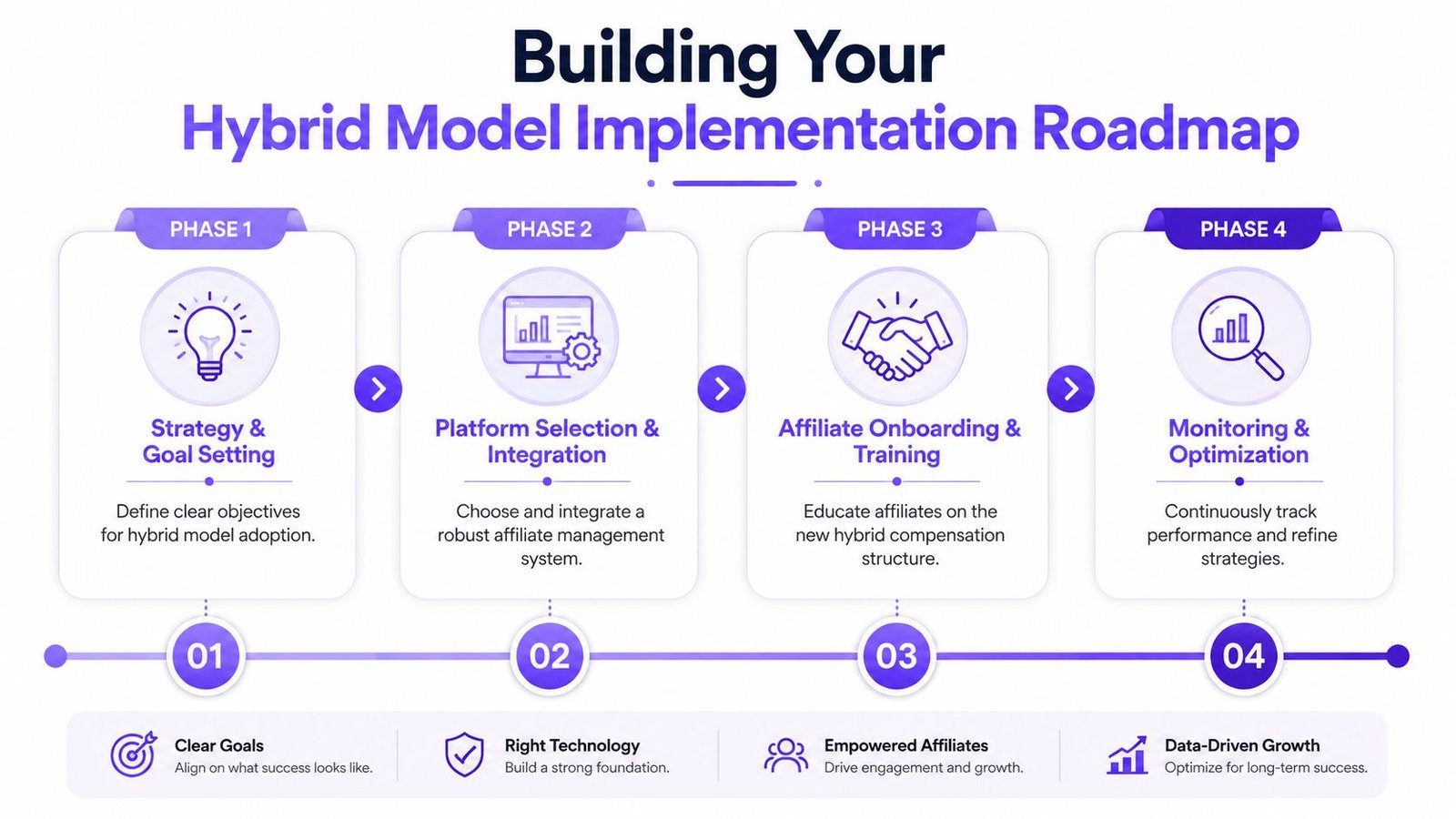
Use a phased rollout
Start with an audit of current affiliate economics. Pull every active partner into a simple review: qualification volume, early retention, NGR quality, payout model, and dispute history. You’re looking for misalignment. The usual pattern is easy to spot. Some partners are overpaid on CPA, some are under-monetized on RevShare, and a few are right for hybrid immediately.
Then segment partners by trust and traffic clarity. Trusted content affiliates, transparent media buyers, and proven direct partners should be first in line for pilot hybrids. Networks and opaque sub-affiliate sources usually need stricter gating before they earn more flexible terms.
Keep the first wave narrow
A clean rollout usually looks like this:
- Audit current deals. Identify where pure CPA is buying poor retention or where RevShare is too slow to attract good partners.
- Define partner bands. Group affiliates by source transparency, quality, and compliance risk.
- Launch limited pilots. Offer a small set of hybrid structures to selected partners with clear qualification terms.
- Automate reporting. Make sure payout logic, event validation, and affiliate-facing dashboards align.
- Review and iterate. Move strong partners toward better lifetime economics and tighten terms for weak traffic.
Start with partners you trust enough to learn from, not with the loudest negotiators.
The operators who manage hybrid models well don’t chase complexity for its own sake. They use it selectively, where it improves payback clarity, traffic quality, and relationship durability.
If you want to operationalize hybrid deals without relying on spreadsheets, iGamingXpert gives operators a single system for real-time tracking, flexible CPA and RevShare logic, fraud controls, compliance workflows, and partner payouts. It’s built for regulated iGaming teams that need to manage complex commission structures across brands, currencies, and jurisdictions with less manual work and better visibility.
