How to Spy on Ads in iGaming: A 2026 Playbook

💡 TL;DR: Effective iGaming ad intelligence requires mapping competitor systems—including landing pages, affiliate networks, and compliance—rather than just copying creatives, to reduce testing costs and manage traffic quality. While free resources like the Meta Ad Library are effective for initial creative and GEO monitoring, scaling requires paid tools that better understand partner behavior and ad history.
A familiar problem hits fast in iGaming. You spot a competitor’s bonus angle across Meta, TikTok, and search. Their affiliates start pushing it hard in one GEO, your click quality softens, and your team is left arguing over the wrong question. Not whether the creative is good, but whether the traffic behind it is real, compliant, and worth copying.
That’s where most guides on how to spy on ads fall short. They show databases and screenshots, but they don’t show the operating model. In this vertical, creative intelligence only matters if you can connect it to partner management, fraud controls, tracking, and GEO-specific compliance. Otherwise, you’re just collecting examples.
The market is big enough to punish guesswork. Global digital ad spending is projected to reach US$740 billion in 2026, commanding 73% of total media spend, which is why operators use ad intelligence to reduce testing costs before committing budget to new campaigns, according to Digital Applied’s 2026 digital advertising statistics. In iGaming, that matters more because a bad test doesn’t only waste spend. It can also expose weak compliance review, poor affiliate governance, and low-grade traffic sources.
Winning the iGaming Ad War Before It Starts
A losing week usually starts with incomplete visibility.
You see one ad in the wild. Maybe it’s a sportsbook welcome offer with a sharper hook than yours, or a casino angle framed around speed of payout rather than bonus size. Your acquisition team reacts by briefing new creatives. Your affiliate team asks which partners are pushing the offer. Compliance asks whether the same wording is even safe in your target market. Nobody has the full picture yet.
What competent ad spying actually means
In practice, to spy on ads well, you need to answer five questions before your team builds anything new:
- Which platforms are carrying the angle
- Which GEOs are seeing it
- Whether the ad is still active
- What funnel sits behind the ad
- Whether the apparent performance is clean or inflated
That’s the difference between casual competitive research and operational intelligence. If I’m reviewing a rival campaign, I don’t start by asking whether I like the video. I start by asking whether the message is broad platform filler or a repeatable acquisition pattern tied to a specific landing page and affiliate relationship.
Practical rule: Don’t copy the ad first. Map the system around it first.
Where most teams waste time
Teams usually fail in one of two ways.
Some stay too shallow. They monitor only creatives and never inspect the lander, tracking behavior, comments, or regional variations. Others go too broad. They subscribe to multiple tools, dump hundreds of ad screenshots into Slack, and still can’t tell which insights deserve production time.
A better workflow is narrower. Watch a defined competitor set. Save active ads by GEO. Group them by angle, not by brand. Then review the destination path, disclaimers, offer framing, and partner footprints. In regulated gambling, the ad itself is only one layer of the commercial logic.
A strong ad spy process gives you three things. Faster response, less wasted testing, and fewer compliance surprises.
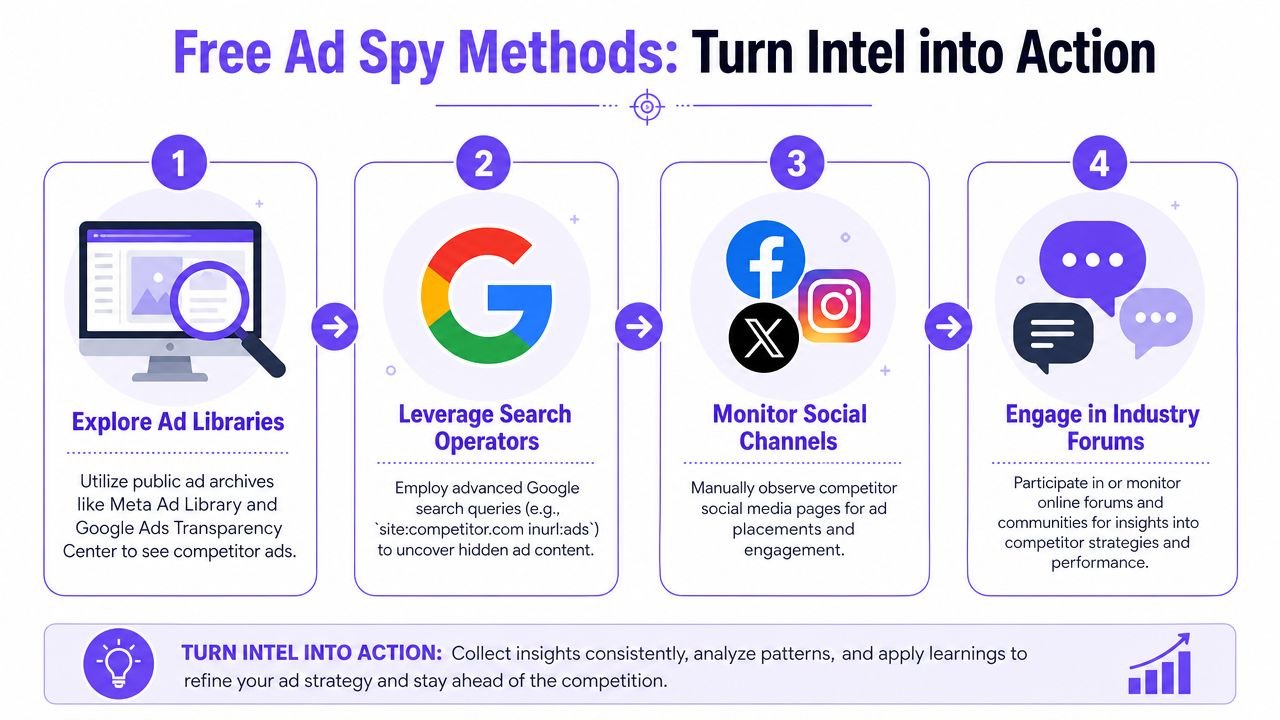
Free Ad Spy Methods That Yield Real Intel
Start free. Paid tools help later, but the foundation should come from public sources and manual verification.
The most useful no-cost asset in this category is Meta’s own library. The Meta Ad Library is the only free, official source providing real-time access to every active ad on Facebook and Instagram, and the key technical detail is easy to miss: you must search by an advertiser’s Facebook Page name to find their Instagram ads, as explained in Benly’s guide to ad spy tools.
Use Meta Ad Library the right way
Most affiliate managers search the brand name they know from Instagram and get partial results. That creates a false read on competitor activity.
Use this sequence instead:
- Find the Facebook Page first
Search the operator, affiliate brand, or media brand by Facebook Page name. If the Instagram handle differs from the Page, the Page still controls discoverability. - Set the delivery country carefully
The country filter is based on ad delivery, not your own location. That matters when you’re trying to separate UK-facing messaging from LATAM or emerging regulated GEO campaigns. - Filter by media type
Separate image, video, and carousel inventory. This quickly shows whether a competitor is testing broad static volume or committing to short-form video. - Check active versus inactive status
Active ads tell you what’s in market now. Inactive ads can still be useful for mapping seasonal offer changes, but they shouldn’t shape your immediate response.
Free methods beyond Meta
Meta is the strongest free source for social competitor work, but it shouldn’t be your only one.
- Google Ad Transparency Center gives you a direct view into search and YouTube advertiser presence. It won’t hand you profitability, but it helps identify message consistency across paid channels.
- TikTok Creative Center is useful for format and hook research. In iGaming, it’s often better for adjacent style research than direct regulated offer analysis.
- Manual social monitoring still matters. Watch page posting patterns, comment moderation, and cross-linking behavior between content pages and promo pages.
- Search operators can surface public ad-related pages, promo paths, and legacy landing structures that standard branded searches miss.
What free methods can and can’t tell you
Free libraries are excellent for three jobs:
| Free method use | What you can learn |
|---|---|
| Creative review | Hooks, offer language, visual patterns |
| GEO monitoring | Country-specific messaging and regulatory wording |
| Channel overlap | Whether the same campaign logic appears across platforms |
They are weak at three others:
- No reliable performance layer beyond visible persistence and public engagement signals
- No affiliate-specific indexing for partner IDs or network clues
- No operational fraud insight into what kind of traffic the ad is buying
Public ad libraries are best used as the first filter, not the final verdict.
If your team can’t extract useful patterns from free tools, a paid stack won’t fix the discipline problem.
Scaling Intelligence with Paid Ad Spy Tools
Free methods break when the volume gets serious. Once you’re tracking multiple brands, multiple GEOs, and affiliate-led distribution, manual review becomes too slow and too fragmented.
That’s when paid ad spy tools start earning their seat.
Worldwide ad spending in the Social Media Advertising market is projected to reach US$338.75 billion in 2026, and tools like AdSpy matter because they offer searchable databases of millions of ads across major platforms, including search by affiliate network and offer ID, according to HubSpot’s marketing statistics resource.
What separates useful tools from expensive noise
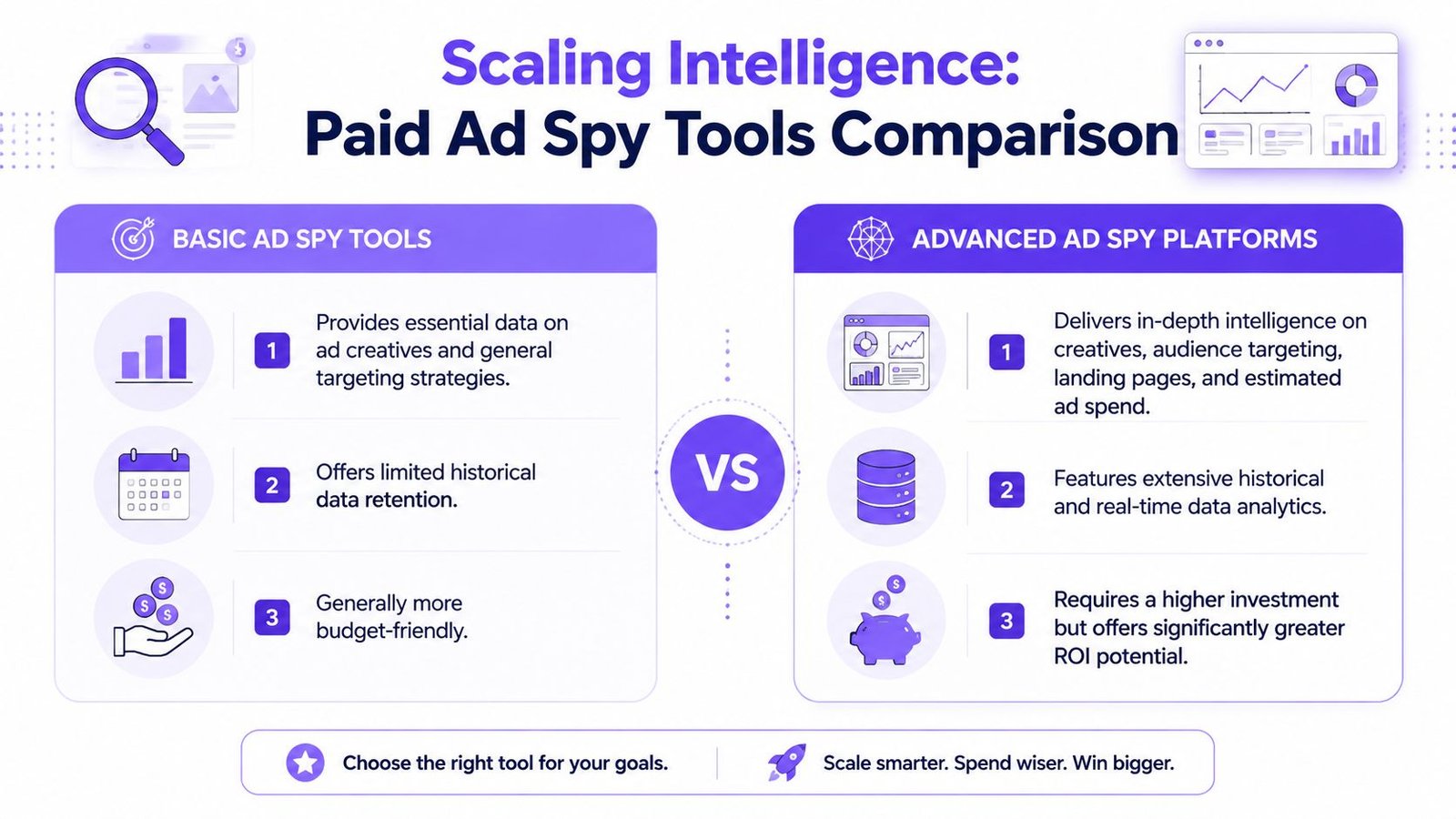
The distinction isn’t free versus paid. It’s shallow indexing versus operational search depth.
A basic tool helps you browse. A stronger one helps you isolate.
| Tool layer | What it’s good for | Where it fails |
|---|---|---|
| Basic ad spy tools | Quick creative lookup, rough competitor scans | Weak historical context, limited partner-level analysis |
| Advanced ad spy platforms | Search by offer structure, landing-page clues, affiliate patterns, media mix | Higher cost, more setup discipline required |
For iGaming affiliate work, I care about a few features more than flashy dashboards:
- Affiliate network and offer search because partner behavior often matters more than the operator brand itself
- Landing page technology clues because they reveal tracking maturity and funnel architecture
- Ad history visibility so you can separate one-week tests from campaigns with staying power
- Comment and reaction context because public feedback often reveals ad fatigue, moderation style, and user objections
AdSpy, BigSpy, and the practical trade-off
AdSpy is still useful when your focus is deep Meta research with partner-oriented filters. BigSpy becomes more attractive when you want broader platform scanning and don’t mind doing more manual validation afterward.
Neither tool should be treated as truth on its own.
That’s the mistake junior teams make. They assume if an ad appears frequently in a paid database, it’s a winner. In reality, the database is just showing visibility. You still have to decide whether that visibility reflects sustained economics, broad testing, or junk traffic.
A good paid stack also needs to connect to your tracking environment. If you’re evaluating software options for campaign surveillance and partner-level monitoring, it’s worth reviewing dedicated ad tracker software for iGaming affiliate programs alongside pure spy tools, because spying alone doesn’t solve attribution, payouts, or traffic validation.
A paid spy tool should reduce analysis time. If it only increases the number of ads you save, it’s not helping.
The buying decision most operators get wrong
Don’t buy based on platform count alone.
Buy based on the searches your team needs to run every week. If your core problem is Meta affiliate intelligence in regulated GEOs, depth beats breadth. If your team handles multi-channel creative response across social, display, and video, broader coverage matters more.
The best setup usually combines one official library for verification and one paid database for speed.
Advanced Technical Analysis Beyond the Ad Creative
A creative can tell you the angle. It rarely tells you why the campaign survives.
Most ad spy tools stop at the ad unit, which is exactly where serious analysis should begin. In iGaming, the monetization logic often sits deeper in the funnel. The lander, the redirect chain, the tracking method, the consent flow, the registration path, and the first deposit journey usually decide whether the campaign is durable.
Longevity matters more than novelty
One blind spot shows up over and over. Data shows 68% of winning iGaming ads run for over 30 days, yet few tools allow filtering by days active per GEO, which makes ad longevity and compliance harder to evaluate in regulated markets, according to Adligator’s analysis of gambling Facebook ad spy gaps.
That matters because a creative that survives across time is often backed by a stable funnel, not just a strong hook.
When I inspect a competitor path, I’m looking for signals like these:
- Lander structure. Is it a thin pre-sell, quiz flow, review page, or direct registration bridge?
- Consent implementation. Is there a visible GDPR or local privacy step, and is it consistent by GEO?
- Tracking style. Does the page rely heavily on client-side scripts, or does it indicate stronger server-side event handling?
- Offer continuity. Does the headline promise match what the registration path delivers?
What to inspect after the click
A quick technical teardown usually follows this order:
- Capture the ad and destination URL
- Review the page source for analytics, tag managers, and tracking scripts
- Check redirect behavior and whether the path changes by country
- Inspect consent language, age-gating, and responsible gambling disclosures
- Compare page variants across devices and GEOs
That last point gets missed a lot. Some competitors run a clean desktop path and a very different mobile path. Others serve different disclaimers or payout framing based on location.
If your own stack still relies too heavily on brittle browser-side attribution, it’s worth understanding the distinction between postback and callback tracking in affiliate systems. That choice affects how confidently you can validate the insights you collect from competitor funnels.
The ad wins attention. The funnel wins margin.
A mature team doesn’t just spy on ads. It reverse-engineers delivery logic, tracking discipline, and compliance resilience.
Decoding Performance The Metrics That Matter
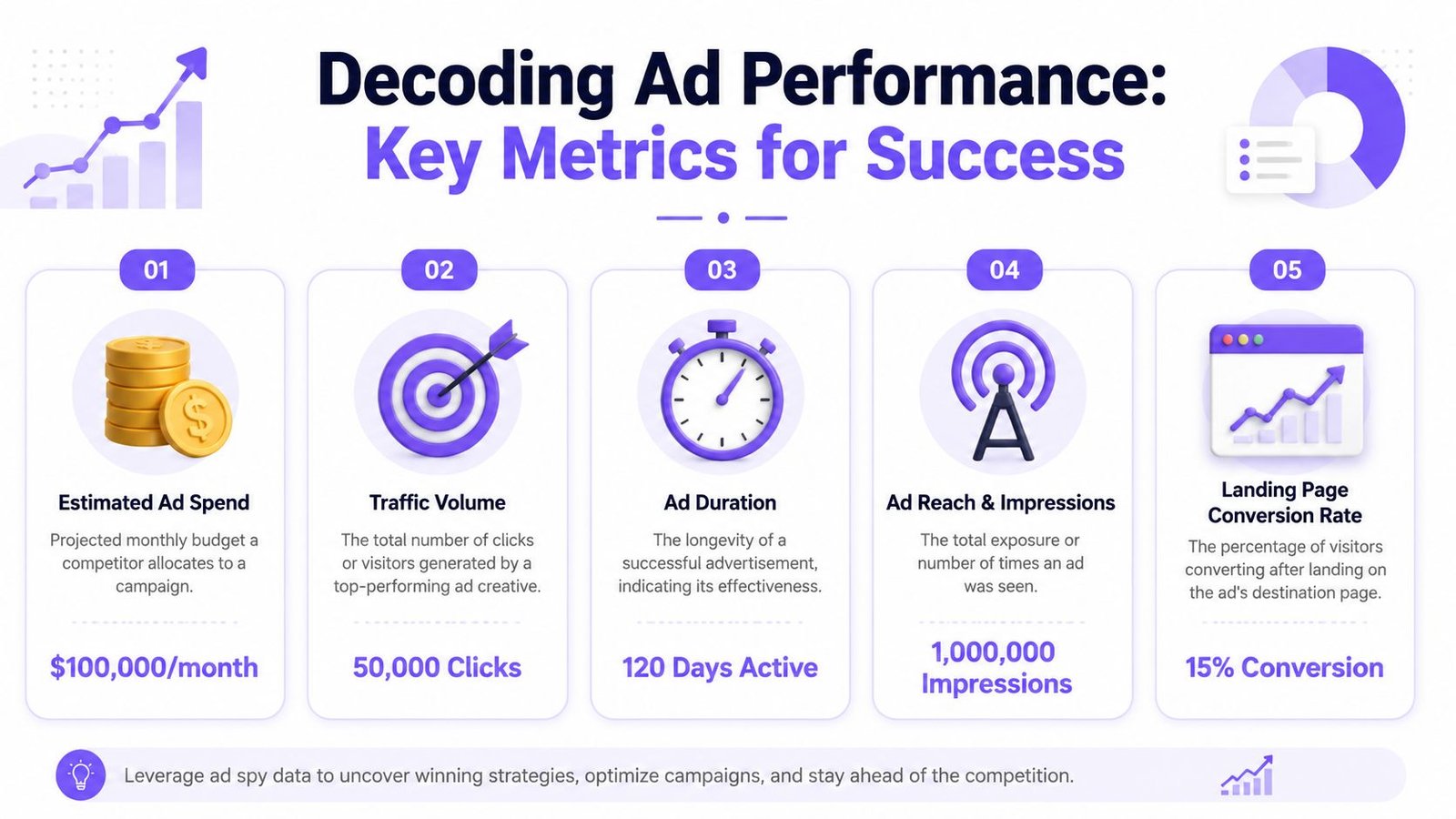
Spy tools tempt people into chasing the wrong signals. Big engagement counts, lots of variants, flashy formats, constant new launches. None of that guarantees profitable acquisition.
In iGaming, the better question is simple. If you copied this pattern tomorrow, would it produce clean depositing traffic or just expensive noise?
Global invalid traffic rates reached 20.64% in 2025, with approximately $84 billion annually attributed to fraud, and a click-to-conversion time under 5 seconds is a key technical sign of attribution injection, according to Improvado’s ad fraud analysis.
Read spy data like an operator, not a designer
The performance signals I care about fall into two groups.
| Signal group | What to review | Why it matters |
|---|---|---|
| Commercial indicators | Ad persistence, funnel consistency, repeated offer framing, partner overlap | Suggests an angle may be producing acceptable economics |
| Traffic-quality indicators | Conversion timing, geography consistency, device repetition, platform-to-analytics discrepancy | Helps identify fraud, stuffing, or low-intent traffic |
You won’t get a clean EPC or ROI number from a competitor ad database. Anyone pretending otherwise is selling fantasy. But you can still make informed judgments by combining visible ad behavior with your own traffic quality standards.
The fraud checks that stop bad copying
A suspicious campaign often looks attractive on the surface. Fast growth. Busy affiliate activity. Plenty of creative variations.
Then the quality checks start failing.
- Click-to-conversion time under 5 seconds is a major warning sign. That often points to attribution injection, not user intent.
- Geo-IP mismatches deserve immediate scrutiny. If device and network signals don’t align, don’t treat the campaign as a clean benchmark.
- Repeated device fingerprints across many sessions can indicate farmed or automated traffic.
- Large discrepancies between platform clicks and analytics sessions suggest something is being fabricated or lost in transit.
- Low viewability placements can indicate stacked or hidden inventory rather than genuine exposure.
The trap here is obvious. If you spy on ads but ignore traffic integrity, you can end up copying a fraud-assisted growth pattern.
If the conversion path is too fast to be believable, it probably is.
What works in real evaluation
A disciplined review of competitor activity usually looks like this:
- Validate the ad is active and not a stale artifact
- Assess whether the landing path is commercially coherent
- Check whether the implied traffic behavior would pass your own fraud rules
- Decide whether to test the angle, not replicate the exact execution
That last line matters. Good teams borrow structures. Bad teams borrow symptoms.
In regulated gambling, profitable media buying isn’t just about finding the loudest ad. It’s about identifying the angle that can survive compliance review, affiliate rollout, and fraud screening once real traffic starts hitting your offer.
From Insight to Action Integrating Spy Data into iGamingXpert
Competitive research only earns money when it enters the operating stack.
The practical workflow is straightforward. You identify a competitor angle that appears durable. You translate that angle into a brief for approved affiliates or internal acquisition channels. Then you track whether the incoming traffic behaves like real users, not just like promising volume.
That final step is where most ad spy setups collapse.
A common user question is whether spy tools can detect bot traffic. The answer is no. With 42% of iGaming campaigns losing revenue to bots, operators must integrate spy data into a platform with real-time fraud controls to validate traffic quality and ensure intelligence leads to profit, not loss, according to RichAds’ review of native advertising spy tool limitations.

The operating workflow that closes the loop
Here’s the process that works better than keeping ad research in a separate folder and hoping somebody acts on it.
Step one pulls in market intelligence
Your team captures competitor ads by GEO, media type, and funnel pattern. At this stage, the objective isn’t to copy. It’s to isolate a message structure that appears sustainable and compliant enough to adapt.
Step two turns intel into partner-ready assets
The affiliate team builds a controlled rollout. That means approved copy variants, allowed geographies, restricted claims, landing page mapping, and tracking links that can be monitored in real time.
Step three validates quality before scale
Once traffic starts, the evaluation shifts from ad observation to traffic proof:
- Watch live click and conversion patterns instead of waiting for delayed batch reports
- Segment by affiliate, campaign, and GEO because weak traffic often hides inside blended reporting
- Block duplicates and bot-like sessions early so cost doesn’t accrue while someone debates performance
- Compare conversion speed and source consistency against the fraud markers already discussed above
For teams that need a deeper fraud-control layer around affiliate traffic, this breakdown of AI-driven affiliate conversion fraud prevention in iGaming is a useful reference point.
Why this model works better than pure spy tooling
A standalone spy tool can tell you that a rival is pushing a welcome bonus through a specific creative format.
It can’t tell you whether your affiliate running a similar angle is sending legitimate users, duplicate accounts, hijacked attribution, or non-compliant traffic from the wrong GEO. An integrated platform can.
That forms the key connection between competitive intelligence and profitable affiliate management. Research identifies the opportunity. Tracking, fraud prevention, payout logic, and compliance controls determine whether the opportunity is real.
The standard to hold your process against
If your team can’t answer these questions inside one workflow, you’re still operating with a gap:
| Operational question | Why it matters |
|---|---|
| Which partner used the angle | Needed for accountability and deal management |
| Which GEO converted cleanly | Critical for regulated expansion and compliance review |
| Whether conversion timing looked natural | Fast way to catch manipulated attribution |
| Whether the traffic stayed profitable after validation | The only result that matters |
Spying on ads is useful. Connecting those insights to affiliate execution is what makes it commercially serious.
iGaming operators don’t need another swipe file. They need a system that ties ad intelligence to live tracking, partner management, fraud prevention, payouts, and compliance. iGamingXpert was built for that job, with real-time reporting, flexible commission models, server-to-server attribution, audit-ready compliance controls, and automated traffic quality protection in one platform.
