AI Optimization for Affiliate Traffic: Boost ROI in 2026

AI-based affiliate marketing can increase sales by as much as 30%, according to industry analysis on automation in affiliate marketing from SitePlug’s review of AI and automation in affiliate marketing. In iGaming, that headline number matters less as a vanity claim and more as a warning. Operators who still run affiliate traffic on delayed reports, loose attribution, and manual partner decisions are making optimization calls with stale data.
That gap gets expensive in regulated markets. The problem isn’t just buying more traffic. It’s identifying which partners, campaigns, and player segments produce durable value while staying inside compliance rules, filtering fraud early, and protecting the LTV:CPA equation that decides whether an affiliate program scales or bleeds margin.
AI changes affiliate traffic when it’s applied operationally. It scores traffic quality in real time. It catches patterns a manager won’t see in a spreadsheet. It shifts budget before poor traffic compounds. It also forces a stricter discipline around data structure, tracking, and deal design. In iGaming, that’s the difference between a smart program and a noisy one.
The New Affiliate Playbook AI and Automation
A team running affiliate traffic across several GEOs can lose margin in a single reporting cycle if source quality drops, compliance flags pile up, or fraud slips through before commission validation. That is the practical reason AI has moved from a nice-to-have test into daily operations for iGaming affiliate teams.
The old model relied on partner relationships, delayed reports, and manual reviews. That approach can hold up with a small portfolio. It starts to fail when one manager is monitoring multiple brands, dozens of affiliates, shifting local rules, and traffic patterns that change by hour, device, promo angle, and registration flow.
AI changes the operating cadence. Instead of waiting for month-end summaries, teams can score traffic quality while campaigns are live, spot unusual conversion patterns before payouts are approved, and adjust exposure before weak cohorts distort the LTV:CPA ratio. In regulated iGaming, that matters more than generic automation claims. Fast optimization is useful. Fast optimization with audit trails, fraud checks, and market-specific controls is what protects margin.
The Practical Changes in iGaming
In iGaming, AI usually sits inside four operating decisions that affect profit every day:
- Traffic qualification: scoring affiliates and sub-sources based on deposit quality, retention signals, chargeback risk, and rule compliance, not just raw FTD volume.
- Budget control: shifting caps, bids, and source weighting during the campaign window, before low-value traffic consumes budget.
- Fraud detection: identifying duplicate account patterns, abnormal registration clusters, bonus abuse signals, and suspicious post-click behavior before commissions are finalized.
- Cohort-based acquisition: judging traffic on what players do after signup, including second deposit rate, net gaming revenue trend, and early churn.
One rule applies across all four. If optimization stops at the first deposit, the model is training on the wrong outcome.
That is where many affiliate programs underperform. They use AI to improve conversion rate, but they do not connect that model to downstream player value, compliance events, or fraud review. The result looks efficient in the dashboard and weak in the P&L.
Human judgment still carries weight. Affiliate directors still need to decide which partners fit the brand, which GEOs justify aggressive acquisition, and where a hybrid deal makes more sense than CPA. AI handles the pattern recognition and monitoring load that a team cannot cover manually. People make the commercial and regulatory calls.
What fails in practice
The failure points are usually operational, not technical:
- Attribution is incomplete. If source IDs, click paths, or postback events are inconsistent, the model optimizes toward noise.
- Commission logic rewards the wrong behavior. A payout structure tied to shallow acquisition will attract shallow acquisition.
- Fraud checks happen too late. If finance is the first team to notice a traffic problem, acquisition data has already been polluted.
- Compliance is treated as a separate workflow. In regulated markets, promo rules, GEO restrictions, and approval status need to sit inside campaign execution, not outside it.
A purpose-built platform matters here because execution is the hard part. iGamingXpert gives teams one place to track affiliate performance, validate traffic quality, monitor deal economics, and apply controls before bad traffic scales. That is the new playbook. Less manual review, tighter feedback loops, and optimization based on player value you can defend.
Decoding Affiliate Commissions CPA RevShare and Hybrids
Commission structure decides what kind of traffic your affiliate program attracts. In iGaming, that decision affects far more than acquisition cost. It shapes player quality, chargeback exposure, bonus abuse, and how quickly a source moves from profitable to unworkable in a regulated market.
AI helps teams spot those patterns faster, but the commercial model still sets the incentive. If a partner gets paid the same for a low-value First-Time Depositor and a player who stays active for six months, the partner has no reason to optimize for quality unless the deal forces that behavior.
CPA, RevShare, CPL, and Hybrid in operational terms
CPA pays a fixed amount for a qualified action, usually an FTD. It gives operators clean budgeting and fast scaling, which is why paid-search affiliates, media buyers, and high-volume comparison sites often prefer it. The downside is simple. CPA can reward speed over durability, especially in GEOs where deposit intent is weak or promo abuse is common.
RevShare pays the affiliate a percentage of net gaming revenue over time. That usually aligns better with retention, deposit depth, and player value, but it also creates margin volatility. In markets with heavier taxation, bonus costs, or negative carry disputes, RevShare needs tighter reporting and clearer contract terms than many teams expect.
CPL pays for a lead before deposit. Some operators use it for pre-registration funnels or CRM-heavy onboarding paths. In practice, CPL needs strict validation rules in regulated iGaming because loose lead definitions invite poor-quality volume, duplicate records, and compliance risk.
Hybrid combines an upfront payment with revenue share. For many affiliate programs, this is the most commercially useful option because it gives the partner early cash flow while keeping part of the incentive tied to downstream value. It also gives the operator room to reduce pure-CPA exposure without losing strong partners who want faster payouts.
Comparison of iGaming Affiliate Commission Models
| Model | How It Works | Operator Risk | Best For |
|---|---|---|---|
| CPA | Pay a fixed amount for a qualified acquisition such as an FTD | Overpaying for low-value players if quality checks are weak | Media buyers, comparison sites, fast-scaling acquisition |
| RevShare | Share player revenue with the affiliate over time | Revenue unpredictability and longer margin realization | Content partners with strong trust and recurring player value |
| CPL | Pay for approved leads before deposit | Lead inflation and poor conversion if lead criteria are loose | Narrow funnels with strict qualification layers |
| Hybrid | Combine fixed acquisition payout with revenue share | More setup complexity and ongoing auditing | Strategic partners where scale and quality both matter |
The metric that matters more than payout type
The critical test is not whether a deal is CPA or RevShare. The ultimate determinant is whether the traffic holds its margin after compliance checks, fraud screening, bonus cost, and retention behavior are included.
That is why affiliate directors track LTV:CPA, not headline acquisition cost alone.
A CPA deal can work well if the source produces players with stable net revenue and low operational friction. A RevShare deal can still underperform if the partner sends low-intent users, bonus hunters, or traffic from GEO segments that clear registration but fail KYC or self-exclude early. Hybrid deals often perform best when the operator wants volume but still needs protection against shallow value.
How strong teams choose the right model
The right commission model depends on partner type, GEO, and your ability to verify quality fast.
Use CPA when:
- the source has a stable history of approved FTDs
- fraud and duplicate account rates are low
- compliance review can happen quickly
- the source performs well on short payback targets
Use RevShare when:
- the affiliate influences longer research journeys
- player retention matters more than front-end volume
- the GEO has enough maturity to support delayed return
- both sides trust the reporting model
Use Hybrid when:
- the partner wants upfront economics
- the operator wants to cap pure CPA risk
- player value varies by brand, GEO, or product mix
- the account needs room for renegotiation based on cohort quality
Use CPL carefully:
- only with narrow qualification rules
- only when lead validation is automated
- only when compliance and KYC teams agree on acceptance criteria
Where AI improves commission decisions
AI is useful here because it helps teams adjust deals before a bad pattern becomes expensive. Instead of waiting for a full cohort to mature, operators can score affiliates on early indicators such as approved FTD rate, second deposit rate, KYC completion, chargeback risk, promo concentration, and source-level fraud anomalies.
That changes how commission reviews work. A partner that looks strong on raw volume might need a lower CPA, stricter qualification terms, or a move to hybrid if the downstream value is weak. Another partner with lower volume might deserve better terms because its cohorts retain, comply, and generate stronger net revenue.
Execution matters. Affiliate ad tracker software gives teams the source-level visibility needed to compare deal terms against actual traffic quality, postback accuracy, and partner performance before commission leakage gets expensive.
Good affiliate managers do not ask which payout model is best in general. They ask which model fits this partner, this GEO, and this margin profile. In regulated iGaming, that is the difference between buying deposits and building profitable player books.
How AI Finds High-Value iGaming Players
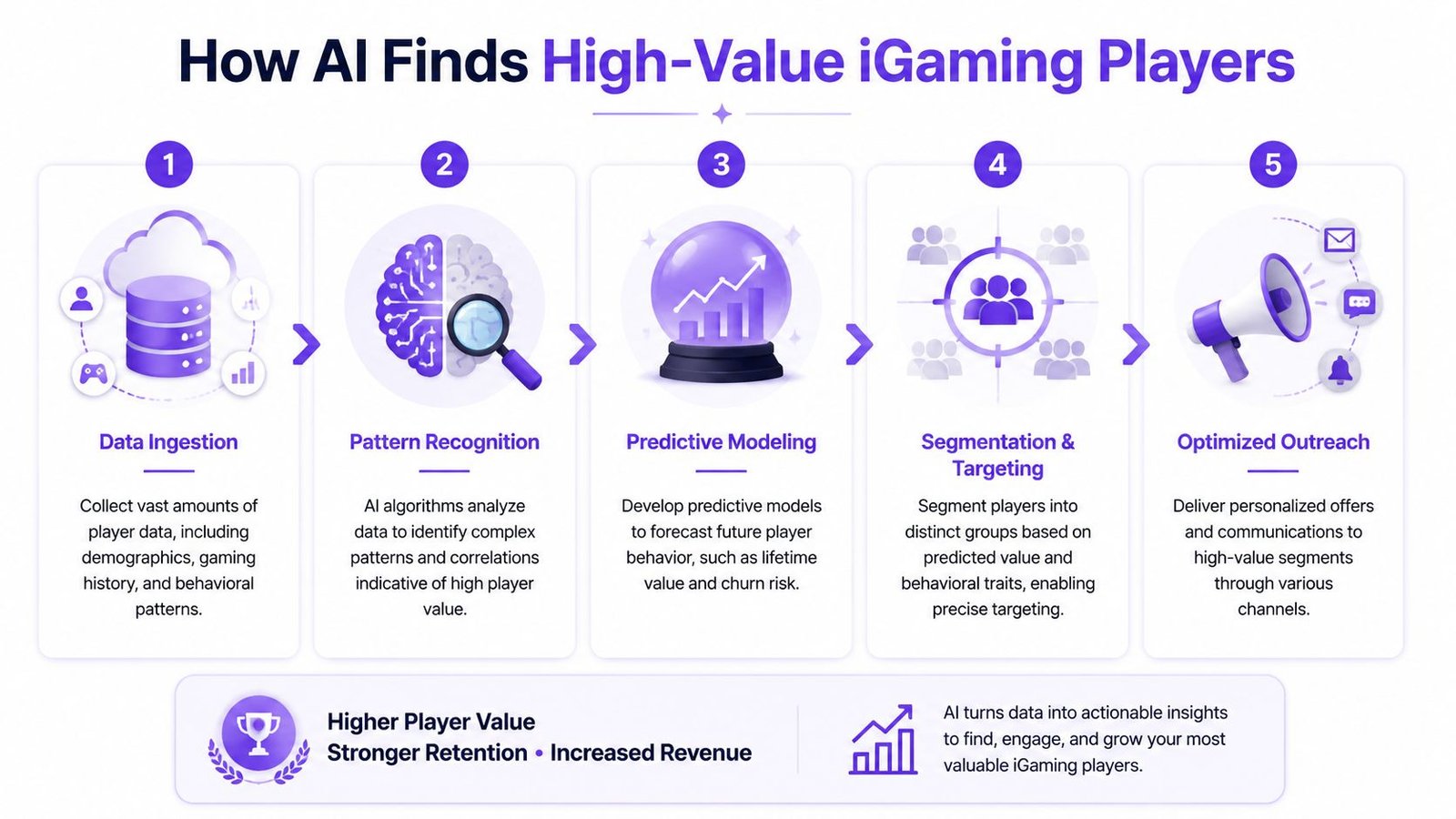
AI earns its place when it helps teams identify traffic that is likely to produce durable player value, not just cheap conversion events. In iGaming, that means combining acquisition signals with behavioral context and then acting on that output while traffic is still flowing.
Predictive scoring before the cohort matures
The first mechanism is predictive LTV scoring. AI models take early-session and acquisition attributes, then estimate which users resemble higher-value players. In iGaming, useful inputs often include GEO, device class, time-of-day behavior, landing-page path, and source-level patterns.
Operators cannot afford to wait for months of player history before deciding whether a traffic source deserves more budget. The model gives a directional view early. It won’t be perfect, but it’s far better than treating every FTD as equal.
Real-time traffic source analysis
The second mechanism is source scoring. AI systems monitor current traffic conditions and compare them with historical quality patterns. When one affiliate source starts sending a different type of user, the system can surface that change quickly.
A concrete example comes from MGID. Its CTR Guard tool improves viewable click-through rate by an average of 29% by analyzing behavioral signals and mitigating ad fatigue without manual intervention, as described in MGID’s guide to AI for affiliate marketing. The iGaming lesson isn’t limited to native ads. It’s that behavioral signal analysis can catch performance deterioration before a manager spots it in a delayed report.
For teams running serious media and affiliate operations, an ad tracker for iGaming campaigns becomes the connective layer between source data and optimization logic.
Automated budget allocation
The third mechanism is budget movement. Once the system has confidence in source quality, it can support rules or automated actions such as:
- Reducing exposure to traffic segments showing weak intent signals
- Prioritizing high-quality windows where conversion behavior and player value line up
- Suppressing fatigued creatives or placements before they drag overall efficiency down
AI should make fewer traffic decisions irreversible. If a source weakens, the system should cut exposure quickly enough that the mistake stays small.
Where teams get this wrong
Two mistakes show up often.
First, they ask AI to optimize broad traffic classes without enough granularity. “Affiliate traffic from GEO X” is too blunt. The useful layer is source plus device plus session behavior plus compliance status.
Second, they overtrust black-box scores. A model can recommend shifting spend. The affiliate director still needs to know why. If the team can’t inspect the signal drivers, they’ll miss fraud patterns, compliance edge cases, or partner-level context the model doesn’t see.
Essential KPIs for Your AI-Powered Affiliate Program
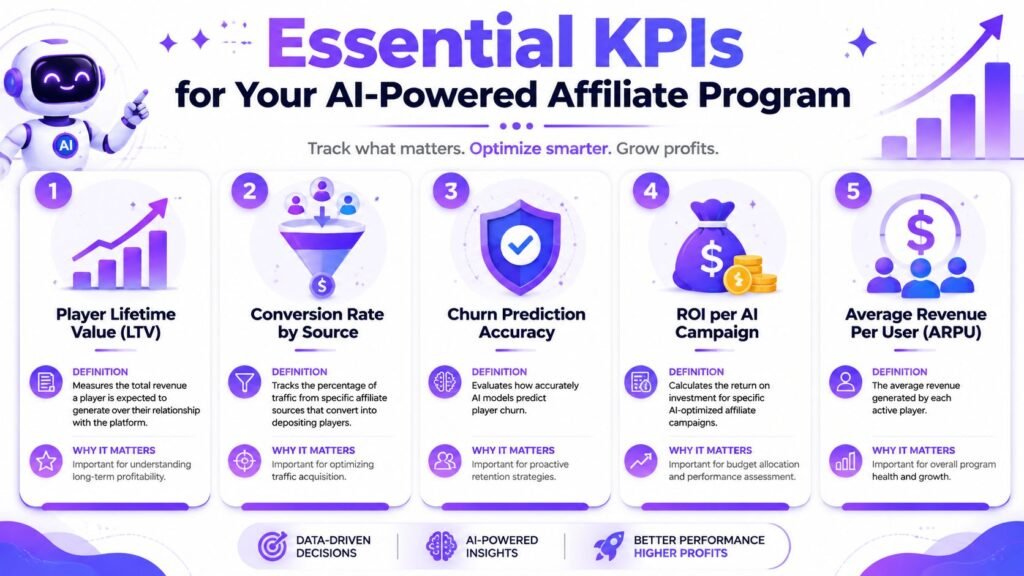
A program can post strong signup numbers and still lose money. In regulated iGaming, the KPI set has to show whether affiliate traffic produces compliant, retained, revenue-generating players, not just deposits.
Start with the north star
The core number is LTV:CPA. That ratio decides whether a source deserves more budget, tighter controls, or a hard cap. If acquired players do not generate enough value to cover acquisition cost with margin left over, the traffic is not good traffic.
In practice, I do not look at LTV:CPA as a headline metric alone. I break it down by affiliate, GEO, product, device, and approval status. A partner can look efficient at account level and still hide unprofitable segments, especially in markets where compliance checks, bonus policy, and payment friction affect who reaches first deposit and who stays active after it.
The supporting KPIs that actually change decisions
The best supporting metrics are the ones that help the team act before payout periods close or fraud losses accumulate.
Keep the reporting stack tight:
- Click-to-FTD rate: Measures whether the source, offer, and landing flow are aligned. A drop often points to traffic mismatch, weak intent, or broken routing.
- CPA recovery window: Shows how long it takes net gaming revenue or rev share to cover acquisition cost. Slow recovery changes how aggressively you can scale.
- Retention by cohort: Tracks whether players remain active after day 7, day 30, and later periods used in your internal forecasting.
- FTD-to-qualified-player rate: Separates raw deposit volume from players who pass checks, stay active, and fit the program’s value profile.
- Fraud and compliance exception rate: Flags duplicate accounts, bonus abuse, chargebacks, restricted GEO activity, or partner traffic that creates regulatory exposure.
- Net revenue contribution by partner: Shows which affiliates produce durable value after deductions, not just first-month volume.
Weak programs usually drift off course. They reward clicks, registrations, or even first deposits without checking whether those users survive KYC, avoid fraud flags, and generate enough downstream revenue to justify the deal.
How AI should use these KPIs
AI models should score traffic on predicted future value, but the model only helps if the input data is clean and joined correctly. That usually means combining tracker data, affiliate source IDs, CRM events, deposit behavior, fraud signals, and compliance outcomes through affiliate data integrations for iGaming teams.
Once that data is connected, AI can do useful operational work:
- Prioritize sources with strong projected LTV:CPA. This improves budget allocation without waiting for full revenue maturity.
- Detect quality decay early. If a partner’s click-to-FTD rate holds but retention weakens, the system should flag that source before the monthly report.
- Separate scale from risk. A source can send volume and still become a liability if exception rates rise or approved-player quality falls.
- Feed decisions back into campaign rules. Reduce exposure, adjust caps, reroute traffic, or revise partner terms based on observed cohort performance.
Operator view: The dashboard should answer a hard budget question in under a minute. Which partner can take more spend today without hurting margin or increasing compliance risk?
What to stop rewarding
Stop rewarding raw top-of-funnel volume.
In regulated markets, a traffic source can look strong on clicks and first deposits while failing on the metrics that protect profit. Low retention, poor CPA recovery, suspicious conversion patterns, and compliance exceptions all reduce the actual value of that traffic. AI improves decision speed, but it does not fix a bad KPI model. The program has to define success in business terms first, then let automation optimize toward that target.
AI Optimization Scenarios in iGaming
A single weekend swing in source quality can erase margin fast in iGaming. The affiliates that protect profit are the ones using AI to catch changes in player value, fraud risk, and compliance exposure before payout liabilities build.
Scenario one: GEO demand shifts faster than manual reporting
A sportsbook campaign enters a high-volume match window across several approved markets. Early traffic from one GEO looks healthy on first deposits, then mobile conversion quality slips late in the evening. At the same time, a second GEO starts producing stronger approved deposits from a narrow mix of browser, device, and screen-size combinations.
Country-level reporting is too blunt for that situation. The useful view is source quality by device, OS, browser, screen size, time window, and market. AI can score those combinations in real time, then recommend changes to caps, routing, or partner weighting based on projected value, not just raw volume.
The trade-off is clear. In regulated markets, aggressive reallocation can improve CPA recovery, but only if the traffic remains within approved GEO, creative, and channel rules. The model cannot chase conversion spikes blindly. It has to respect licensing boundaries and compliance logic while optimizing.
Scenario two: conversion spikes that look profitable and turn expensive
A partner with stable weekly output suddenly sends a sharp rise in conversions. An inexperienced team sees growth. An experienced affiliate manager checks approval rates, deposit timing, duplicate account patterns, payment-method concentration, and retention signals before increasing exposure.
AI is useful here because it compares live behavior against the partner’s historical baseline. If click patterns, session depth, device clustering, or FTD timing move outside the normal range, the system should flag the source for review. In practice, that means holding commission approval, reducing caps, or sending the traffic into a stricter QA workflow until the pattern is explained.
Fast action depends on connected systems. Teams that run fraud review, attribution, and payout control from the same event stream can react before bad traffic turns into booked commission. That is much easier with iGaming affiliate integrations that connect tracking, partner, and revenue data.
Scenario three: the partner sends volume, but LTV collapses after day 7
This is common in casino and sportsbook acquisition. A source keeps delivering acceptable CPA on first view. The problem only appears after the first week, when retention drops, bonus costs rise, chargeback rates increase, or net gaming revenue fails to mature.
Manual reviews usually catch this too late. By the time finance reconciles the cohort, the affiliate has already been scaled.
AI can model early-life indicators against historical cohorts and estimate whether that new traffic is likely to recover acquisition cost. That changes how the team responds. Instead of pausing the partner outright, the program can lower bids, shift the source to a hybrid deal, tighten bonus exposure, or isolate traffic by sub-ID until quality stabilizes. That is how experienced teams protect LTV:CPA without cutting off every source that shows temporary volatility.
Scenario four: AI search influences the player journey before attribution catches up
Affiliate traffic no longer starts and ends with a tracked last click. AI search and answer engines are changing how players discover brands, especially for comparison terms, bonus research, and bookmaker credibility checks.
Some content partners now shape consideration earlier in the journey than standard attribution reports show. A publisher may influence brand recall, bonus understanding, or trust signals without getting the final tracked click. That creates a real operating problem for affiliate directors. If the commission model only rewards the closing interaction, the program can underfund partners that contribute to qualified demand upstream.
The answer is not to abandon performance discipline. It is to test contribution with better tagging, assisted-path analysis, brand-lift signals, and content-level cohort reviews, then decide where hybrid structures or custom terms make economic sense.
AI helps in iGaming when it is tied to actions operators can take. Reweight traffic by market. Freeze suspect sources. Reprice partner terms. Protect compliance. Push more budget toward cohorts that are likely to produce durable net revenue, not just fast deposits.
Managing AI-Driven Campaigns with iGamingXpert
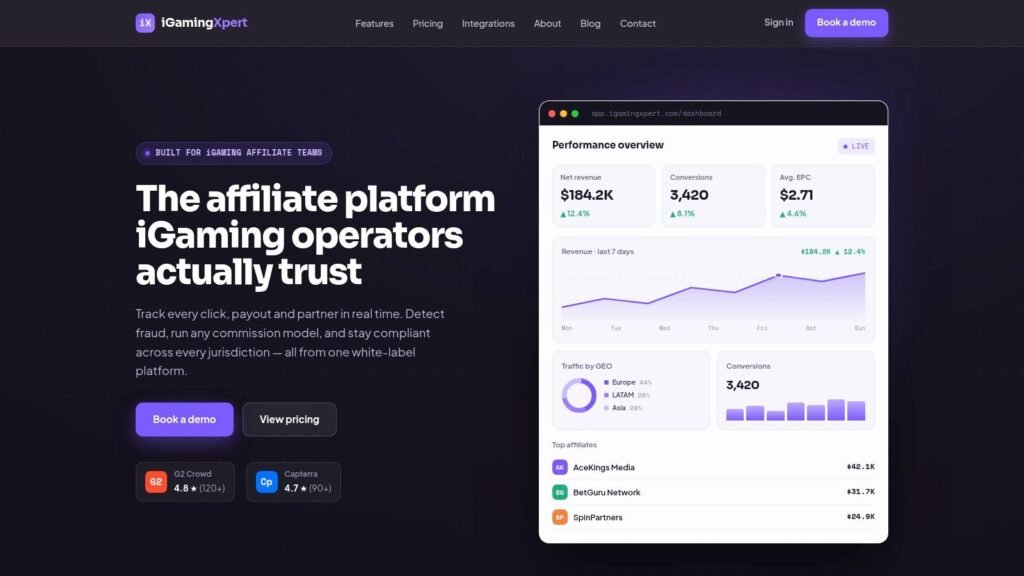
AI optimization sounds advanced, but execution still comes down to operating discipline. In regulated iGaming, the platform underneath your affiliate program determines whether your models receive trustworthy signals or corrupted ones.
Start with the data layer
A platform built for iGaming has to ingest click, conversion, revenue, payout, and partner data in real time. Batch thinking is the enemy of live optimization. If the affiliate team sees changes late, AI only helps explain the miss after it happens.
This is especially important on mobile, because mobile traffic is essential in iGaming and needs device-aware analytics and optimization, as noted in Tracknow’s guide to iGaming affiliate marketing. A system that tracks performance across devices and keeps reporting current gives AI models the granularity they need to score traffic accurately.
The commission engine matters more than most teams think
AI can identify quality differences between partners. You still need software that lets you act on those findings. That means support for CPA, RevShare, Hybrid, and CPL structures, plus tiering and custom logic by brand, campaign, or partner class.
When the platform is rigid, the affiliate manager ends up making strategic decisions with operational handcuffs. You know a partner should move from pure CPA to a hybrid deal, but the system makes that painful. In practice, the bad deal survives because the workflow is clumsy.
Fraud and compliance can’t be bolt-ons
A real iGaming setup needs traffic quality controls before cost accrues. It also needs auditable data handling in regulated markets. That’s why compliance architecture has to sit inside the same operating layer as tracking and payouts.
For teams dealing with sensitive jurisdictions, GDPR and data residency controls for iGaming affiliates aren’t a legal afterthought. They affect what data is collected, where it sits, who can access it, and whether the optimization program itself is defensible under audit.
The platform should reduce operational ambiguity. If finance, compliance, BI, and affiliates are all reading different versions of the truth, AI will only accelerate confusion.
Why an integrated platform wins
The advantage of a purpose-built platform isn’t a flashy prediction widget. It’s consolidation.
- Real-time tracking and reporting keep the optimization loop current.
- Multi-brand management supports operators running multiple products or regions from one system.
- Fraud controls help block low-quality traffic before payouts harden.
- Payment and reporting workflows reduce the spreadsheet layer that usually introduces delays and errors.
- APIs and webhooks make it possible to connect BI, ad platforms, and internal systems without patchwork exports.
In short, AI gets the headlines. The operating system underneath it is what determines whether the strategy survives contact with reality.
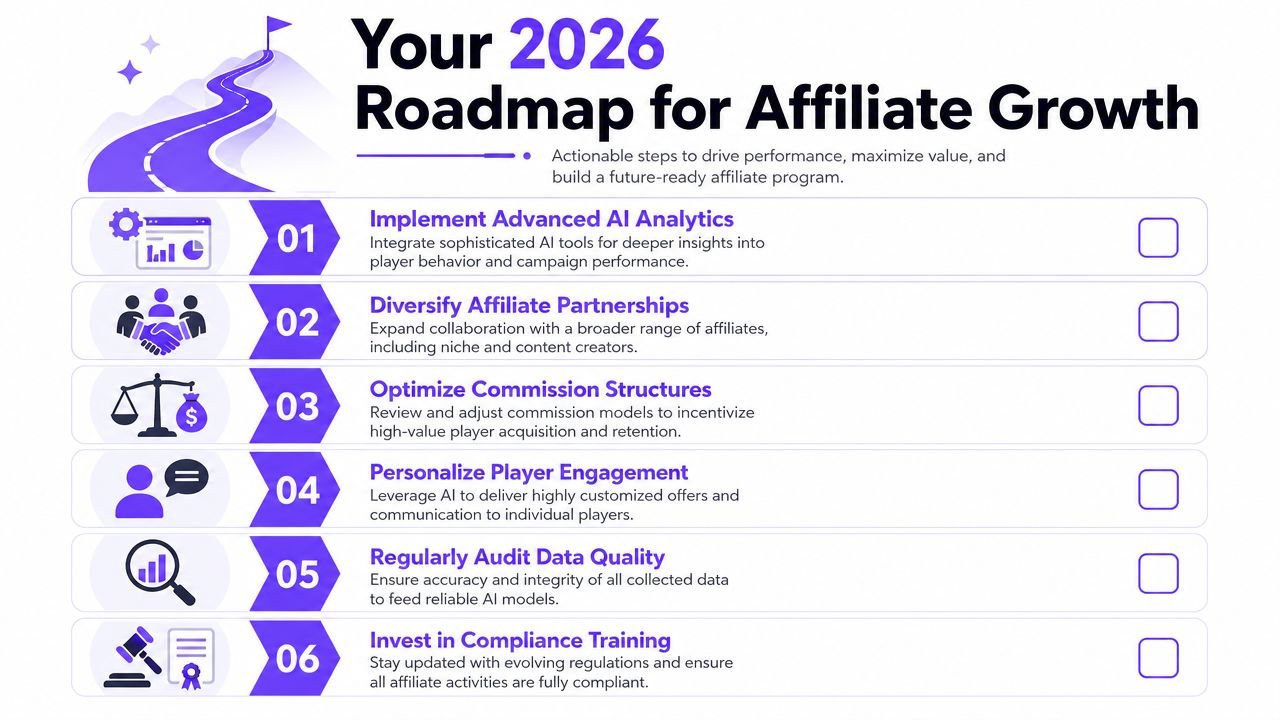
Your 2026 Roadmap for Affiliate Growth
Affiliate growth in 2026 will be decided by one ratio. LTV to CPA. In iGaming, AI only improves acquisition if the underlying program can tell the difference between a cheap registration and a player cohort that deposits, stays active, and survives compliance review.
A practical roadmap
If I were auditing an affiliate program for 2026 readiness, I would start with six checks.
First, attribution has to be reliable enough to support automated decisions. In regulated iGaming, that usually means server-side postbacks, clean event mapping, and clear reconciliation between affiliate, product, and finance data. If registration, FTD, and net revenue events do not match across systems, AI will optimize toward noise.
Second, traffic data needs more depth than channel and GEO summaries. Teams need placement-level detail, sub-source visibility, device splits, and enough cohort history to separate traffic that converts fast from traffic that holds value over time. That is how you stop overpaying for flashy top-line volume.
Third, commission models need a fresh audit. CPA, RevShare, and hybrid deals should map to partner behavior, fraud exposure, and expected payback window. A media partner sending compliant, high-retention casino traffic may justify a different structure than a comparison site driving bonus-heavy sportsbook signups with weaker retention.
The next three checks are operational. Live fraud monitoring has to catch click injection, duplicate accounts, incentive abuse, and unusual conversion patterns before payouts are approved. Reporting has to work at mobile speed because device-level differences still shape conversion quality and deposit behavior. Compliance controls have to sit inside the workflow so market restrictions, audit logs, and approval rules are enforced at the point of execution.
The next frontier is visibility that does not fit neatly into last-click reporting.
Some partners influence discovery earlier in the decision path. In practice, these are often authority publishers, expert reviewers, and content partners whose pages are cited, surfaced, or summarized inside AI-assisted search journeys. They may not close the conversion directly, but they still affect brand consideration and player trust.
That creates a compensation problem. If an operator pays only for the final tracked click, those partners are often undervalued. If the operator pays loosely for “awareness,” margin disappears fast, especially in markets where every acquisition channel is already under compliance pressure.
The workable middle ground is controlled hybrid compensation. Give authority partners performance terms tied to measurable outcomes, then layer in limited fixed support only where content quality, market fit, and compliance standards are clear. Set review windows. Define approved content types. Measure whether those placements improve assisted conversions, branded search lift, or downstream player value by cohort. If they do not, cut the support and keep the relationship on pure performance terms.
That is the 2026 roadmap in plain terms. Better attribution. Better traffic qualification. Better commercial discipline. AI helps with scale, but growth still comes from operators that can connect prediction, compliance, fraud control, and payout logic in one operating model.
iGamingXpert gives regulated operators a practical way to run this playbook. Its platform combines real-time tracking, flexible commission models, fraud prevention, compliance controls, and multi-brand reporting in one system built for iGaming workflows. If you want to operationalize AI optimization for affiliate traffic without stitching together trackers, spreadsheets, and payout tools, explore iGamingXpert.
