Affiliate Policy Monitoring in iGaming: Expert 2026 Guide

Summery: The “Post-Revenue Discovery Gap” in iGaming refers to the critical vulnerability where compliance breaches are detected only after revenue is generated and commissions are owed, a common issue in 2026. This, compounded by rapid regulatory shifts in markets like the UK and Sweden, necessitates a move from manual audits to continuous, automated monitoring within the affiliate stack to manage risk effectively.
Revenue usually lands before the breach is found. That is the operating failure behind affiliate compliance in iGaming, and it is still common in 2026.
The weak point is not partner onboarding. It is everything that happens after approval, when an affiliate swaps creative, adds an unapproved traffic source, routes volume through a sub-affiliate, or pushes claims that were never cleared by compliance. By the time those issues surface in a manual review, the clicks have already arrived, players have already converted, and commission liability may already sit in finance.
That is the Post-Revenue Discovery Gap.
It describes the period between partner approval and actual breach detection, where operators carry compliance, brand, and margin risk without live enforcement.
I have seen the same pattern across mature programs. Teams review sites, sign terms, set market permissions, and assume the control layer is in place. It is not. Static checks do not monitor runtime behavior. Monthly audits do not catch a campaign that went live this morning. Affiliate manager judgment helps, but it does not preserve evidence, quarantine payouts, or trace activity back to a specific source once traffic has been mixed.
Manual audits still matter. They are useful for exception handling, partner reviews, and regulator-ready documentation. They do not prevent revenue from being booked on traffic that should have been blocked.
The new standard for 2026 is continuous monitoring built into the affiliate stack itself. That means event-level tracking, rule-based alerts, creative and landing-page surveillance, sub-affiliate visibility, and commission controls that can pause, hold, or reverse payments based on policy status. Without that infrastructure, operators are not managing live affiliate risk. They are discovering it after the revenue event.
Introduction The Post-Revenue Discovery Gap
Affiliate risk is usually discovered after revenue is booked. That is the operating failure.
Many operators still treat affiliate compliance as an onboarding task. They KYC the partner, review the site, approve territories, issue tracking links, and record acceptance of terms. The exposure starts after that point. A partner can swap creative, change bonus wording, push unapproved geos, buy paid traffic through third parties, or route volume through sub-affiliates that never went through direct review. If detection starts with a manual check, the operator is already behind.
That lag is the Post-Revenue Discovery Gap. It is the period between partner approval and breach detection, where traffic, registrations, deposits, and commission liability keep moving while policy enforcement is effectively blind. In practice, the contract is not the control. The control is the monitoring layer attached to clicks, redirects, landing pages, player events, and payout rules.
I have seen this gap create the same problems across large programs. Compliance finds the issue after the campaign has produced revenue. Finance has already accrued commission. Affiliate managers are left reconstructing which domain, page variant, or sub-source drove the activity. If the evidence trail is weak, the operator still carries the regulatory and commercial downside.
Why reactive monitoring breaks at scale
Reactive monitoring fails because the evidence decays fast. Pages change. Redirect chains are replaced. Ad copy is edited. Traffic is mixed across source IDs that were never mapped cleanly enough for audit.
Three control failures follow:
- Evidence is incomplete: By the time a breach is reviewed, the original page, claim, or redirect path may no longer be live.
- Payouts move too early: Revenue can be recognized and commissions approved before traffic quality or policy status is validated.
- Ownership is blurred: Teams can confirm a breach existed, but they cannot always tie it to a specific source, timestamp, approval state, or sub-affiliate relationship.
A manual report is useful for escalation. It is a poor primary detection method.
The fix is a technology-first model that checks runtime behavior, not just partner intent. Operators need event-level tracking, landing page capture, redirect logging, source-level rule checks, and payout controls that can hold or reverse commission when policy conditions fail. Data residency and auditability also need to be designed into that stack, especially for cross-market programs with shared tooling and vendor access. Teams working through GDPR data residency requirements for iGaming affiliates already know that weak data architecture turns a compliance issue into an evidence issue very quickly.
What a 2026 standard actually requires
In 2026, affiliate policy monitoring sits inside the acquisition stack, not beside it. The operator needs a live control layer that joins compliance, fraud, attribution, and finance. That means traffic can be evaluated before commission is finalized, source quality can be scored continuously, and exceptions can trigger automated holds instead of retrospective email chains.
The strongest programs do not rely on partner reputation or periodic audits as their main defense. They use platform controls to verify that traffic is still permitted, attributable, auditable, and payable every day the campaign is live.
The Core Challenge of iGaming Affiliate Compliance
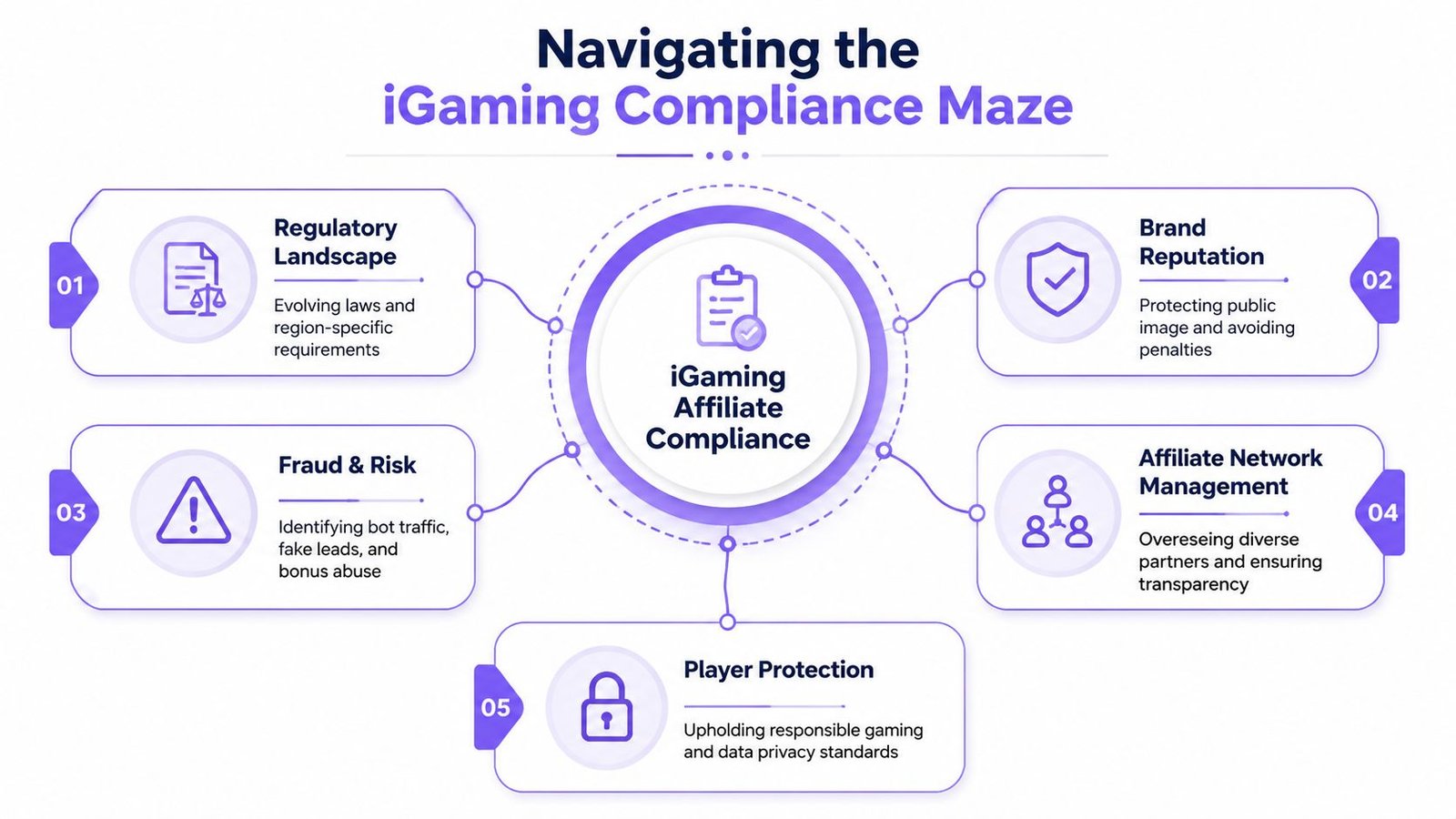
The hard part of iGaming affiliate compliance isn’t writing policy. It’s maintaining control while regulations shift by market, partners localize at different levels of maturity, and commercial teams still need to scale acquisition.
That tension got sharper in 2025. Regulatory updates in the UK introduced stricter ad restrictions around content focused on under-25s, while Sweden increased enforcement around bonus term visibility, and affiliate terms may now be adjusted quarterly according to this review of market changes. In practice, that means affiliates can’t rely on a static approved-creative pack for long. Operators have to keep refreshing rules, disclosures, and landing page requirements.
Regulation changes faster than affiliate habits
The UK is the clearest example of how quickly affiliate risk becomes operator risk. Restrictions around younger audiences, tighter standards from the ASA on bonus messaging and urgency wording, and stricter affordability expectations force operators to review affiliate creative with much more frequency. Sweden adds another layer with self-exclusion obligations and bonus-term visibility. Norway’s posture pushes affiliates away from offshore routing and toward licensed-only promotion.
That mix creates a simple operational truth. An affiliate who was compliant last quarter can be non-compliant this quarter without changing intent. The rulebook changed under them.
For teams working across multiple jurisdictions, policy monitoring also intersects with data handling and regional controls. That’s where technical compliance and privacy operations meet. Operators dealing with cross-border partner activity usually need a clear stance on hosting, locality, and consent records, especially when affiliate workflows touch player data.
The business impact goes beyond fines
When affiliate compliance breaks, the damage rarely stays in one lane.
- Brand damage: Non-compliant bonus language or irresponsible creative becomes public-facing quickly.
- Commercial leakage: Traffic from restricted markets can distort performance reports and create payout disputes.
- Operational drag: Affiliate managers, legal, fraud, and finance all get pulled into manual review.
Compliance breaks first in operations, then in reporting, then in governance.
Manual spot-checking can catch obvious issues on top partners. It doesn’t work for long-tail affiliates, localized landing pages, search placements that change by device, or sub-affiliate chains that the master partner only partially discloses.
The real challenge is control at scale
The reason many programs struggle isn’t lack of awareness. It’s that they’re trying to control a live, distributed acquisition channel with static controls. PDFs, quarterly terms updates, and approval emails don’t monitor anything by themselves.
A compliant program has to answer five questions continuously:
- Where is traffic coming from?
- What message did the player see?
- Was that message valid for that GEO and audience?
- Did the click qualify commercially and regulatorily?
- Can the operator prove all of the above later?
If the stack can’t answer those questions on demand, the affiliate program is operating on trust where it should be operating on evidence.
Technical Foundations for Real-Time Monitoring
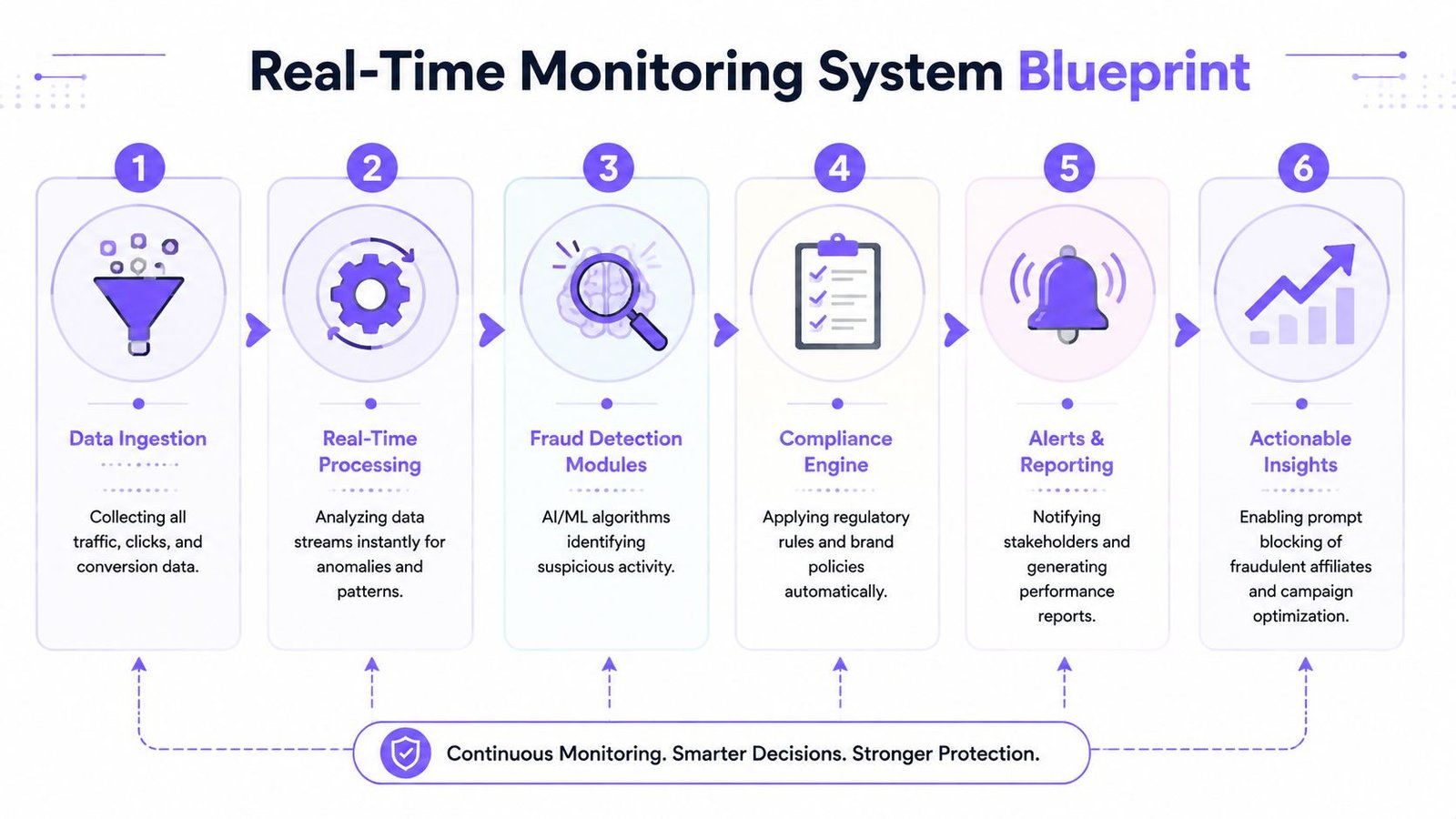
The modern monitoring stack has one job: convert policy into machine-enforced workflow. Anything less becomes a review queue.
In regulated markets, geo-based tracking layers flag and exclude clicks from restricted jurisdictions, leading to real-time commission holds and clawbacks, which turns fraud detection into a compliance mechanism with regulator-ready evidence according to this explanation of affiliate compliance infrastructure. That cause-and-effect is the foundation. Detection without enforcement is only observation.
Event accuracy comes first
If tracking is weak, every downstream control is weaker. Real-time monitoring starts with server-to-server attribution, durable click IDs, partner and sub-source parameters, and immediate event ingestion. Browser-only setups leave too many blind spots, especially when ad blockers, script restrictions, or redirected journeys break attribution chains.
For teams comparing implementation patterns, the practical distinction between browser-driven and server-driven measurement is covered well in this overview of postback vs callback tracking.
Three technical requirements matter most:
- Deterministic click-to-conversion linkage: Every qualified event must map back to the affiliate, campaign, and sub-source that generated it.
- Low-latency processing: Policy decisions lose value when they arrive after the payout queue.
- Immutable logging: If a commission is held, rejected, or clawed back, the reason needs to be preserved.
Monitoring has to become enforcement
Many teams still separate “reporting” from “control.” That’s a design mistake. The same event pipeline that ingests clicks should also evaluate GEO permissions, market-specific terms, self-exclusion relevance, and commercial qualification status.
A workable architecture usually includes:
| Layer | What it does | Why it matters |
|---|---|---|
| Tracking layer | Captures clicks, redirects, and conversion identifiers | Preserves attribution integrity |
| Rules engine | Applies market, offer, and eligibility logic | Decides whether traffic qualifies |
| Evidence layer | Stores redirect logs, screenshots, and timestamps | Supports dispute handling and audits |
| Commission layer | Holds, approves, or rejects earnings | Enforces consequences immediately |
A compliance system that can’t touch commissions is only an alerting tool.
What good operators automate
Weekly reviews still matter, especially for trend analysis. But the operational controls should run continuously:
- Restricted GEO filtering: Block or exclude traffic from non-approved jurisdictions at click or conversion stage.
- Creative proof capture: Archive landing page state and redirect path when a rule breach is suspected.
- Sub-affiliate lineage: Preserve parent-child relationship data so violations can be traced through the chain.
- Real-time state changes: Move traffic into hold status automatically when a qualification rule fails.
The best technical stacks don’t create more dashboards for affiliate managers to watch. They reduce the number of decisions humans need to make under time pressure. That’s the only sustainable way to monitor policy at program scale.
Automating Fraud Detection and Traffic Quality Control
Fraud in affiliate programs usually hides inside what first looks like performance. A traffic spike can be growth. A conversion burst can be campaign fit. A strong registration day can still be low-value or invalid if deposit behavior, devices, and session patterns don’t support the story.
That’s why automated control matters more than manual investigation. Advanced fraud prevention uses device fingerprinting correlated with behavioral biometrics to detect bots at the point of entry, while machine learning models trained on historical player quality generate dynamic risk scores that trigger real-time alerts and automated blocking.
What sophisticated affiliate fraud looks like
The usual schemes aren’t difficult to name. The difficulty is catching them before cost accrues.
Take cloaking. An affiliate may show compliant content to known review sessions while serving aggressive or misleading pages to real users from a specific GEO, browser, or daypart. A manual reviewer sees a clean page. Live users see the breach.
Brand bidding creates a different problem. On the surface, traffic converts. Underneath, the affiliate is intercepting intent the operator would likely have captured anyway, often using trademark-adjacent search behavior or redirected branded terms. The payout issue is only part of it. Brand bidding can also mask prohibited traffic acquisition methods.
Cookie stuffing and bot traffic create another pattern. Registrations appear, sub IDs fire, and attribution looks intact. Then quality collapses. Time-to-event compresses unnaturally. Device repetition rises. Deposit behavior doesn’t match expected user journeys.
What the detection layer needs to see
A strong anti-fraud setup correlates signals rather than relying on one rule.
- Fingerprint overlap: Shared devices, repeated configurations, and suspicious session clustering.
- Behavior mismatch: Registration paths that look automated rather than human.
- Attribution inconsistency: Affiliate-submitted sub-tracking that doesn’t line up with on-site player behavior.
- Value distortion: Traffic that clears the top of the funnel but fails quality checks downstream.
For operators applying AI to traffic review, this article on AI optimization for affiliate traffic is relevant because it reflects how optimization and fraud analysis increasingly use the same event stream.
The best fraud systems don’t ask, “Was this click fraudulent after the fact?” They ask, “Should this source be trusted right now?”
What works and what doesn’t
What works is layered automation with human review reserved for edge cases.
What doesn’t work is waiting for finance to notice poor cohort value, then asking affiliate managers to reverse-engineer the source after the campaign has moved on.
A practical response model looks like this:
- Score every inbound source continuously. Risk shouldn’t be static after onboarding.
- Quarantine suspicious cohorts before approval. Hold state is often more useful than immediate rejection.
- Cross-check with fraud and AML teams. If player behavior contradicts affiliate claims, someone needs authority to stop traffic fast.
- Preserve evidence automatically. Screenshots, redirect logs, and timestamps settle arguments faster than email threads.
- Requalify after remediation. Don’t fully restore a partner because they fixed one visible issue.
Traffic quality control is a commercial function too
Low-quality traffic is often discussed as a fraud issue. It’s also a pricing issue. If you can’t distinguish genuine first-time depositors from low-intent or manipulated registrations quickly, you’ll overpay on CPA, misread affiliate contribution, and reward the wrong sourcing behavior.
That’s where traffic quality control earns its place inside affiliate policy monitoring in iGaming. The goal isn’t only to block obviously bad actors. It’s to prevent weak traffic from becoming normalized just because it arrives through an approved affiliate account.
Structuring Commission Models for Compliance
Commission plans shape affiliate behavior more than policy documents do. Affiliates follow incentives faster than they read terms.
That’s why commission design should be treated as a compliance control. If a deal pays quickly on shallow actions, low-quality sourcing will find it. If a deal rewards verified value and leaves room for holds, review windows, and market-level exclusions, the economics push the program in the right direction.
Why flat deals create avoidable risk
A flat CPA across all GEOs and traffic types sounds simple. In practice, it ignores regulatory cost differences, player quality differences, and verification timing. It also creates tension when one market has stricter qualification requirements than another.
Better structures usually separate the commercial promise from the qualification state. The affiliate sees the deal terms, but earnings don’t finalize until the traffic clears the rules attached to that market and product.
Commission design choices that improve control
- Hybrid deals: These reduce pressure to optimize only for front-loaded acquisition events. They can balance volume with longer-term player value.
- Tiering by verified quality: Reward traffic that sustains value after validation, not just raw registration or FTD count.
- Market-specific terms: Different GEOs should have different qualification logic where regulation and tax costs differ.
- Hold and clawback clauses: These shouldn’t sit only in the contract. They need workflow support in the payout logic.
If the payout model rewards speed but the compliance model needs verification time, the operator has built an internal conflict.
The practical trade-off
Affiliates don’t love friction. Strong affiliates also understand that regulated-market traffic requires more controls. The answer isn’t to make every deal punitive. It’s to make the rules visible, consistent, and tied to objective qualification states.
A mature commission framework does three things well:
| Design goal | Commission response | Compliance effect |
|---|---|---|
| Reward real value | Use quality-based tiering | Reduces incentive for junk traffic |
| Protect against invalid conversions | Apply hold states before approval | Prevents premature payout |
| Match market rules | Localize deal structure by jurisdiction | Aligns affiliate behavior with licensing scope |
Negative carryover, probation periods for new sources, and sub-affiliate-specific review triggers can all help, but only if the system can enforce them automatically. Otherwise, the affiliate manager becomes the bottleneck, and exceptions start piling up faster than they can be reviewed.
The strongest programs don’t separate commercial design from risk design. They pay in a way that tells affiliates exactly which behavior the operator is willing to fund.
Key KPIs and Analytics for Program Optimization
Most affiliate dashboards show activity. Fewer show whether that activity should be trusted, paid, or scaled.
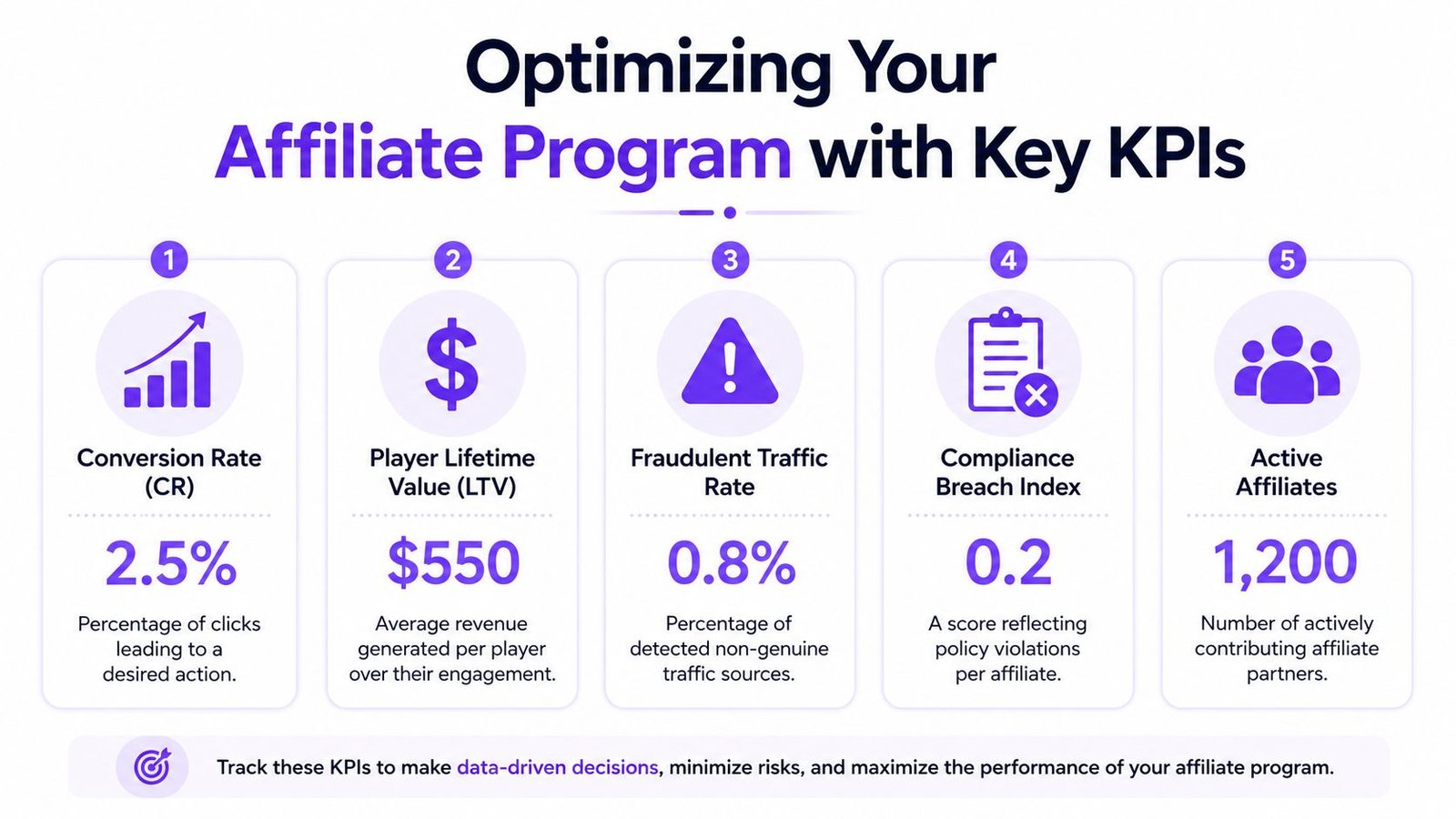
The most useful KPI set combines performance, quality, and policy signals in one view. That’s the only way to identify when a partner is producing apparent growth while weakening program economics or increasing compliance exposure.
The threshold logic that matters
A strong example from automated fraud control is simple and effective: alert when an affiliate’s daily new registrations exceed a set limit while the registration-to-deposit conversion rate falls below a certain percentage, because that pattern often indicates low-quality traffic or bonus abuse, as noted in this fraud monitoring guidance. The point isn’t the exact threshold. The point is that volume should never be read without quality.
That same principle applies across program management. Clicks without deposit quality are noise. Registrations without GEO fit are noise. Revenue without retention context is often misleading.
Essential iGaming affiliate monitoring KPIs
| KPI | What It Measures | Why It Matters for Policy Monitoring |
|---|---|---|
| Conversion rate by GEO | The share of clicks that become defined conversion events in each market | Highlights abnormal market behavior and possible unauthorized promotion |
| Registration-to-deposit rate | The share of registrations that become depositors | Exposes weak traffic quality, bonus abuse patterns, or bot-driven acquisition |
| eEPC | Earnings efficiency relative to click volume | Helps compare source quality, not just scale |
| Player value by affiliate cohort | Downstream commercial quality of referred players | Distinguishes sustainable partners from shallow acquisition sources |
| Hold rate | Share of commission entering review or hold state | Reveals where policy and qualification rules are being triggered most |
| Rejection reason mix | Distribution of why conversions or commissions were rejected | Surfaces repeated control failures by affiliate or campaign |
| GEO mismatch rate | Traffic attempting to convert outside approved jurisdictions | Identifies compliance leakage at the market level |
| Sub-affiliate concentration | How much traffic comes from nested partners under a parent affiliate | Flags dependency on opaque acquisition chains |
What experienced teams watch daily
The daily dashboard should answer operational questions, not just summarize yesterday.
- Which affiliates changed behavior suddenly? Look for sharp movement in registration velocity, source mix, or device patterns.
- Which markets show conversion anomalies? GEO-level drift often appears before a clear policy breach is logged.
- Which hold reasons are increasing? A rising hold queue usually points to one broken process or one aggressive source.
- Which affiliates look profitable but fail quality checks later? That’s where reactive programs lose margin.
Good KPI design reduces investigation time because it groups risk where it starts, not where it finally surfaces.
Avoid vanity analytics
Clicks, impressions, and raw registrations still belong in reporting. They just shouldn’t anchor decision-making. The operators who run disciplined programs score affiliate traffic the way trading teams score counterparties. They care about consistency, qualification, and confidence in the data.
That’s the deeper point in affiliate policy monitoring in iGaming. Analytics shouldn’t be a retrospective performance report. They should be the control surface that tells affiliate management, fraud, compliance, and finance whether a source deserves trust.
Conclusion Building a Proactive and Scalable Program
The old operating model is easy to recognize. Onboard carefully. Trust the partner. Review performance. Investigate exceptions later. That model no longer fits regulated iGaming.
The pressure comes from several directions at once. Rules change quickly by market. Traffic quality can deteriorate faster than manual reviews can catch it. Sub-affiliate chains reduce visibility. Commission systems often pay before the operator has enough verification context. That’s how the Post-Revenue Discovery Gap keeps opening.
A stronger program closes that gap with infrastructure, not optimism.
What the mature model looks like
The best affiliate programs now run on four connected controls:
- Real-time tracking with deterministic attribution
- Automated policy enforcement at GEO, offer, and qualification level
- Fraud prevention that blocks suspicious traffic at entry
- Commission logic that rewards verified value, not unverified volume
Those controls matter because they remove delay. Delay is what turns an affiliate issue into a revenue issue, and then into a regulatory issue.
Scale comes from reducing human dependency
Most operators don’t need more dashboards. They need fewer manual interventions. When systems can flag, hold, reject, and document activity automatically, affiliate managers can spend their time on exceptions, partner strategy, and commercial growth instead of constant triage.
That’s also what makes a program scalable. Compliance at small volume can survive on judgment and memory. Compliance at multi-market scale needs logs, rules, thresholds, and clear handoffs between affiliate, fraud, legal, finance, and BI teams.
One practical shift changes everything: stop treating affiliate monitoring as a reporting problem and start treating it as a live control problem. Once that happens, the rest of the architecture becomes clearer. Tracking must support enforcement. Fraud tools must support qualification. Commission workflows must support auditability.
Affiliate policy monitoring in iGaming is no longer about proving that your team checked something. It’s about proving that your systems prevented, isolated, or documented the event at the moment it mattered.
iGaming operators that want one system for real-time tracking, commission accounting, fraud prevention, and compliance controls should look at iGamingXpert. It’s built for regulated affiliate programs that need live reporting, flexible deal structures, audit logs, multi-brand operations, and automated traffic-quality controls without stitching together multiple point tools.
