Top 7 AI Tools for Affiliate Marketing in iGaming

In regulated iGaming, affiliate fraud and non-compliance create more than wasted spend. They introduce licensing risk, trigger operator escalations, and distort the data used to price traffic, approve partners, and calculate commissions.
AI changes the operating model because it can score traffic quality, detect policy breaches, and flag payout anomalies at machine speed. The practical advantage is not automation on its own. It is the ability to turn fragmented checks across compliance, fraud, and attribution into a single control loop that can act before exposure spreads across brands or jurisdictions.
That matters most at scale. Mature programs do not manage affiliates with static rules. They maintain dynamic blacklists and whitelists for domains, devices, IP ranges, creative variants, traffic sources, geo-specific disclaimers, and payment behavior. Manual review cannot keep pace when campaign velocity rises and enforcement windows shrink.
The strongest AI stack is therefore architectural, not tactical. Monitoring tools scan SERP activity, brand bidding, page-level compliance, click quality, and invalid traffic. Tracking and partner platforms receive those signals through APIs, postbacks, and webhooks, then apply automated actions such as blocking traffic, pausing partners, routing cases for review, or adjusting commission eligibility inside a central system such as iGamingXpert.
The following tools address that problem from different control points. Their core value lies in how they connect into an auditable workflow for regulated affiliate programs, where every detection event should map to a recorded decision, an accountable owner, and a measurable commercial outcome.
1. iGamingXpert
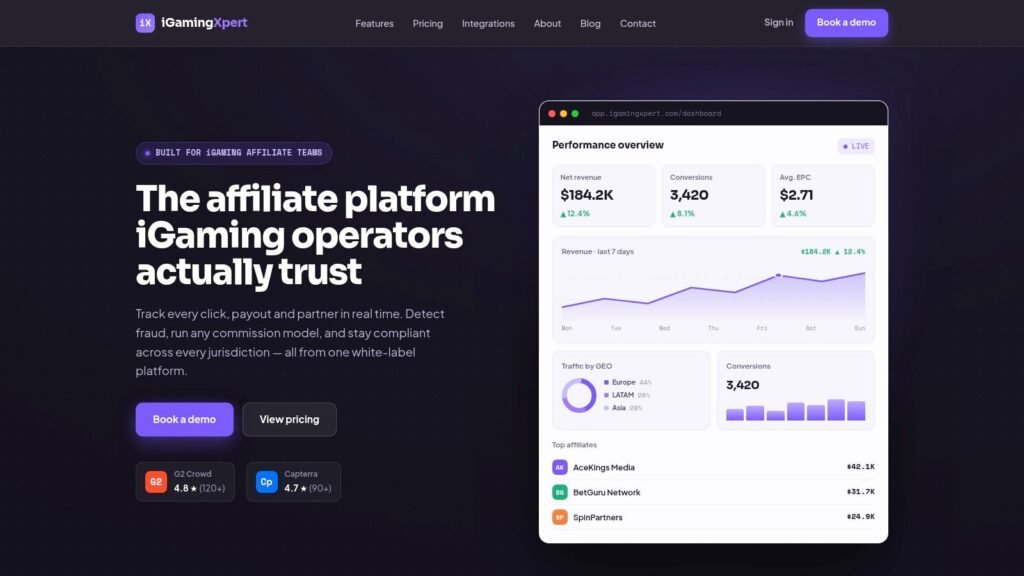
Operators running regulated affiliate programs rarely fail because they lack dashboards. They fail when fraud signals, compliance findings, attribution events, and commission rules sit in separate systems and no one can prove which action was taken, by whom, and before or after revenue was booked. iGamingXpert addresses that operational gap by acting as the system of record for affiliate tracking, partner management, commission logic, and enforcement.
That role makes it different from the monitoring tools later in this list. Those products detect a specific class of risk. iGamingXpert is the layer where those detections can be converted into recorded actions through APIs, webhooks, postbacks, and rule-based partner controls. For teams building an AI-assisted compliance stack, that distinction is critical because the value of an alert depends on whether it can change payout eligibility, traffic routing, or partner status in real time.
The platform covers the core mechanics an iGaming program needs to run at scale: click and conversion tracking, revenue reporting, white-label affiliate portals, CPA and RevShare deal support, hybrid structures, sub-affiliate management, and multi-tier network operations. That flexibility has direct commercial value in a sector where commission structures vary widely by product, GEO, and affiliate type, as outlined in Rainmaker Agency’s iGaming affiliate commission guide. A tracker that cannot model those edge cases forces manual workarounds. Manual workarounds create audit gaps.
Why it works as the central hub
A mature stack needs a place to normalize events from multiple control points. iGamingXpert fits that role because it combines REST API access, server-to-server postbacks, real-time webhooks, pixel tracking, and partner-level administration inside the same environment where payouts are calculated. If Rightlander flags a prohibited claim, or a click-quality tool identifies invalid traffic, those signals can be pushed into the platform and mapped to a specific partner, campaign, or source parameter.
That connection changes the operating model. Instead of logging an issue in one tool and debating remediation in another, teams can suspend a partner, quarantine traffic, hold commissions for review, or preserve the case history in the same platform used for reconciliation. In regulated markets, the audit trail often matters as much as the detection itself.
Practical rule: Put enforcement logic as close as possible to attribution and payout logic. Separation between those layers creates leakage, disputes, and slow response times.
Operational depth that general affiliate software often misses
iGamingXpert is designed for gambling programs with jurisdictional complexity, not generic e-commerce referrals. The platform includes GDPR controls, consent capture, audit logs, data residency options, multi-brand support, multi-currency operations, and GEO-specific configuration. Those capabilities matter once a program spans several regulators, multiple products, and affiliates promoting different brands under different market rules.
Its published product specifications also point to production readiness. On the iGamingXpert website, the company cites 99.99% uptime, sub-40 ms event latency, support across more than 180 countries, and $2.4B in annual tracked volume. For affiliate directors, those figures are not marketing decoration. They indicate whether the platform can handle high event throughput, near-real-time decisioning, and the reconciliation pressure that comes with large partner networks.
The white-label portal is also more important than it looks. Giving affiliates self-serve access to tracking links, performance data, and payment documentation reduces account-management overhead, but it also standardizes what partners see and when they see it. That lowers avoidable disputes and keeps operator-side controls intact.
The tradeoff is clear. Pricing is not public, and smaller programs may view the platform as heavier than a basic tracker. For regulated operators and networks, that extra weight is often the point. It replaces disconnected tools with a single control layer where AI detections can trigger actions, every action can be logged, and compliance, fraud, and payout decisions can be audited against the same event history.
2. Rightlander
In regulated iGaming, one affiliate breach rarely stays isolated. A single outdated bonus, a banned phrase, or a misplaced age-gating disclaimer can trigger partner remediation, compliance review, and attribution disputes at the same time. Rightlander addresses that operational problem by turning affiliate monitoring into a continuous evidence process instead of a periodic manual check.
Its value is less about generic monitoring and more about coverage across fragmented partner activity. Affiliates publish across review sites, comparison pages, social channels, and paid placements. Those surfaces change faster than most account teams can audit manually. Rightlander scans those environments for issues such as expired offers, prohibited claims, missing disclosures, and market-specific wording that may breach local advertising rules.
That matters most in jurisdictional enforcement.
An affiliate creative set can be acceptable in one GEO and unacceptable in another because the restriction is not only the offer itself, but the way the offer is described, who can see it, and which disclaimer appears beside it. For teams tightening affiliate policy monitoring in iGaming, Rightlander adds a detection layer that identifies those exceptions before they become regulator-facing incidents.
The practical advantage is workflow control. Rightlander can feed findings into a central affiliate platform such as iGamingXpert through APIs or webhook-based alerting, so a compliance event does not sit in an inbox waiting for manual triage. It can become a logged case tied to the affiliate account, creative asset, GEO, timestamp, and remediation history. That creates a usable audit trail, not just a screenshot archive.
Its human review model also fits the reality of iGaming compliance. Automated detection is good at locating suspect content and classifying obvious violations. Grey-area cases still need a reviewer who understands local rules, translation nuance, and the difference between aggressive copy and a reportable breach. Rightlander reduces review volume by narrowing attention to the placements that require judgment.
A sensible deployment usually includes three layers:
- Discovery: Monitor affiliate pages, social content, and ads for unapproved language, lapsed promotions, and missing responsible-gambling disclosures.
- Case creation: Push each finding into the central platform with source URL, capture time, partner ID, and rule category.
- Enforcement logging: Record outreach, takedown status, repeat offenses, and escalation steps for internal controls and regulator audits.
In regulated programs, undocumented remediation creates its own risk. If a partner fixes a breach but the operator cannot show when it was detected, who reviewed it, and how it was resolved, the control framework still looks weak.
The tradeoff is straightforward. Rightlander does not remove the need for compliance staff, and custom pricing may be difficult for smaller programs to justify. For operators and networks managing multi-GEO affiliate portfolios, the stronger case is architectural. Rightlander works best as a specialist surveillance layer inside an integrated stack, where detections trigger platform actions, exceptions are auditable, and compliance evidence sits beside traffic, attribution, and partner payment records.
3. BrandVerity
Brand bidding abuse remains one of the most persistent leak points in iGaming affiliate management. It distorts attribution, inflates acquisition costs, and creates conflict between paid search teams and affiliate managers who are both claiming the same player journey. BrandVerity is one of the cleaner solutions for that exact problem.
Its focus is narrow but valuable. BrandVerity monitors paid search results to identify affiliates or competitors bidding on protected terms, then captures ad copy, landing pages, and final URLs for enforcement. In iGaming, that evidence layer is critical because policy disputes usually hinge on what appeared in market, not what a partner says they intended to run.
Why specialist PPC compliance still matters
A lot of programs assume their tracker will surface this abuse. It usually won’t. Tracking platforms show outcomes. BrandVerity shows the policy breach itself. That’s a different job.
This matters even more in mixed acquisition programs where SEO affiliates, PPC affiliates, media buyers, and influencers overlap. Without dedicated search monitoring, operators often discover cannibalization only after branded CPA rises or direct traffic conversion patterns start looking wrong.
For teams tightening affiliate policy monitoring in iGaming, BrandVerity works best as the search-specific enforcement layer feeding a broader partner governance workflow.
Best fit and limitations
BrandVerity is strongest when your problems are concentrated around trademark bidding, misleading ad copy, and unauthorized landing pages. Its evidence capture is what gives account managers an advantage in partner conversations because it reduces ambiguity.
A few considerations matter before rollout:
- Specialized scope: BrandVerity complements a tracking platform. It doesn’t replace one.
- Enforcement quality: The value isn’t just alerting. It’s preserving screenshots, URLs, and timing so teams can act with confidence.
- Geo complexity: Brand terms and PPC rules often vary by market, so search coverage should mirror your licensing footprint.
The catch is that pricing is custom and keyword or GEO expansion can increase cost. That’s normal for search monitoring. In exchange, you get a direct answer to one of the oldest affiliate channel conflicts in iGaming: who’s monetizing your brand demand, and under what rules?
4. TrafficGuard

A meaningful share of affiliate loss in iGaming does not start inside the affiliate platform. It starts earlier, at the click layer, where bots, click farms, device spoofing, and low-intent arbitrage distort attribution before compliance or CRM teams see the lead.
TrafficGuard is useful in that upstream position. Its machine learning models score traffic in real time and suppress invalid sessions before they create media cost, pollute partner reporting, or trigger commission on traffic that was never commercially viable. For regulated operators, that matters because poor traffic quality is rarely confined to one acquisition channel. The same actor can hit paid search, social, app campaigns, and affiliate links with slightly different signatures, which makes channel-specific tooling less effective.
The operational value is response time.
Manual review is too slow for this problem set. By the time an analyst confirms suspicious click patterns, spend has already cleared and attribution models have already absorbed the noise. TrafficGuard helps teams shorten that interval by automating enforcement actions and feeding a common fraud signal into both paid media and affiliate operations. That shared view is often more important than the initial alert, because it lets acquisition, compliance, and partner managers investigate the same event history instead of reconciling separate dashboards.
This is also where stack design matters. TrafficGuard performs best as a traffic sanitation layer connected by APIs and webhooks to the central affiliate platform, where blocked sessions, risk scores, and source-level anomalies can be logged alongside partner data, compliance evidence, and conversion outcomes. For teams building AI optimization for affiliate traffic, that integration model is more useful than a standalone fraud dashboard because it creates an auditable trail for disputes, reversals, and partner remediation.
Its best use cases in iGaming usually fall into three areas:
- Pre-conversion IVT filtering: Remove invalid clicks before they distort EPC, CPA, and source-level quality benchmarks.
- Arbitrage pattern detection: Flag traffic that appears legitimate at first glance but breaks normal patterns across device reuse, session timing, referrer consistency, or click-to-registration behavior.
- Cross-channel fraud correlation: Identify the same abuse pattern across paid and affiliate campaigns so teams can act on one incident instead of several isolated symptoms.
TrafficGuard’s limitation is implementation depth. It needs clean event flows, clear rules for automated action, and coordination between media buyers, affiliate managers, and analytics teams. Without those inputs, teams get alerts but not a controlled enforcement process. With them, TrafficGuard becomes the first gate in an automated anti-fraud stack, sending cleaner traffic and better evidence into platforms such as iGamingXpert rather than forcing those systems to sort fraud after attribution is already contaminated.
5. Lunio
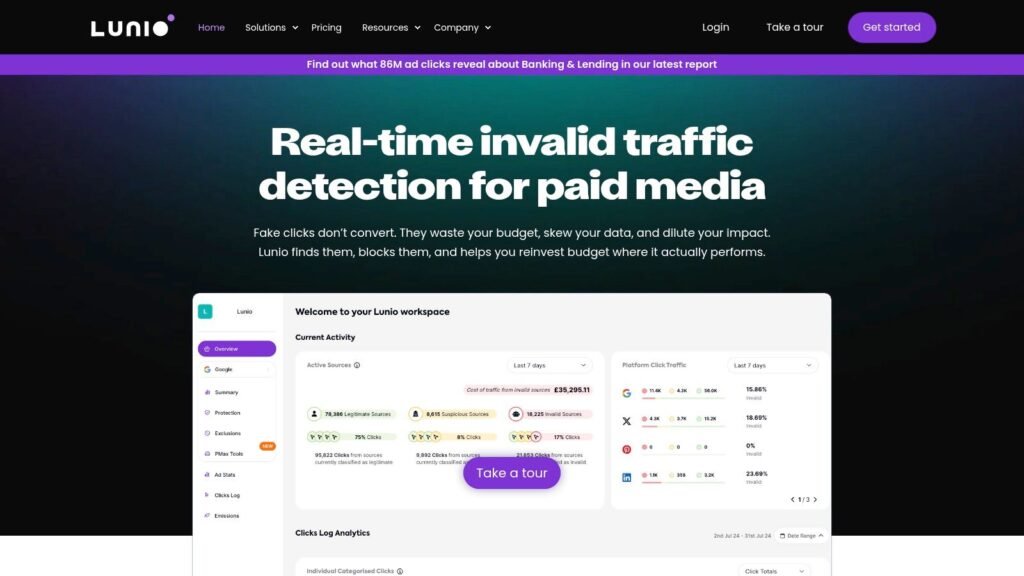
Lunio is one of the more interesting options for teams that need invalid traffic prevention but want workflows that acknowledge affiliate fraud as its own operating problem. Many IVT platforms focus almost entirely on paid media teams. Lunio extends further into affiliate-specific review and evidence handling.
That distinction matters in iGaming because not all bad affiliate traffic is simple bot activity. Some of it shows up as brand bidding misuse, suspicious click paths, or incentive-driven traffic that degrades quality without immediately breaking obvious rules. AI-driven fraud detection that uses behavioral anomaly detection and cohort-level scoring on patterns such as login velocity, bonus-claim timing, and deposit-to-bonus ratios consistently outperforms traditional rules-based systems in regulated iGaming, especially against multi-account bonus abuse and self-referral rings, according to iRev’s analysis of AI fraud detection in affiliate marketing.
Why Lunio stands out
Lunio’s practical advantage is workflow design. It doesn’t just identify suspect activity. It also gives teams structured review processes for affiliate fraud, including evidence sharing and brand bidding assessment. That helps bridge the gap between fraud operations and partner management, which is where many programs lose time.
For operators pushing AI optimization for affiliate traffic, Lunio can serve as the analytical layer that classifies suspicious traffic before the core platform decides whether to block, hold, or investigate.
Best use case
Lunio is strongest when your affiliate channel is already large enough that manual review has become inconsistent. At that point, the question isn’t whether invalid traffic exists. It does. The question is whether your team can classify it fast enough to stop paying for low-quality actions while preserving legitimate partner volume.
A smart deployment usually emphasizes:
- Cross-channel review: Compare affiliate traffic quality with other acquisition channels to spot recurring abuse patterns.
- Evidence-backed remediation: Give account managers records they can use in partner disputes.
- Controlled blocking: Tune prevention carefully so false positives don’t damage good affiliate relationships.
Its limitations are typical of more advanced IVT tools. Pricing isn’t public, and platform-level blocking needs careful calibration. But for teams that want affiliate fraud prevention workflows, not just anomaly dashboards, Lunio is one of the more practical AI tools for affiliate marketing in iGaming.
6. Everflow
Everflow approaches the market from a different angle. It isn’t iGaming-native in the same way iGamingXpert is, but it’s technically appealing for teams that care about developer access, automation, and the ability to let AI agents interact with program data through documented interfaces.
That matters more than it sounds. Many affiliate platforms expose reports. Fewer are designed so external systems, or AI agents operating through MCP and OpenAPI-style interfaces, can read tracking data, analyze it, and trigger operational actions in a disciplined way.
Why technical teams like it
Everflow’s strength is extensibility. If your team wants to build custom workflows around tracking, attribution, and partner reporting, the platform gives you enough access points to do that. It also includes fraud detection features and integrations with specialized fraud-scoring tools, which helps if you want to combine native heuristics with external risk signals.
This is a good fit for networks or larger operator groups where internal engineering or analytics teams want to automate repetitive tasks such as partner anomaly review, attribution checks, or data exports into warehouse environments.
A few scenarios where Everflow makes sense:
- API-led operations: Pull tracking and conversion data directly into internal models or alerting systems.
- Agent-assisted analysis: Let AI systems query performance and fraud data rather than relying on static dashboards.
- Cross-channel ingestion: Bring in data from large media platforms to compare partner contribution more holistically.
Everflow is less compelling if what you need first is regulated-market compliance scaffolding. It can be part of that environment, but you’ll likely need to design more of the governance model yourself. Pricing is custom, there’s a stated commitment requirement, and advanced setups usually need technical resources. For teams with that capability, though, Everflow gives you a modern automation surface rather than a closed reporting box.
7. impact.com
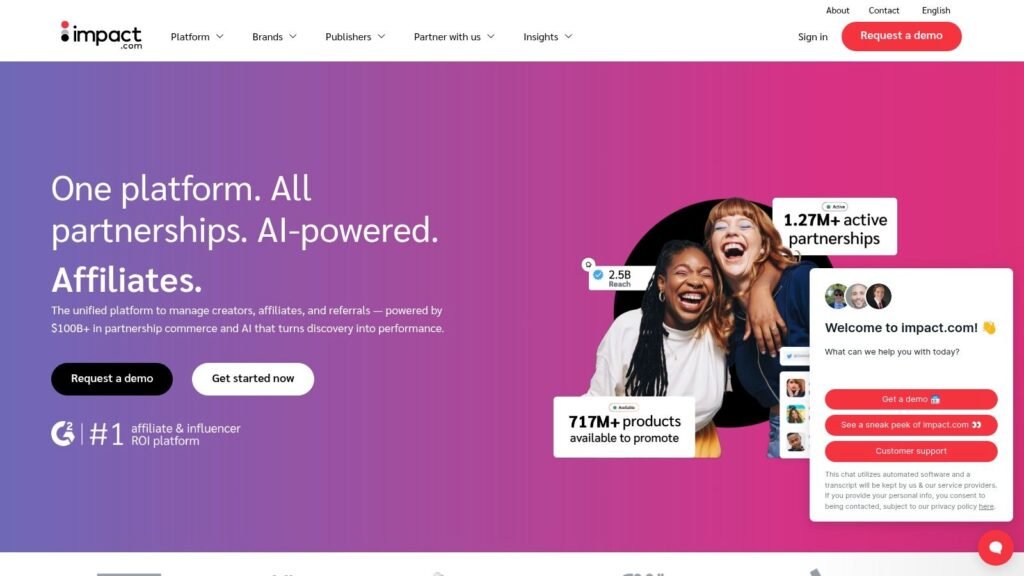
Large iGaming programs rarely fail because they lack tracking. They fail because partner onboarding, payout approval, fraud review, and compliance evidence sit in different systems. impact.com is relevant here because it gives enterprise teams a single partnership operating layer across affiliates, creators, and media partners, with AI features focused on partner discovery, workflow routing, and payment risk review.
That matters more in regulated markets than in general affiliate commerce.
For an operator running multiple brands, the question is not whether impact.com can track conversions. The stronger use case is whether it can sit upstream of the gambling-specific controls already in place and standardize how partner records, contract terms, and payout decisions move through the business. In that model, impact.com becomes part of an integrated stack. A central affiliate platform such as iGamingXpert can receive conversion and deal data through APIs or webhooks, then reconcile those records against compliance status, traffic-quality signals, and finance rules before a payout file is approved.
Where impact.com adds operational value
impact.com’s strength is partner program governance at scale. AI-assisted partner recruitment can help teams filter large prospect pools, but the bigger gain for iGaming operations is process control. If a partner changes ownership, traffic profile, promotional method, or geo focus, those changes need to trigger review steps instead of waiting for a quarterly audit.
Payout controls are especially relevant for operators using hybrid CPA and RevShare models. Those deals create more exposure than flat CPA because the operator is validating both acquisition quality and downstream revenue share entitlement. A platform that flags payment anomalies, routes exceptions, and logs approval history reduces the chance of paying on disputed traffic, restricted geos, or non-compliant promotional activity.
The practical value is auditability. If compliance, affiliate, and finance teams all work from the same partner object and event history, disputes are easier to resolve and regulator-facing evidence is easier to assemble.
Fit within an AI-powered compliance and anti-fraud stack
impact.com is strongest when it is connected, not isolated. An effective iGaming setup routes partner and transaction events into a central system where other tools handle the controls impact.com does not specialize in. Compliance crawlers can monitor affiliate pages. Brand protection tools can watch paid search misuse. Invalid traffic systems can score suspicious clicks and conversions. The affiliate platform then becomes the decision layer that records the evidence, applies deal logic, and determines whether traffic should be approved, held, or clawed back.
That architecture is more useful than treating each tool as a separate dashboard.
Caveats for regulated operators
Operators should confirm category support, jurisdiction restrictions, and onboarding policy before implementation. Enterprise breadth often brings longer rollout cycles, more stakeholder alignment, and more configuration work across legal, finance, and acquisition teams.
For iGaming, impact.com is best viewed as a partnership governance platform with AI-assisted controls, not as a complete compliance stack. Used that way, it can add structure and payment discipline around a broader, API-connected system designed for regulated acquisition.
Top 7 AI Tools for iGaming Affiliate Marketing, Comparison
| Solution | Implementation complexity 🔄 | Resource requirements 💡 | Expected outcomes ⭐📊 | Ideal use cases 📊 | Key advantages ⚡ |
|---|---|---|---|---|---|
| iGamingXpert | High, enterprise integrations & compliance setup 🔄 | Dedicated ops, compliance and BI; onboarding with sales | Real-time tracking, reduced fraud, audit-ready payouts ⭐⭐⭐⭐ | Regulated iGaming operators, affiliate networks, multi-brand programs | All-in-one white‑label tracking + compliance + scalability ⚡ |
| Rightlander | Low–Medium, SaaS crawl with review workflows 🔄 | Minimal tech; compliance reviewers for human‑in‑the‑loop checks | Automated discovery and audit trails; lowers manual monitoring ⭐⭐⭐ | Compliance monitoring, regulatory evidence and partner auditing | AI-assisted crawls + human validation for edge cases ⚡ |
| BrandVerity | Low–Medium, keyword/geo configuration and monitoring 🔄 | Ops for keyword scope and enforcement outreach | Detects brand-term PPC violations; captures evidence for takedowns ⭐⭐⭐ | PPC brand protection and affiliate PPC enforcement | Deep paid‑search coverage and evidence capture for enforcement ⚡ |
| TrafficGuard | Medium, requires ad account and tracker integrations 🔄 | Integration with ad platforms; ongoing tuning and monitoring | Real‑time IVT detection/prevention; reduced wasted ad spend ⭐⭐⭐⭐ | Paid acquisition and affiliate channels needing IVT protection | Prevention mode with automated enforcement (e.g., IP blocks) ⚡ |
| Lunio | Medium, ML tuning and affiliate workflow setup 🔄 | Config + centralized review; sales engagement for pricing | AI IVT detection with affiliate‑specific workflows; risk benchmarks ⭐⭐⭐ | Affiliate fraud prevention in Gaming/iGaming verticals | Affiliate‑focused workflows and vertical risk benchmarks ⚡ |
| Everflow | High, API-first, technical integration and automation 🔄 | Developer resources to implement OpenAPI/MCP and integrations | Extensible tracking, attribution and fraud heuristics for partners ⭐⭐⭐⭐ | Developer-led, multi-brand networks seeking automation/extensibility | OpenAPI/agent access, cross‑channel ingestion and automation ⚡ |
| impact.com | High, enterprise onboarding and governance setup 🔄 | Enterprise teams for partner ops, legal and program governance | AI-driven partner discovery, fraud scoring and payout blocking ⭐⭐⭐⭐ | Large multi-geo, multi-partner enterprise programs | Mature enterprise ecosystem with AI-native partnership tools ⚡ |
From Tools to Systems Building an Integrated Defense
In regulated iGaming, a single missed compliance alert can affect partner status, payout accuracy, and audit readiness at the same time. The operational question is not which standalone tool looks strongest in a product demo. The question is whether external risk signals can move through your stack fast enough to change attribution, commissions, and partner access before exposure grows.
That is why the stack design matters more than any one feature.
A central affiliate platform should act as the decision layer. Monitoring tools detect policy breaches. Invalid traffic tools score click quality and suspicious behavior. The platform receives those signals through APIs, postbacks, and webhooks, then converts them into recorded actions such as affiliate pauses, payment holds, ticket creation, rule-based traffic blocking, or manual review queues. In practice, that architecture creates a closed control loop rather than a set of disconnected alerts.
A workable division of labor usually looks like this:
- Rightlander and BrandVerity identify content, disclosure, and paid-search violations.
- TrafficGuard and Lunio flag or suppress invalid traffic, bot activity, and click anomalies.
- iGamingXpert, Everflow, and impact.com store partner events, update risk states, apply payout rules, and preserve a timestamped audit trail.
The distinction matters because these tools solve different control problems. A compliance crawler can tell you that an affiliate used prohibited copy on a GEO-specific landing page. It cannot, on its own, suspend that partner, quarantine conversions tied to the breach window, and document the enforcement sequence for legal and finance. A traffic protection tool can classify suspicious sessions. It does not replace the system that decides whether those sessions should be excluded from reporting, blocked from payout, or escalated to partner management.
Teams that collapse those functions into one layer usually create blind spots. The tracker becomes a weak compliance database. The compliance tool becomes an informal case-management system. Neither outcome stands up well under regulatory review or commercial dispute.
The stronger model is event-driven. A policy violation triggers a webhook. The platform writes the incident to the partner record, changes the affiliate’s status according to predefined thresholds, and routes the case for review. An invalid-traffic score can update a shared blacklist or risk flag before low-quality sessions contaminate revenue reporting and CPA calculations. Because every action is recorded in one system, operations, finance, and compliance teams can reconstruct what happened without reconciling six vendor dashboards by hand.
This connected model also changes forecasting. Once the same data layer captures fraud signals, compliance actions, conversion quality, and partner-level outcomes, analysts can do more than remove bad traffic. They can compare net value by source after enforcement costs, not just headline deposits or registrations. That produces a more accurate view of which affiliates, GEOs, and channel mixes deserve budget and account-management time.
AI-driven execution is also expanding content volume. Operators using AI for content and SEO have reported substantial productivity gains, according to Eventus International’s review of practical AI use cases in iGaming marketing. Higher output increases the number of pages, creatives, and partner assets that need checking. For affiliate leaders, the implication is straightforward. Scaling acquisition without scaling control creates a larger compliance backlog, not a stronger program.
Channel mix is shifting in the same direction. Reach Effect’s summary of iGaming trend reporting notes the expected rise of influencer marketing. That creates more content variants, faster publishing cycles, and more jurisdiction-specific disclosure risk. API-connected enforcement becomes more valuable in that environment because manual review cannot keep pace with short-form content production across multiple markets.
Single tools improve detection. Integrated systems improve governance, payout accuracy, and response time. In regulated affiliate programs, that difference has direct commercial value.
