Server-Side Tracking Benefits for iGaming Explained By Software Provider

Server-Side Tracking (SST) bypasses browser-based blocks to deliver 100% accurate player data, maximizing ROI for iGaming operators.
As your infrastructure partner, we host a dedicated server that acts as a secure buffer between your casino or sportsbook platform and external marketing vendors. Instead of a player’s browser sending data directly to third parties, your game servers send it to your private tracking cloud first.
Summery:
1. Defeat Ad Blockers and Privacy Shields
- Bypass tracking blockers. Traditional browser pixels are routinely blocked by Brave, Safari ITP, and uBlock Origin.
- Capture missing conversions. Server-to-server data streams ensure 100% of registrations and deposits are recorded.
- Restore data fidelity. Stop losing up to 30% of your marketing attribution data to browser restrictions.
2. Safeguard Proprietary Player Data
- Eliminate rogue JavaScript. Third-party browser tags can scrape sensitive player behavior or interface details.
- Control data leakage. Filter, mask, or anonymize player data before it leaves your cloud infrastructure.
- Enforce strict compliance. Ensure absolute alignment with global regulations like GDPR and local gambling commission rules.
3. Maximize Paid Media ROI
- Feed precise algorithms. Deliver clean, real-time conversion data directly to Google Ads and Meta Conversions API (CAPI).
- Lower acquisition costs. Accurate data trains ad networks to find higher-value players for less money.
- Fix affiliate attribution. Eradicate cookie-dropping fraud and ensure your true traffic sources get paid accurately.
4. Boost Casino Page Load Speeds
- Strip out heavy SDKs. Remove bloated tracking scripts that slow down your web application or lobby page.
- Reduce player churn. Faster load times keep players engaged and prevent drop-offs during game loading.
- Improve SEO rankings. Leaner frontend code translates to higher Core Web Vitals scores on Google.
5. Prevent Promo and Affiliate Fraud
- Verify events server-side. Validate deposits and bonus triggers internally before firing marketing webhooks.
- Eliminate browser manipulation. Prevent malicious users from spoofing pixel events via the browser console.
- Protect your margins. Only pay affiliate commissions on successfully settled, non-fraudulent player funds.
Deployment Blueprint: How We Spin Up Your Infrastructure
[ Player Browser / App ]
         │  (First-Party Secure Stream)
         ▼
[ Your Dedicated Tracking Server ] ───► [ Data Masking & Validation ]
         │
         ├───► Google Ads / Meta CAPI
         ├───► Affiliate Platforms
         └───► Internal CRM / Analytics
- Provisioning: We deploy a managed server cluster under your own first-party subdomain (e.g.,
://yourcasino.com). - Consolidation: Your platform sends a single, encrypted data stream to this secure server.
- Distribution: Our infrastructure maps, formats, and routes that data to all your marketing endpoints simultaneously.
Affiliate programs in regulated iGaming often lose a meaningful share of conversion visibility before the data ever reaches the dashboard. The missing events tend to be the ones that matter most to revenue: registrations, KYC progression, first deposits, and qualified net gaming revenue activity tied to affiliate payouts.
That gap creates more than reporting noise. It affects how operators calculate commissions, how quickly finance can reconcile partner invoices, and how confidently compliance teams can defend an attribution record if a partner dispute or audit lands on their desk.
Server-side tracking fixes part of that operational risk by shifting key event capture out of the browser and into infrastructure you control. For iGaming operators, that matters because the benefit is not limited to better attribution. It also improves fraud checks, supports cleaner consent and recordkeeping workflows, and makes it possible to run commission models based on verified backend events instead of fragile page-level signals.
Pixels still have a place. They are easy to deploy, useful for basic marketing visibility, and fine for low-stakes use cases. They are a weak source of truth for a regulated affiliate program where payment decisions depend on complete, defensible event data.
Server-side tracking gives operators a stronger base for growth. It helps protect revenue, reduce manual reconciliation, and support more advanced partner deals that rely on confirmed deposits, trading activity, retention, or net revenue conditions that client-side tracking struggles to capture reliably.
The Unseen Hole in Your Affiliate Reporting
A small tracking gap at the top of the funnel can turn into a large payout and compliance problem by the time a player reaches first deposit. In regulated iGaming, that is not a reporting annoyance. It is a weakness in the operating model.
The browser pixel is often treated as the source of truth in affiliate management, but its reliability is frequently overestimated. It only works if the page loads, the script executes, consent allows the call, storage persists, and the browser does not block the request. That is a long dependency chain for events that decide partner payments.
The failure pattern is easy to miss because the browser still gives you partial visibility. Clicks come through. Some registrations appear. A portion of deposits gets credited. Teams assume the gaps are normal variance until finance starts reconciling affiliate invoices against CRM and payment data.
In iGaming, those gaps carry more weight than they do in standard ecommerce. Operators are not only tracking a sale. They are tying affiliate attribution to age-gated registration, KYC status, deposit confirmation, jurisdiction rules, bonus abuse checks, and revenue-based commissions. If the browser misses the event that proves the player qualified, the platform cannot defend the payout logic cleanly.
That creates three concrete problems.
First, commission accuracy suffers. A CPA or hybrid deal based on first-time deposit cannot be trusted if the event depends on a client-side script firing after a payment flow.
Second, compliance teams lose a clean audit trail. In a regulated market, it matters whether attribution can be traced back to backend records and consented identifiers instead of a browser callback that may never have completed.
Third, fraud controls get weaker. Browser-side tracking is easier to interfere with, easier to duplicate, and harder to validate against the operator’s own source systems.
Practical rule: If a commission-triggering event lives only in the browser, assume your affiliate reporting is incomplete until backend records prove otherwise.
Where the blind spot shows up first
The pattern usually appears before anyone labels it a tracking issue:
- FTD underreporting: The player deposited in the operator platform, but the affiliate system never received the qualifying event.
- KYC mismatch: Registration is tracked, but the approved account state that should control payment is missing or delayed.
- iOS and privacy-browser gaps: Mobile traffic looks weaker in partner reports than it does in product and payment data.
- Partner disputes: Affiliates challenge counts because click volume and credited conversions do not line up.
- Manual reconciliation: Ops and finance teams export logs, compare timestamps, and adjust partner payments outside the platform.
None of those symptoms are random. They come from anchoring high-value attribution to a browser environment you do not control.
Pixels still have a place. They are useful for marketing visibility, page-level analytics, and quick deployment. They are a weak foundation for regulated affiliate programs that need auditable deposit attribution, cleaner fraud checks, and commission logic tied to verified backend events. A proper postback vs callback tracking comparison makes the trade-off clear. Once payouts depend on confirmed registration states, deposits, retention windows, or net gaming revenue rules, browser-only tracking starts limiting both accuracy and what commercial models you can run.
Client-Side vs Server-Side A Technical Breakdown
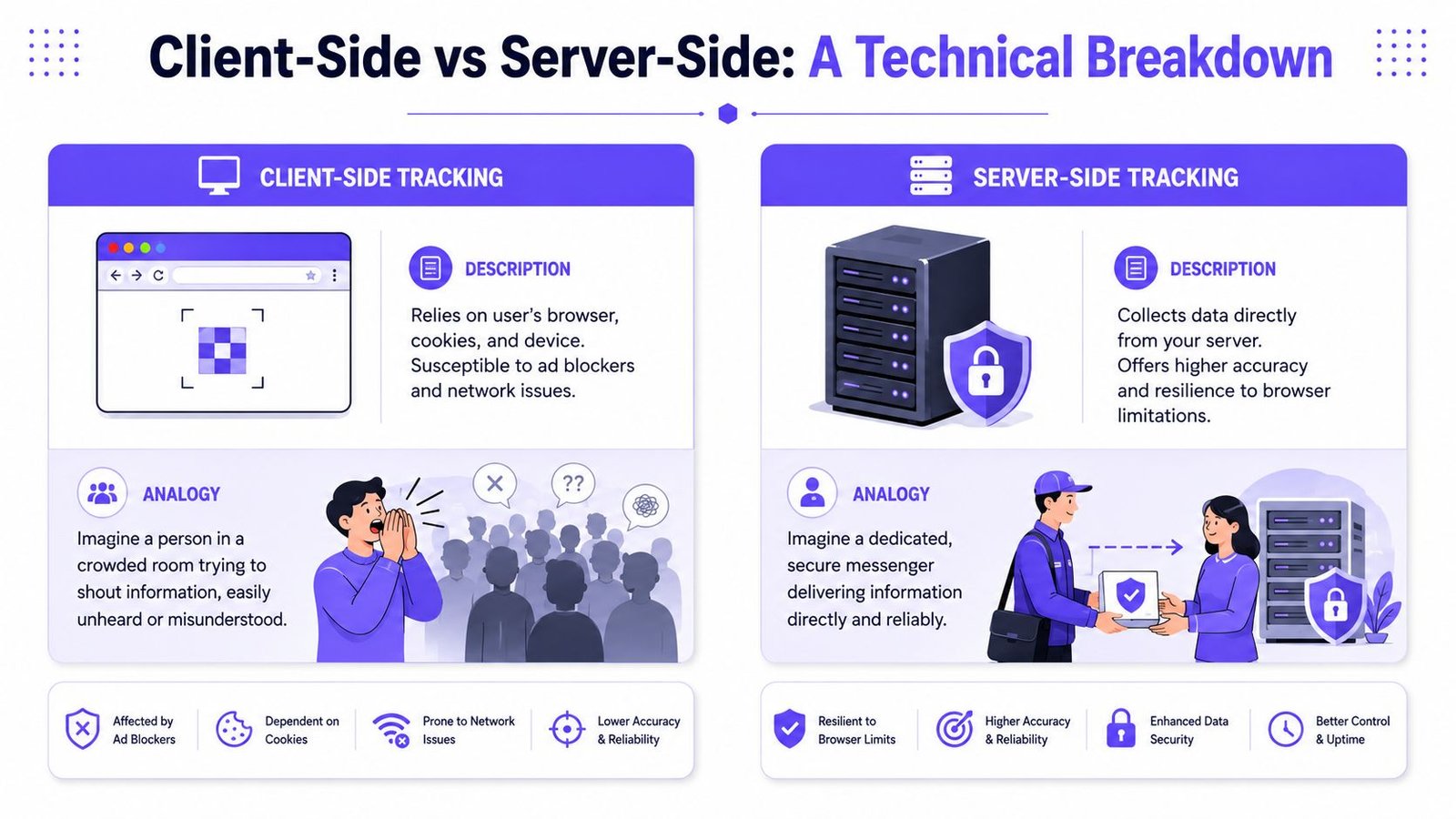
The simplest way to explain it is this. Client-side tracking is like putting a security camera in the visitor’s browser and hoping the footage reaches every vendor intact. Server-side tracking is a direct handoff between systems that already know the event happened.
That difference sounds small until you work with depositing traffic, affiliate IDs, and payout rules.
How the two methods actually behave
With a client-side pixel, the page loads code in the browser. That code reads available identifiers, listens for actions, and sends event data outward. This is easy to launch, but it’s exposed to browser limits, consent conditions, connection issues, and script blocking.
With a server-side postback, your platform records the event in backend logic and sends it directly to the tracking system. A successful deposit, approved registration, or qualified lead can be transmitted from server to server without asking the user’s browser to cooperate.
If you’re comparing transport patterns in detail, this breakdown of postback vs callback tracking is worth reading because many teams still mix up browser callbacks, webhook-style notifications, and affiliate postbacks.
What changes operationally
The strongest server side tracking benefits appear when the conversion event has financial consequences. A click can be noisy. An FTD cannot.
Client-side tracking says, “the browser told us something happened.”
Server-side tracking says, “the platform recorded the event and sent a signed message.”
That changes how confident you can be in billing, affiliate settlement, and fraud review.
| Attribute | Client-Side (Pixel) | Server-Side (Postback) |
|---|---|---|
| Conversion accuracy | Depends on browser execution and script delivery | Based on backend event confirmation |
| Resilience to ad blockers | Weak | Strong |
| Impact on page speed | Adds third-party scripts to the page | Reduces browser-side script burden |
| Data privacy control | Limited once third-party tags run in the browser | Strong control before forwarding data |
| Implementation complexity | Faster to launch | Requires backend coordination and testing |
Performance is part of the business case
There’s also a web performance angle that technical affiliate teams often ignore because it sits outside attribution. By shifting processing from the client device to the cloud, server-side tracking reduces third-party script load by 40 to 60% and cuts page load times by 0.3 to 0.8 seconds, which improves user experience and can support SEO performance, according to DinMo’s explanation of server-side tracking.
For iGaming landing pages, that matters. Affiliate traffic is impatient, often mobile, and often arriving from comparison pages, tipster sites, or geo-targeted paid campaigns. Fewer front-end scripts means less friction before the registration flow even begins.
The technical win isn’t just “more tracked events.” It’s moving critical attribution away from the least reliable part of the stack, which is the browser.
Core Server-Side Tracking Benefits for iGaming
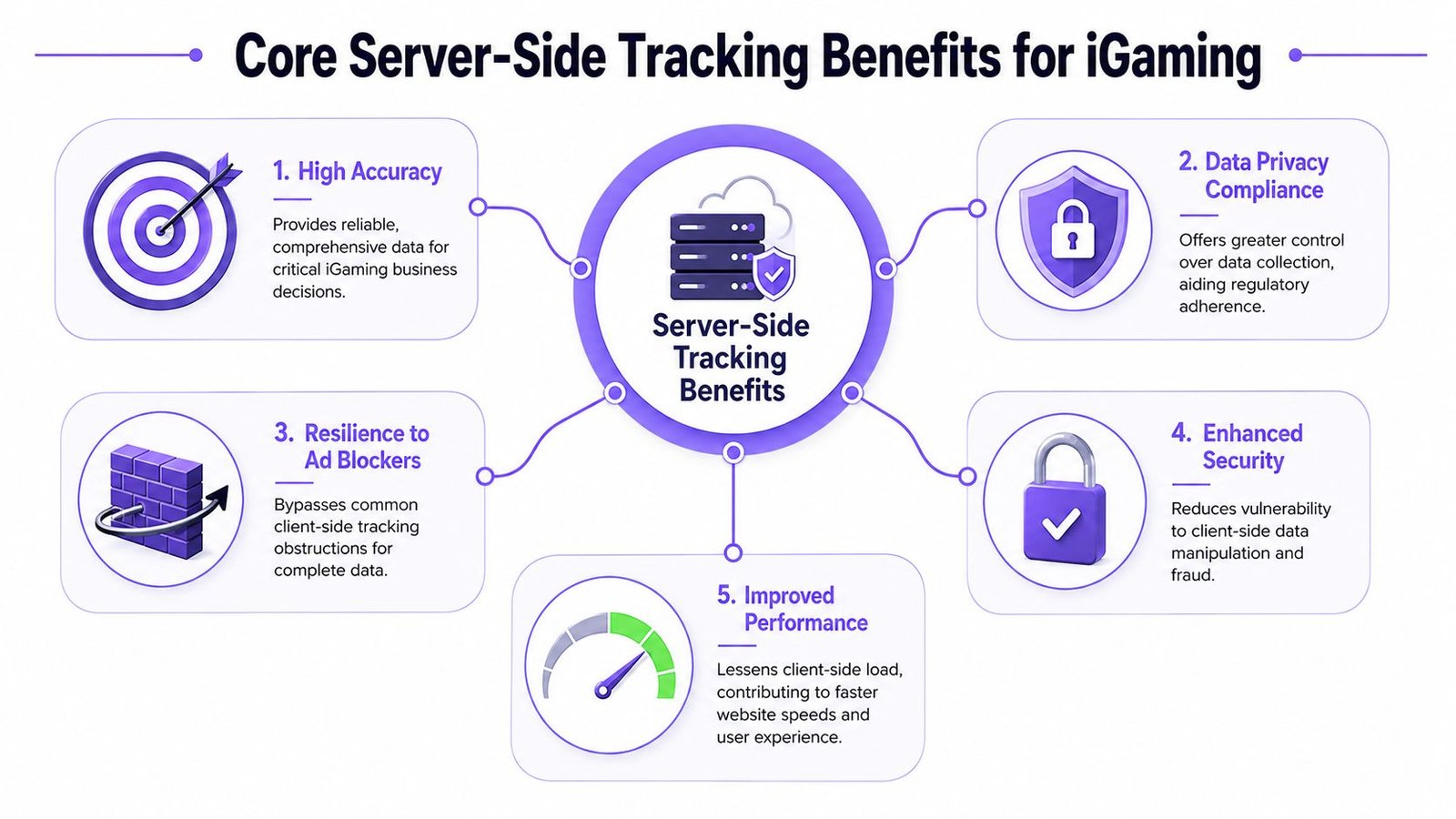
The strongest case for server-side isn’t that it sounds more modern. It’s that it solves several regulated-market problems at once. Better attribution is only the first layer.
Accurate payouts and fewer disputes
Affiliate programs break down when conversion records aren’t trusted. A missed registration can often be tolerated. A missed depositing player cannot. Once commission logic includes CPA, RevShare qualification, hybrid thresholds, or sub-affiliate rollups, every missing event creates downstream accounting work.
Server side tracking benefits compound. A server-confirmed event can carry the exact identifiers and status needed for settlement logic. That makes it easier to tie a click to a player, a player to an FTD, and an FTD to the correct partner agreement.
It also supports more advanced models that pixels handle poorly, such as delayed qualification rules, net revenue adjustments, or event-based milestones that depend on back-office validation rather than page visits.
Compliance control instead of vendor sprawl
In regulated iGaming, data flow matters as much as attribution. Server-side architecture lets the operator act as a gatekeeper. Data can be filtered, hashed, or anonymized before it reaches third parties. That’s much safer than dropping multiple scripts into the browser and hoping each vendor only collects what you intended.
DinMo notes that server-side tracking allows businesses to control and sanitize personally identifiable information before forwarding it onward, which supports GDPR and consent-compliant handling in more complex setups. Their overview is useful if you’re working through data-gatekeeping and privacy control in server-side tracking.
For operators dealing with multiple licenses, residency rules, and auditable consent records, that control isn’t optional. It’s part of the operating model.
Better bidding because the platforms finally see the event
A benefit that many teams miss is bidding efficiency. Marketers often say server-side improves “accuracy” and stop there. That undersells the effect.
When Google Ads and Meta receive more complete conversion data, their optimization systems make better decisions. Documented case studies show up to a 46% increase in reported conversions from Google Ads after implementing server-side tracking, while Meta reports a 13% reduction in cost per result for advertisers using its Conversion API compared to pixel-only tracking, as summarized in Usercentrics’ review of server-side tracking outcomes.
For affiliate and paid acquisition teams running side by side, that has real consequences. The cleaner your event feedback loop, the less budget gets steered by partial data.
Stronger fraud resistance at the event layer
Server-side tracking doesn’t eliminate fraud. It does remove one easy failure mode, which is trusting browser-side signals as if they were proof of value. A client-side event can be blocked, duplicated, or manipulated more easily than a backend event tied to actual account and deposit logic.
That matters when your program pays for qualified actions. A technical affiliate manager doesn’t just need conversion volume. They need confidence that the event is real, deduplicated, and eligible under the commercial deal.
If a commission model depends on approved revenue events, backend confirmation should be the default source of truth.
Case Study How an Operator Boosted Accuracy by 38 Percent
A 38 percent lift in attributed FTDs changes more than a dashboard. In a regulated iGaming program, it changes who gets paid, which partners you trust, and how quickly finance can close a commission cycle.
We saw that pattern with an operator relying on pixel-only tracking for FTD attribution. Click volumes looked healthy and registrations were in range, but approved deposit numbers kept falling short of what affiliates expected. The gap was worst on mobile web, iOS traffic, and privacy-restricted browsers. Those were the same segments creating the most payout disputes.
The operational cost was obvious. Affiliate managers were fielding claim reviews every week. Finance was delaying approvals while teams checked CRM records against platform logs. Compliance also had a problem, because the program was trying to pay on browser-reported events instead of backend-confirmed player states.
What changed in the setup
The operator kept pixels where they still had value for top-of-funnel reporting. The payout layer moved to server-side postbacks tied to backend events, specifically approved registrations, first deposits, and qualification outcomes used in commission rules.
That one change gave the team a cleaner source of truth.
The implementation also made room for more precise commercial logic. Instead of paying from a simple browser fire, the operator could validate whether an FTD was approved, reversed, linked to a duplicate account, or excluded under local compliance rules before it entered affiliate reporting. That is the practical difference between a tracking setup built for marketing visibility and one built for regulated revenue attribution. Teams evaluating affiliate ad tracker software for iGaming operators usually reach this point fast. Accuracy matters, but payout control matters more.

What the numbers looked like
Across migrations like this, the recurring outcome is a sharp increase in correctly attributed FTDs and a steep drop in manual commission corrections during the first reporting cycles. In practice, that means fewer disputed players, fewer spreadsheet audits, and less time spent explaining reporting gaps to top affiliates.
The 38 percent improvement in attributed conversions matters because it compounds. Once more approved deposit events reach the platform reliably, the operator can support commission models that break under pixel-only tracking. Hybrid deals, qualified FTD tiers, negative-carryover exceptions, revenue-share based on approved backend revenue, and clawback rules all become easier to run because the event stream is tied to player status and finance logic, not browser behavior.
Why this matters to affiliate teams
Affiliate managers feel the benefit first. Reports line up more closely with deposit records. Payout cycles move faster. High-value partners get fewer reasons to challenge numbers or hold back traffic.
There is also a fraud and compliance angle that pixel-only setups handle poorly. If a deal depends on approved value events, the operator needs to know the conversion came from an eligible account, in an eligible market, under an eligible commercial rule. Server-side tracking does not solve every fraud problem, but it gives the program a stronger control point for validation, reversals, and audit trails. In regulated iGaming, that is where the ROI shows up.
Implementing Server-Side Tracking in Your iGaming Program
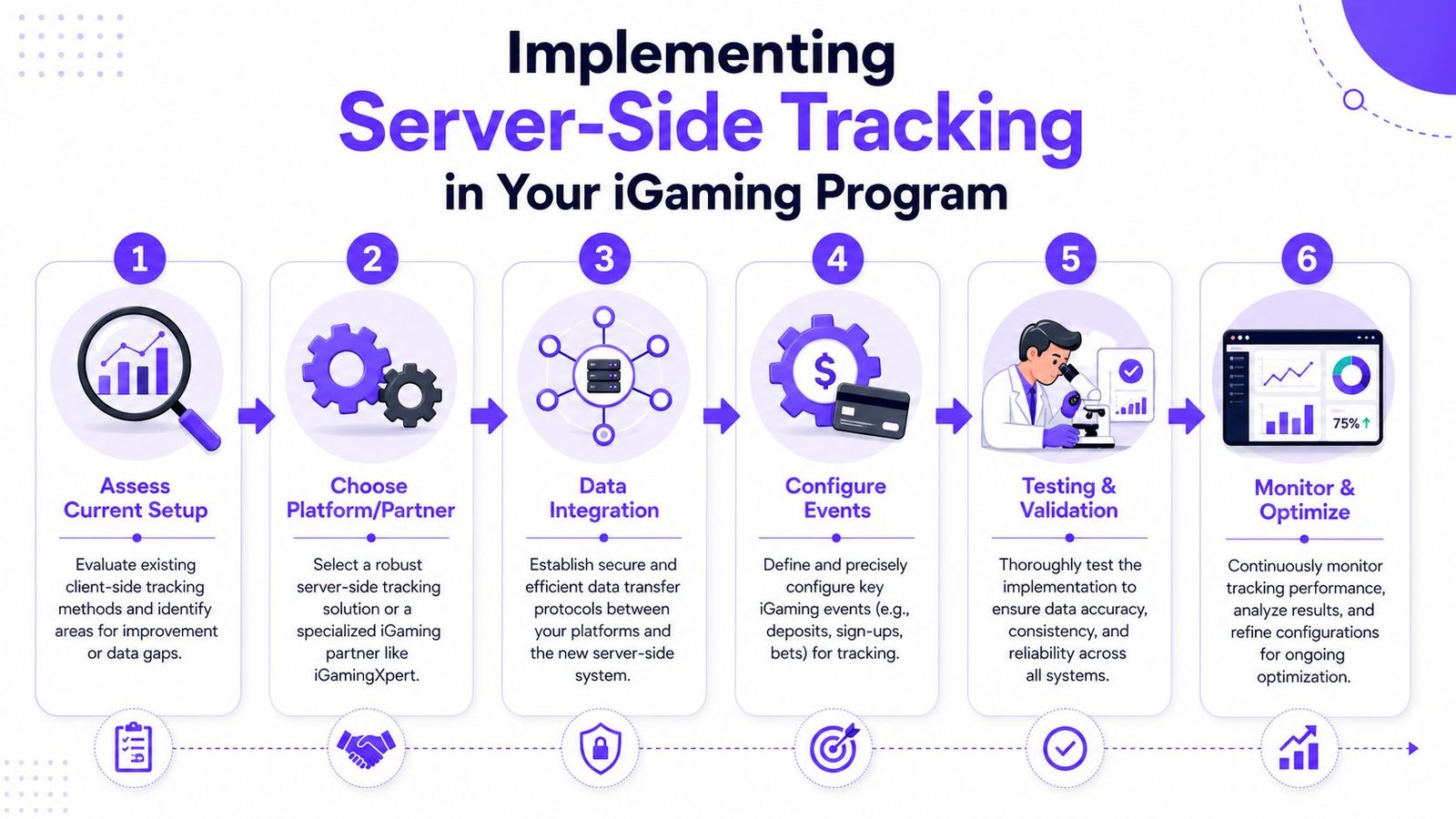
A good implementation doesn’t try to force everything into one method. The cleanest setups use a hybrid model. Put high-value, payout-relevant events on server-to-server rails. Keep selected browser-side tags where they still help with top-of-funnel analytics, remarketing support, or product analytics.
That balance gives you resilience without turning the project into unnecessary engineering theatre.
Start with the events that affect money
Don’t begin with pageviews. Start with events that trigger commission, qualification, or partner disputes.
For most regulated programs, that means:
- Registration approval: Not just form submission, but the backend-confirmed registration state you pay against.
- First Time Deposit: Usually the single most important affiliate event in the stack.
- Qualified deposit states: Useful when the commercial deal depends on thresholds or anti-fraud validation.
- Revenue events: Needed for RevShare or hybrid models tied to net gaming revenue logic.
- Status changes: Self-exclusions, duplicate accounts, bonus abuse flags, or reversed events where contracts require them.
Choose the transport model carefully
There are two common patterns. One is a GTM server-side container approach. The other is direct backend postback or API integration from your product and wallet systems into your tracking layer. Both can work.
For affiliate attribution in regulated iGaming, direct event transmission from backend systems is usually stronger for payout-critical events because it originates where the truth already exists. Browser instrumentation can still complement it, but it shouldn’t own final attribution for deposits.
If you’re evaluating vendor fit and architecture options, an affiliate ad tracker platform built for postbacks and event routing should support both server-to-server event intake and the compliance controls around it.
Essential parameters to pass in every postback
The difference between a “working” server-side setup and a reliable one is parameter discipline. If identifiers are inconsistent, you’ll just move confusion from the browser to the backend.
A practical checklist includes:
- Click identifier: The partner click ID or token that ties the player back to the exact referral event.
- Player identifier: Your internal player or account ID.
- Event type: Registration, FTD, redeposit, revenue event, qualification update, or reversal.
- Timestamp: The backend time the event was confirmed.
- Brand and GEO context: Needed for multi-brand and multi-market programs.
- Currency context: Critical where programs span several account currencies.
- Validation state: Whether the event is pending, approved, rejected, or reversed.
Expect duplication and validation issues unless you design for them
The most common implementation mistake is running browser and server events in parallel without clear deduplication logic. That inflates counts and destroys confidence quickly. Decide which source owns each event and define how fallback works when one signal arrives before the other.
Another common problem is sending events too early. For example, a deposit-initiation event may fire before payment confirmation. In affiliate accounting, “started” and “completed” are not the same thing. The postback should represent the commercial truth, not a hopeful intermediate status.
Use pixels for visibility. Use postbacks for accountability.
Why the hybrid model works best
Server-side tracking enables iGaming operators to bypass ad blockers like uBlock Origin and Safari’s Intelligent Tracking Prevention, which improves cross-channel attribution without relying on browser-executed scripts, as explained in Fresh Egg’s privacy-first tracking overview.
That doesn’t mean every event belongs on the server side. Product teams still benefit from client-side analytics for UI behavior, testing flows, and micro-interactions that don’t affect partner payments. The goal is not purity. The goal is trust in the data that affects money, compliance, and optimization.
A good rollout sequence is simple. Audit the current loss points. Move payout-critical events first. Validate against CRM and payment records. Then expand carefully where the added complexity produces actual value.
Your Roadmap to Superior Affiliate Tracking
If your affiliate program still depends on browser pixels as the main source of truth, you’re carrying avoidable risk. That risk shows up in undercounted FTDs, payout disputes, weak optimization signals, and compliance headaches when data lineage needs to be explained.
The strongest server side tracking benefits come from how they reinforce each other. Cleaner event capture improves attribution. Better attribution improves commission confidence. Better control over data flow supports privacy and residency requirements. Stronger backend confirmation also gives fraud and finance teams a firmer basis for event validation.
What to audit right now
A useful internal review starts with a few blunt questions:
- Which events determine partner payouts? Those should not rely on browser execution alone.
- Where do disputes originate? Look for repeated mismatches by device, browser, GEO, or affiliate source.
- Which identifiers survive the full path? If click IDs and player IDs don’t stay linked through registration and deposit, settlement will stay messy.
- What can your compliance team defend? If the answer depends on multiple third-party scripts firing in the browser, the architecture is weak.
What a mature setup looks like
A mature iGaming tracking stack doesn’t abandon pixels completely. It assigns them the jobs they can do well and removes them from jobs they can’t. Browser-side tools are fine for many interaction signals. They are not enough for the commercial core of an affiliate program.
That core needs backend event confirmation, consistent identifiers, controlled data sharing, and a clean audit trail. Once those pieces are in place, growth gets easier because the team can trust the numbers in front of them.
The operators that treat tracking as infrastructure, not just marketing instrumentation, usually make better decisions. They can scale partners faster, settle deals with less friction, and defend their data flows when regulators or internal stakeholders ask hard questions.
If your team is reviewing tracking gaps, payout disputes, or compliance exposure in a regulated affiliate program, iGamingXpert provides the infrastructure to move high-value events onto reliable server-to-server rails while keeping reporting, commission accounting, fraud controls, and audit-ready data in one system.
