How iGaming CRM Integration Can Streamline Operator’s Blueprint in 2026?

Summary: An iGaming CRM integration streamlines an operator’s tasks by automating the flow of data between the Player Account Management (PAM) system, gaming engines, and marketing channels. This creates a unified infrastructure that eliminates manual operations, controls bonus costs, and ensures instant compliance across highly regulated markets
In regulated markets, 40% of operators say their CRM campaigns misattribute traffic because of delayed affiliate data integration, which creates compliance risks and wasted spend. That single failure mode changes how I look at affiliate operations.
Most operators already understand real-time player data. They’ve invested in triggers around deposits, sessions, churn risk, and bonus eligibility. The weaker area is upstream. Affiliate clicks, source IDs, postbacks, fraud flags, and approval states often arrive late, arrive in batches, or land in the wrong system. Then the CRM starts acting on traffic that finance hasn’t validated, compliance hasn’t cleared, and the affiliate team is still disputing.
That’s where iGaming CRM integration either becomes a profit engine or a liability. A serious affiliate program isn’t built on a tracker alone, and it isn’t managed inside the CRM alone. It runs on a disciplined data flow between the affiliate platform, the CRM, and the player account stack so each system sees the same truth at the right time.
The High Cost of Disconnected Affiliate Data
A disconnected setup usually looks acceptable on the surface. The affiliate platform records clicks and conversions. The CRM handles journeys. The PAM records registrations, deposits, and gameplay. Each team has its own dashboard. The problem starts when those systems don’t agree on event timing and event status.
If an affiliate conversion reaches the CRM before fraud screening completes, the CRM may trigger a welcome offer to a player who should never enter the lifecycle in the first place. If the CRM receives a registration event without the final affiliate source metadata, it may assign that player to the wrong segment, the wrong campaign family, or the wrong bonus logic. Those aren’t reporting annoyances. They affect commercial decisions and regulated messaging.
Where operators usually get this wrong
Many teams optimize player-side speed and ignore affiliate-side speed. They’ll demand immediate deposit and session events, but they’ll accept delayed affiliate reconciliation because it sits outside the CRM team’s direct remit. That separation is a mistake.
Three gaps show up repeatedly:
- Batch ingestion of affiliate events: The tracker exports traffic data on a schedule, while the CRM expects live eligibility signals.
- Weak event taxonomy: “Lead,” “registration,” “qualified player,” and “approved conversion” get used interchangeably across teams.
- No suppression logic tied to affiliate validation: The CRM can message a player before traffic quality checks complete.
Practical rule: If the CRM can trigger before affiliate validation finishes, your architecture is backwards.
The cost is larger than bonus waste. Compliance teams end up investigating attribution mismatches. Finance teams challenge commission statements. Affiliate managers manually reconcile source-level disputes. CRM managers lose trust in their own segments because acquisition metadata can’t be relied on in-session.
The real issue is data velocity, not just data access
Operators often say they have integration because one platform can export a CSV or because an API exists. That’s not enough. iGaming CRM integration has to solve for data velocity, event confidence, and decision timing.
The affiliate channel produces fast-moving operational signals: click IDs, landing page parameters, registration confirmations, duplicate checks, fraud alerts, deal assignment, and approval outcomes. If those signals reach the CRM too slowly, the CRM makes decisions on stale acquisition context. Once that happens, everything downstream gets noisier. Segmentation weakens. Offer logic drifts. ROI reporting becomes political.
Professional setups treat affiliate data as a core input to lifecycle marketing, not as an external ledger reconciled after the fact. That’s the difference between a channel that scales and one that keeps creating edge cases nobody owns.
Establishing Your Strategic and Compliance Foundation
Before choosing a tracker, CRM, or integration method, decide what the affiliate channel is supposed to produce and under which constraints it must operate. Too many programs buy software first, then discover the commercial model, legal model, and reporting model don’t align.
That mistake is expensive in a market that’s still expanding. The global iGaming platform market, including CRM suites, was valued at $14.8 billion in 2025 and is projected to reach $42.6 billion by 2034, with SaaS architectures expected in 74% of deployments by 2029 (DataIntelo market projection for iGaming platforms). More platforms are available than ever. More choice doesn’t reduce operator risk. It increases the odds of buying overlapping tools that solve different versions of the same problem.
Define the operating model before the toolset
An affiliate program needs a clear commercial brief and a clear compliance brief.
Commercially, you need to know what kind of affiliate mix you want. Content affiliates, streamers, paid media arbitrage partners, tipster communities, SEO review sites, and master affiliates all produce different quality patterns and different management overhead. If the business wants stable long-term value, the data model must support player quality analysis by partner and by deal type. If the business wants controlled acquisition in specific markets, the commission design and CRM rules need to reflect that from day one.
Compliance needs the same level of specificity. “We’ll be GDPR-compliant” isn’t a plan. You need defined rules for consent capture, local storage, auditability, access permissions, and which teams can see cross-brand player data. Operators dealing with multiple jurisdictions should ground those decisions in practical GDPR and data residency considerations for iGaming affiliates, because data routing choices made early tend to become hard architecture constraints later.
Questions that should be answered before implementation
Use planning sessions to force decisions that usually get postponed:
- Which acquisition states matter operationally: Is a player visible to CRM on registration, on KYC completion, on first deposit, or only after fraud approval?
- Who owns suppression rules: CRM, compliance, affiliate ops, or a shared workflow?
- What constitutes payable traffic: The answer affects both commissions and lifecycle entry logic.
- How are multi-brand permissions handled: One unified profile sounds efficient until a regulator asks who had access to what and why.
A lot of integration failures aren’t technical failures. They’re unresolved business decisions disguised as API work.
Strategy-first programs avoid rebuilds
The strongest setups work backwards from controlled growth. They define target markets, acceptable traffic sources, payout logic, fraud tolerance, data locality, and lifecycle eligibility before implementation starts. That gives engineering a stable event contract and gives legal a workable governance model.
Amateur setups do the reverse. They switch on tracking, connect a CRM, and start paying partners while definitions are still fluid. Then they discover the affiliate platform classifies a player one way, the CRM classifies the same player another way, and finance pays on a third version. By then, every fix requires reprocessing, exceptions, and partner communication.
A scalable affiliate program starts with policy. The technology should enforce it, not invent it.
Architecting Your Integrated Tech Stack
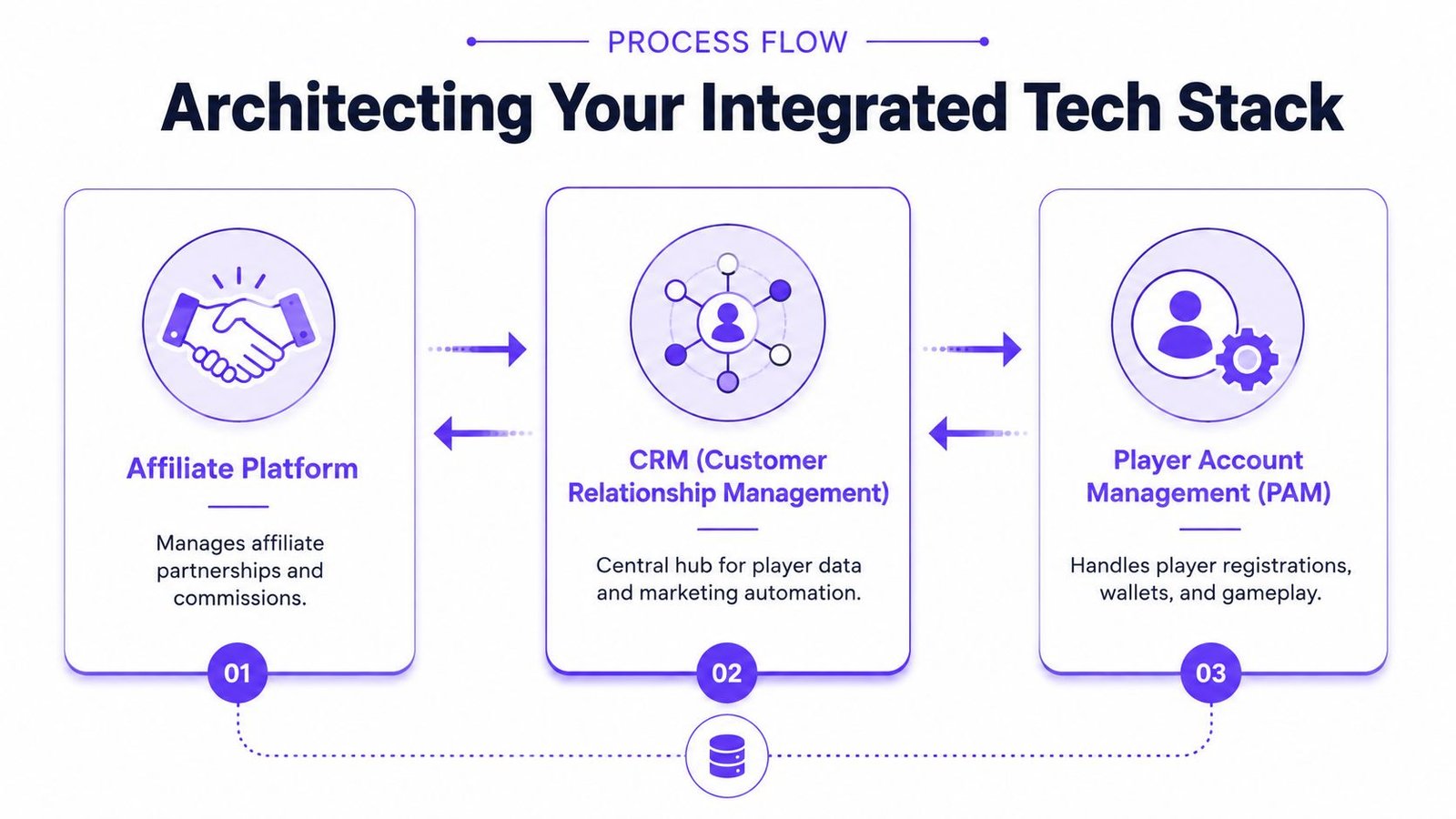
The core stack has three systems that must exchange data cleanly: the affiliate platform, the CRM, and the PAM. If one of them lags or stores a different player identity map, the whole operating model starts to wobble.
Here’s the simplest way to visualize it.
The three-system contract
The affiliate platform should own partner attribution, traffic classification, commission logic, and source-level metadata. The CRM should own segmentation, messaging, journey orchestration, and marketing eligibility. The PAM should own account state, wallet events, KYC status, and gameplay records.
The mistake is letting each platform infer what the other meant. Don’t let the CRM guess affiliate quality from downstream behavior alone. Don’t let the affiliate platform infer retention state from delayed exports. Don’t let the PAM become the accidental master for marketing classification because nobody designed a proper event contract.
A mature implementation defines exactly which events move between systems and in what order.
Why S2S is non-negotiable
For affiliate attribution in regulated iGaming, server-to-server tracking is the standard to build around. Pixel-only setups are too fragile. Browser restrictions, ad blockers, and client-side loss create blind spots right where operators need confidence.
If your team is still weighing both approaches, this breakdown of postback versus callback tracking in affiliate systems is useful because it frames the issue the way operators experience it: reliability first, terminology second.
A practical event chain usually looks like this:
- Click event captured with partner ID, campaign ID, creative ID, GEO hint, device context, and click ID.
- Registration event confirmed from the PAM to the affiliate platform with a persistent player identifier.
- Validation layer applied for duplicates, blocked GEOs, promo abuse patterns, or known bad traffic.
- Webhook sent to CRM only when the player is eligible for lifecycle treatment under the operator’s rules.
- Subsequent revenue and quality events continue flowing back for segmentation and commission accounting.
That order matters. The CRM shouldn’t be first to learn about a player if affiliate validation is still unresolved.
Real-time means more than “fast enough”
Real-time processing systems in iGaming, powered by engines like Apache Flink, can handle millions of events per second with sub-second latency, enabling instant fraud detection and personalization. Operators don’t need every internal component to use Flink specifically, but they do need the same architectural principle. Events should be processed as streams, not as reporting files.
That matters for affiliate-to-CRM sync because timing changes business outcomes:
- Fraud alerts need immediate suppression: A delayed fraud signal turns a preventable marketing error into an incident.
- Source metadata needs to arrive with the player record: Appending it later often breaks segmentation logic.
- Commission state and player state need separation: A player can be valid for retention while a payout remains under review, but that distinction must be explicit.
The best integrations aren’t just fast. They’re opinionated about event order.
What a resilient implementation includes
A clean iGaming CRM integration for affiliates usually contains these controls:
| Component | What it should do | What breaks without it |
|---|---|---|
| Event schema | Standardize click, registration, approval, fraud, and revenue events | Teams map the same player differently |
| Identity resolution | Tie click IDs to player IDs and account IDs reliably | Source loss and duplicate attribution |
| Webhook delivery | Push key state changes immediately to CRM | Delayed or stale segmentation |
| Retry and logging | Preserve failed deliveries and audit every event | Silent data loss |
| Suppression rules | Block marketing on disputed or risky traffic | Non-compliant campaigns |
Experienced operators differ from first-time programs. They don’t think in terms of “integrations completed.” They think in terms of event certainty. Can the CRM act on this player right now, yes or no? If not, what exact state is missing? That’s the level of precision that keeps affiliate, CRM, compliance, and BI teams aligned.
Designing Flexible and Scalable Commission Models
Commission design should follow traffic reality, not affiliate folklore. Operators often inherit a patchwork of deals because each new partner was negotiated in isolation. That doesn’t scale. It creates reporting friction, payout disputes, and poor alignment between what the operator wants and what the affiliate is rewarded for delivering.
The right model depends on player quality, source predictability, and how much commercial risk the operator is willing to carry.
Comparison of iGaming Affiliate Commission Models
| Model | Best For | Operator Risk | LTV Alignment |
|---|---|---|---|
| CPA | High-volume acquisition where the operator wants predictable upfront cost | Higher risk if traffic quality is inconsistent | Lower unless qualification rules are strict |
| Revenue Share | Partners that consistently send valuable depositing players | Lower upfront acquisition risk, longer payout exposure | Strong when player value is durable |
| Hybrid | Mixed traffic portfolios and negotiated partnerships | Balanced risk across acquisition and retention value | Good when both conversion and downstream value matter |
Where each model works
CPA works when the operator wants cost control and clear entry criteria. It’s common for broad acquisition pushes, launch periods, or markets where traffic quality can be tightly qualified before payout. The weakness is obvious. If qualification is loose, the operator absorbs poor downstream value.
Revenue share is better when a partner has demonstrated the ability to send players who deposit, retain, and behave within expected risk limits. This model aligns incentives well, but only if your reporting layer can separate genuine player value from temporary spikes, bonus distortion, and source contamination.
Hybrid deals are usually the most practical in mature programs. They let the operator de-risk acquisition while preserving upside for affiliates that send strong players. The challenge is operational. If the platform can’t manage custom splits, tier logic, brand exceptions, and source-level overrides without manual work, hybrids become an admin burden.
For teams handling both fixed acquisition economics and long-tail value, this guide to managing hybrid CPA and revshare structures is the kind of operational reference worth having on hand.
What separates scalable deals from messy deals?
Good commission architecture includes controlled flexibility, not endless exceptions.
- Qualification logic should be explicit: Tie CPA eligibility to defined account and value states, not verbal agreements.
- Revshare rules should reflect operational reality: Negative carryover, product scope, and brand scope need to be documented consistently.
- Tiers should be automated: If top partners earn improved terms, the system should apply them based on agreed logic rather than manual recalculation.
- One-off deals should be rare: If every partner needs a custom spreadsheet, the platform isn’t supporting the business model.
A strong affiliate manager knows that compensation design is also traffic shaping. If the deal rewards volume without quality controls, that’s what the channel will send. If the deal rewards durable value and the platform reports it transparently, better partners usually respond well.
Embedding Automated Fraud and Compliance Controls
Fraud control and compliance control should sit inside the operating flow, not at the end of the month when someone reviews anomalies. The affiliate channel generates too many edge cases for manual policing to work consistently.
Here’s what disciplined oversight looks like in practice.
Fraud patterns that break weak integrations
The common issues are familiar. Bot traffic inflates clicks and registrations. Duplicate account behavior creates false acquisition signals. Cookie stuffing and attribution hijacking distort partner credit. Incentivized traffic appears compliant at the click layer but produces poor-value or policy-breaking users downstream.
The operational question isn’t whether those patterns exist. It’s whether your systems can react before the CRM starts treating that traffic as normal.
A professional setup routes risk signals early enough to matter. That means the affiliate platform should classify suspicious source behavior, the PAM should confirm account-level anomalies, and the CRM should receive suppression-ready status fields rather than raw ambiguity.
Compliance gets harder in multi-brand operations
Multi-brand groups usually want unified visibility. Regulators and privacy teams often want carefully limited visibility. That tension becomes sharp when affiliate-acquired users are shared across casino and sportsbook brands, or when different markets have different residency rules.
65% of EU operators cannot implement cross-brand loyalty campaigns without violating data residency laws, as CRM systems often default to centralized data stores (Symplify on iGaming CRM and cross-brand constraints). That’s a structural warning. If affiliate data enters a centralized CRM without brand- and jurisdiction-aware rules, the operator may gain convenience at the cost of governance.
Controls that actually work
The strongest controls are boring. They rely on clear status fields, narrow permissions, and hard stop logic.
- Pre-lifecycle validation gates: Don’t expose new affiliate registrations to CRM journeys until required trust checks complete.
- Brand and GEO tagging at source: Pass these values with affiliate events immediately so downstream systems don’t guess jurisdiction.
- Role-based access controls: Affiliate managers, CRM teams, and compliance teams shouldn’t all see the same dataset by default.
- Immutable audit logs: Every event change should be reviewable, especially if a commission dispute overlaps with a marketing decision.
- Consent-linked activation: If a player’s consent scope is brand-limited or market-limited, the CRM must respect that at entry.
Operational test: If compliance asks why a player received a campaign, you should be able to reconstruct the full path from affiliate click to CRM trigger without relying on screenshots and Slack messages.
Fraud and compliance are the same architecture problem
Operators often treat fraud prevention as a traffic-quality issue and compliance as a legal issue. In the stack, they’re connected. Both depend on trustworthy event flow, identity consistency, and immediate suppression when something changes.
If a fraud flag takes too long to reach CRM, the operator may send prohibited communications. If brand-level consent isn’t attached to affiliate-sourced identities correctly, the CRM may segment users in ways the legal basis doesn’t support. In both cases, the root problem is usually the same. The systems exchanged data, but not the right data, not in the right order, and not with enough confidence.
That’s why mature affiliate programs build controls into the integration itself. The workflow shouldn’t hope that managers catch bad traffic or bad routing later. It should make the wrong action difficult to execute in the first place.
Streamlining Partner Onboarding and Operations
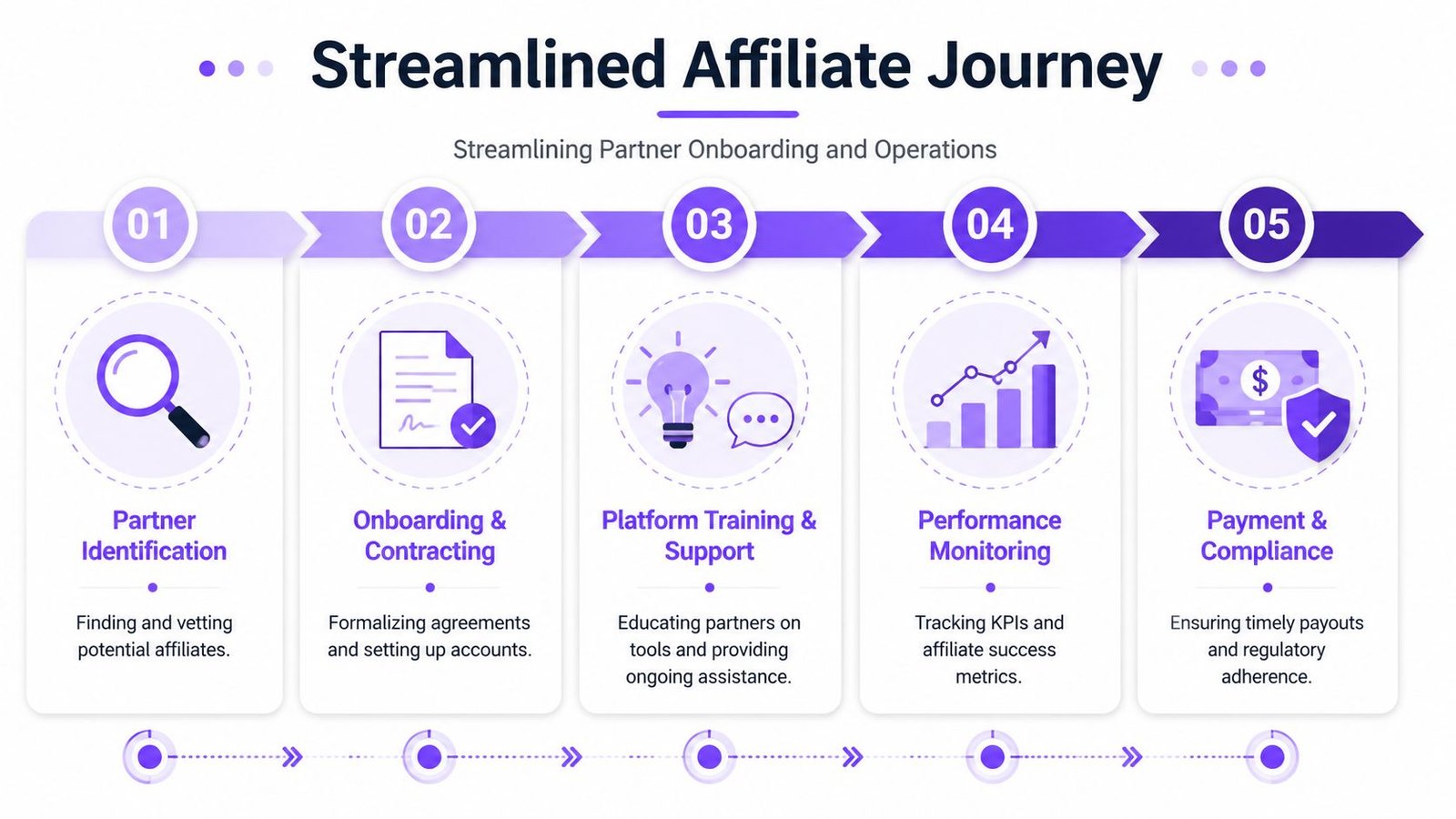
A scalable affiliate program is operationally clean long before it becomes commercially large. Most early inefficiency comes from inconsistent onboarding, unclear documentation, and too much manager dependency for basic tasks. Good systems reduce that drag without making the program feel impersonal.
The goal is simple. Affiliates should be able to understand your rules, obtain the right assets, access performance data, and get paid without opening a support ticket for every routine action.
Build an onboarding flow that filters as much as it welcomes
The first step is partner vetting. Not every applicant deserves a contract, and not every apparently strong publisher fits a regulated operation. You need to know how they acquire users, which markets they touch, what claims they make in content, and whether they can operate within your approval process.
After approval, keep the handoff structured:
- Contract and deal confirmation with precise commission terms and market scope.
- Tracking setup using approved links, source labels, and postback parameters.
- Portal access so the partner can self-serve links, creative, reports, and payment records.
- Compliance guidance covering restricted messaging, brand language, and market limitations.
- Escalation path for technical issues, disputed traffic, and payment queries.
Weak programs skip steps because they’re trying to launch faster. Then they spend months cleaning up misunderstandings that should’ve been prevented in the first week.
The best operations teams reduce manual dependency
Self-service matters. Affiliates shouldn’t need an account manager to generate a tracking link, pull a report, or confirm whether a player was approved. Every manual dependency slows scaling and increases the chance of inconsistent answers across the partner base.
The operator still needs close account management for valuable partners, but that time should go to negotiation, optimization, and market insight. It shouldn’t go to repetitive admin.
A mature operational stack also improves internal visibility. BI can review source quality. CRM can inspect downstream value. Finance can see payout status. Compliance can audit what happened and when. When those teams work from one event chain, fewer disputes turn into multi-day investigations.
Measure partner quality with player-level context
Volume metrics alone create blind spots. Good affiliate ops tracks whether a source brings players worth retaining. That’s where predictive quality signals become useful. AI models trained on a player’s own behavioral data can accurately predict traffic quality scores and LTV trajectories, outperforming static models built on industry averages.
That doesn’t mean every operator needs a complicated AI layer. It means the best analysis uses player-specific behavior rather than generic assumptions. In day-to-day operations, that changes how you assess partners:
- Quality over raw conversion count: A partner with fewer registrations may still be stronger if downstream value is healthier.
- Source-specific churn patterns: Traffic can convert well and still collapse later if the acquisition promise was weak.
- EPC and retention context together: Earnings per click is useful, but only when paired with approval quality and player durability.
The affiliate manager who only watches registrations is usually the last person to notice quality decay.
Operations scale when the onboarding process, the data model, and the reporting layer all point in the same direction. Partners know what’s expected. Internal teams know what each traffic source means. The CRM receives cleaner acquisition data, which makes every later optimization more reliable.
Your Affiliate Program Launch Checklist
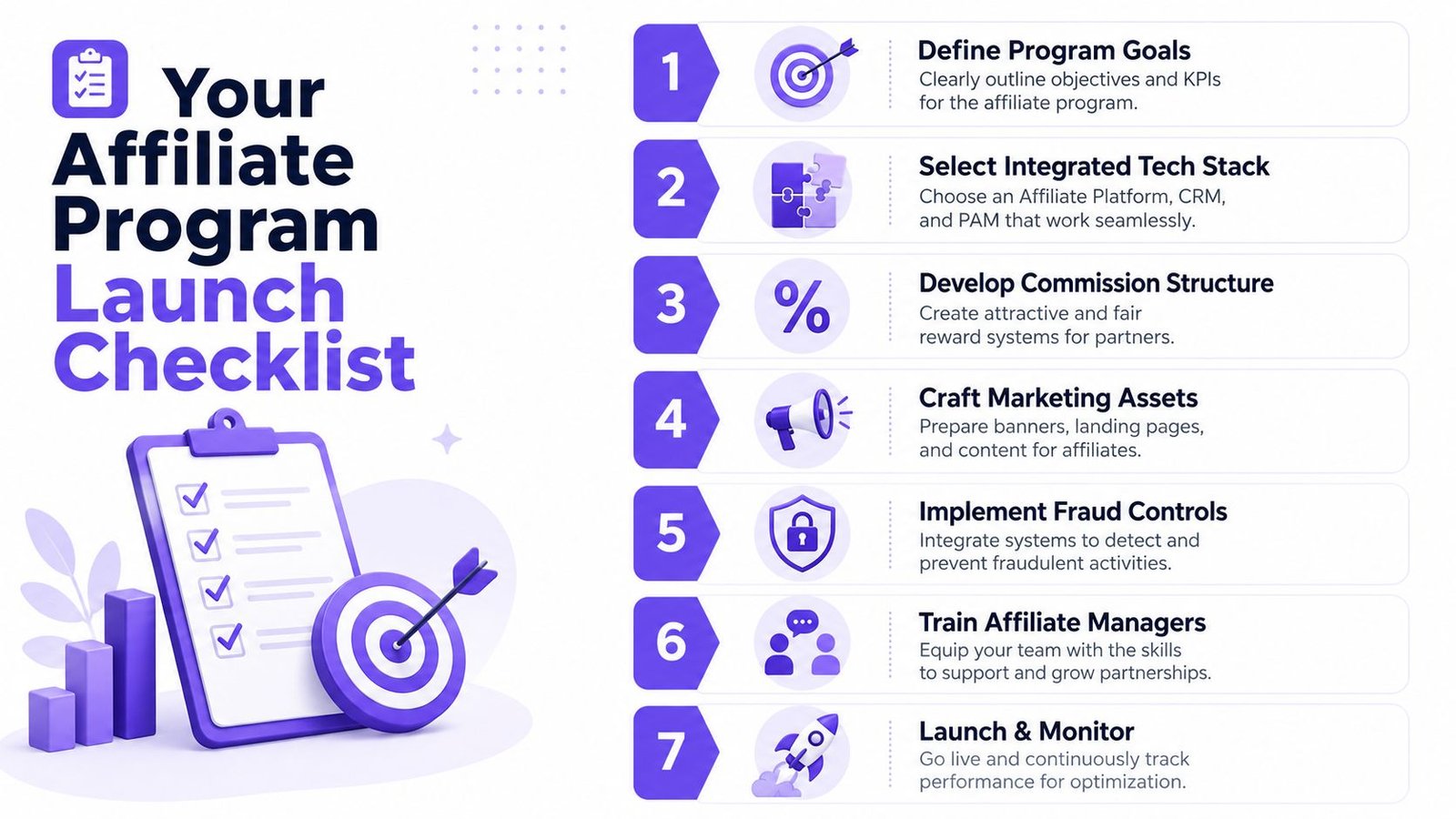
Launching an affiliate program isn’t about turning on links and waiting for volume. The hard part is making sure affiliate, CRM, PAM, finance, and compliance all work from the same operating logic. If that alignment exists, growth becomes manageable. If it doesn’t, every new partner introduces another exception.
This checklist is the practical minimum for a launch that won’t need immediate rework.
Core launch checks
- Define commercial intent: Decide which partner types you want, which markets you’ll open, and how player quality will be judged after acquisition.
- Lock your event definitions: Registration, approved conversion, qualified player, fraud flag, and payable event must mean the same thing across teams.
- Map the system contract: Document what the affiliate platform sends to the CRM, what the CRM sends back, and what the PAM confirms as the source of truth.
- Install suppression logic early: Don’t wait until after launch to decide which events block messaging or commission approval.
- Prepare affiliate-facing operations: Contracts, portal access, approved assets, and support routes should be ready before recruitment begins.
Final readiness review
Before launch, I’d pressure-test the setup with a short list of scenario checks rather than a broad “UAT completed” statement.
| Launch question | What a good answer sounds like |
|---|---|
| Can the CRM identify unapproved traffic immediately? | Yes, and it suppresses messaging automatically |
| Can finance trace commission logic back to source events? | Yes, every payable state is auditable |
| Can compliance reconstruct a player’s acquisition path? | Yes, from click through campaign eligibility |
| Can affiliates self-serve routine needs? | Yes, without relying on manager intervention |
| Can the stack handle exceptions without spreadsheets? | Yes, standard workflows exist for disputes and overrides |
The practical standard
iGaming CRM integration should be judged by one operational test. When a player enters through an affiliate source, can every downstream team trust the status, source, eligibility, and audit trail without manual reconciliation?
If the answer is yes, the program is ready to scale.
If the answer is “mostly,” it isn’t.
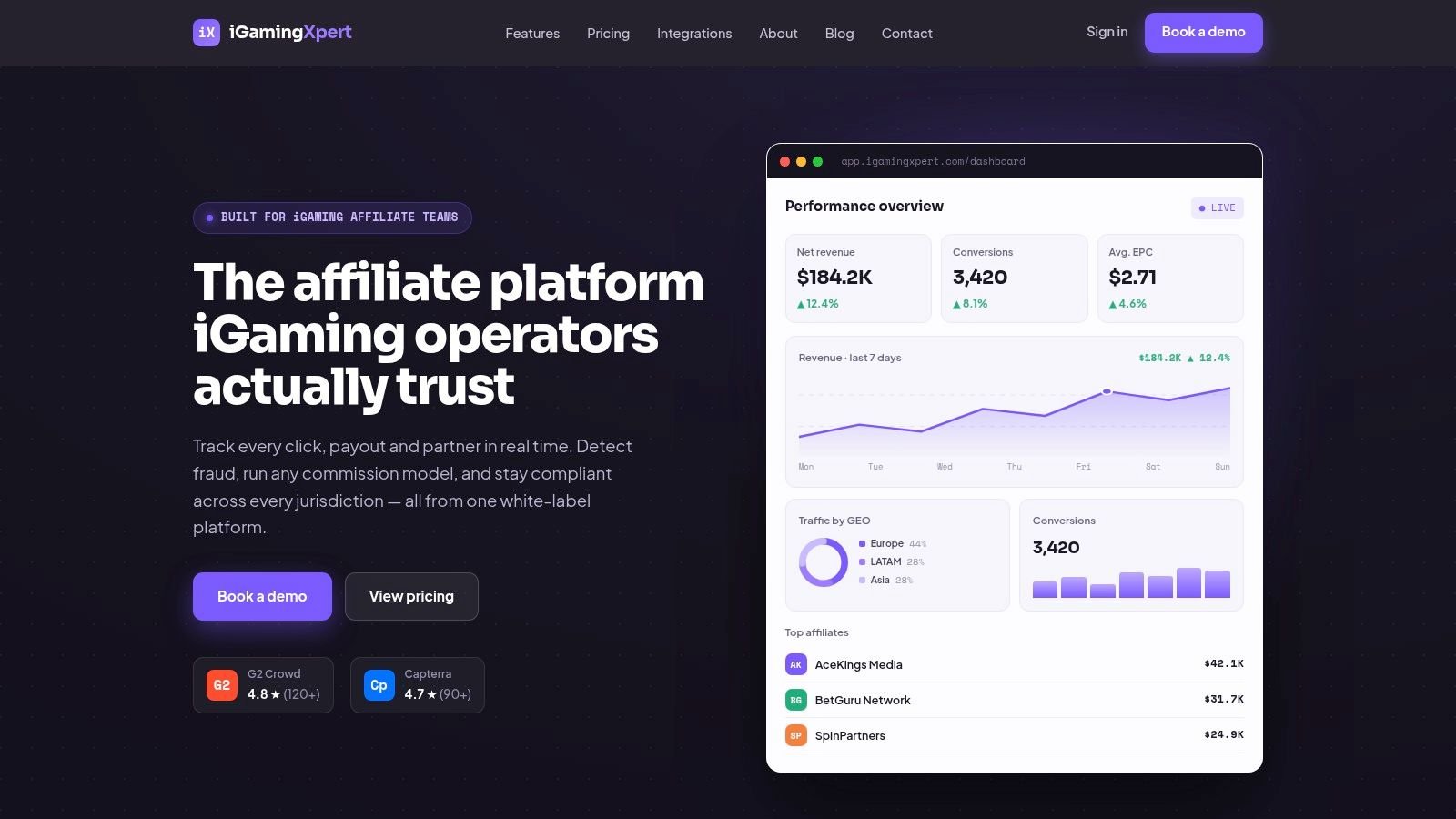
Operators that want a cleaner way to run affiliate tracking, payouts, fraud controls, and real-time CRM-ready event flows should look at iGamingXpert. It’s built for regulated gambling teams that need one platform for affiliate operations across brands, markets, and compliance boundaries, without relying on batch reporting and spreadsheet reconciliation.
